Key News Facts
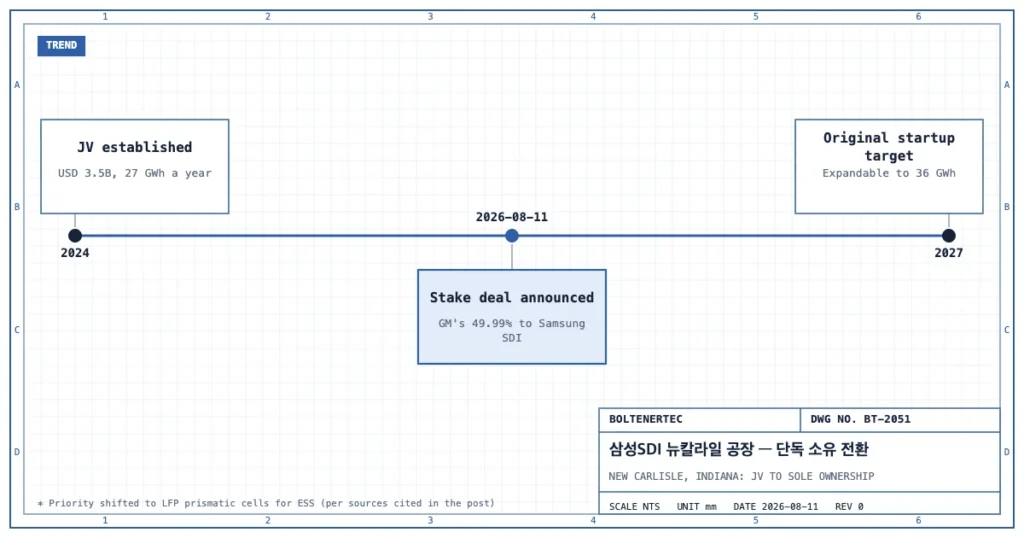
Samsung SDI announced on August 11 that it will acquire GM’s entire 49.99% stake in their joint venture ‘SynergyCells’ and take over full ownership. This effectively converts the joint plant into a sole-owned operation, a move driven by GM’s revised EV strategy amid a slower-than-expected recovery in US EV demand.
SynergyCells is the EV battery manufacturing joint venture Samsung SDI and GM established in New Carlisle, Indiana in 2024. The two companies invested a combined USD 3.5 billion to build a battery plant with an annual capacity of 27GWh, and construction is underway with a targeted 2027 startup.
With this stake acquisition, Samsung SDI secures its first sole-owned battery plant in North America. The plant is planned to mass-produce Samsung SDI’s flagship battery products for multiple applications, including next-generation prismatic EV batteries co-developed with GM. Notably, the New Carlisle site also has ESS (Energy Storage System) battery production facilities under construction, positioning Samsung SDI to respond proactively to the rapidly growing North American ESS market as well.
According to evertiq and ChargedEVs reports (August 21, 2026), Samsung SDI separately signed a three-year supply contract for LFP prismatic cells for energy storage systems (ESS), confirmed to be worth more than KRW 2 trillion (approximately USD 1.35 billion) (source: ChargedEVs). The New Carlisle plant’s initial annual capacity is 27 GWh, expandable to 36 GWh (same source). While the original plan prioritized high-nickel NCA prismatic cells co-developed with GM for EV applications, the restructuring has shifted priority to LFP prismatic cells for ESS (same source). ChargedEVs assessed that prismatic cells offer advantages for ESS applications, with less dead space in module assembly compared to cylindrical cells and requiring less external support than pouch-type cells, noting that ESS cells prioritize cycle life and cost per kWh over energy density (source: ChargedEVs).
Mechanism-Perspective Impact Analysis
Moving to sole ownership concentrates equipment-spec decision-making in a single company. Under the joint-venture structure, coater/calender/slitter line specifications had to satisfy both companies’ requirements; these can now be redesigned or optimized to a single Samsung SDI standard. In particular, as the lineup expands into prismatic-type batteries, electrode-process equipment previously scoped around cylindrical/pouch formats will likely need a wider response range, along with a re-examination of tension-control logic.
The separate construction of ESS battery production facilities is also notable. ESS cells differ from EV cells in thickness and energy-density specification, which could lead to a dedicated coating/winding line rather than shared production on the same line. The trend in North American battery equipment orders warrants continued monitoring.
The shift in initial mass-production chemistry from NCA to LFP carries significant equipment implications. LFP has lower particle hardness than NCA and a different conductive-additive formulation ratio, which may require resetting the coating die lip gap and drying-oven hot-air profile by chemistry. Additionally, since LFP cells for ESS prioritize cycle life and cost per kWh over energy density, electrode thickness and calendering density targets are expected to be set differently from EV-oriented NCA cells (estimated; exact electrode design specs undisclosed).
Shop-notes
Options for handling the chemistry transition include a lower-cost approach that converts the existing coater for dual use by replacing only the die and slot, versus a higher-cost approach of building a dedicated LFP coater/calender line to fully separate NCA and LFP operations. The former has lower upfront investment but incurs cleaning/verification downtime with each chemistry changeover, while the latter requires greater investment but allows independent production schedules for both chemistries — likely the more rational choice as volume grows over time under the planned 27→36 GWh expansion (estimated).
Design Reflection Checklist
- Confirm whether coating die/drying-oven hot-air profile reset is needed for LFP prismatic cell production
- Determine coater/calender dual-use vs. dedicated new line for the 27 GWh to 36 GWh expansion
- Review cleaning/verification downtime impact when converting between parallel NCA and LFP production
One-line summary: SynergyCells’ move to sole ownership and its priority on prismatic LFP cells for ESS call for a single decision-maker on coater and calender specs and a decision on separating lines by chemistry.
※ This article was compiled based on Chosun Biz reporting dated August 11, 2026.