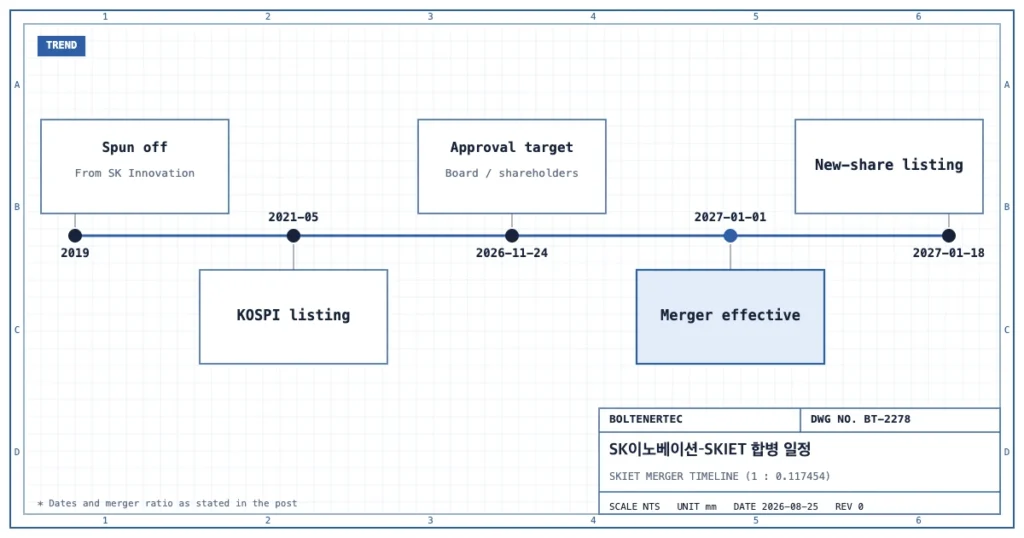
On August 25, 2026, SK Innovation’s board approved absorbing its battery-separator subsidiary SK IE Technology (SKIET). This reverses, five years later, the 2019 spin-off of the materials business and SKIET’s May 2021 KOSPI listing, bringing the unit back under the parent company.
Key News Facts
SK Innovation will be the surviving entity and will issue new shares to SKIET shareholders. The merger ratio is 0.117454 SK Innovation shares per 1 SKIET common share. SK Innovation’s board and SKIET’s shareholder meeting target approval on November 24; the merger takes effect January 1, 2027, and the new shares list on January 18. SK Innovation stated that because this qualifies as a small-scale merger, it proceeds without a shareholder meeting or appraisal-rights procedure for its own shareholders.
The background is that delayed EV-demand recovery and intensifying price competition from Chinese makers have made it difficult for SKIET to improve profitability and secure funding on its own. Per THE ELEC’s coverage of the merger explanation conference call, SK Innovation set a target of approximately ₩60 billion in additional annual EBITDA improvement from the merger and stated a goal of turning EBITDA-positive within two years. It also explained that roughly ₩2 trillion has been invested to date in its new Poland plant, with most of that investment set to be completed within this year.
Mechanical-Design Impact Analysis
Wet-process separators are made via an R2R process that biaxially stretches a polyethylene (PE) film and then applies a ceramic coating. Unlike the electrode and assembly processes, the core of the separator line is tension uniformity in the stretching zone. Because film thickness is typically in the 5–9μm range (estimated; material spec unconfirmed — confirm after field measurement), even a small width-direction tension deviation can cause a localized break (web break) that stops the entire line.
The ESS-use separator that SK Innovation named as a new growth area post-merger has a thicker cell and lower discharge rate than EV-use separator, which changes the ceramic-coating-layer thickness formulation. In other words, even using the same R2R base equipment, the coating die-head discharge-rate profile and drying-oven zone length must be re-tuned for each application. Rather than the organizational integration itself, this dual-tracking of coating specifications is the real task facing the equipment-engineering department.
The conference call disclosed that Q1 operating rate stood at only about 20% (per THE ELEC), which can be seen as related to the fact that R2R separator lines require substantial time for initial warm-up and web-alignment setup, and that tension-control response stabilization is comparatively difficult at low operating rates, amplifying start-up losses (estimated). Given that the China plant divestiture and the suspension of the Jeungpyeong plant are proceeding in parallel, raising the operating rate on the remaining Poland and domestic lines is likely to become the equipment engineering organization’s priority task.
On the call, SK Innovation stated its policy of combining SKIET’s separator product-development capabilities with its own R&D capabilities to raise product-development efficiency and technical competitiveness (per THE ELEC); from an equipment standpoint, this means consolidating the coating-slurry recipe database and die-head parameter setup know-how under a single engineering organization. On R2R separator lines, every recipe change requires resetting the die-head gap and drying-oven temperature profile, so without a standardized procedure after integration, changeover time could actually increase (estimated).
Spec Comparison Table
| Item | Details |
|---|---|
| Merger ratio | 1 SKIET share : 0.117454 SK Innovation shares |
| Board / shareholder approval target | November 24, 2026 |
| Merger effective date | January 1, 2027 |
| New-share listing date | January 18, 2027 |
| SKIET listing history | KOSPI listing May 2021; spun off from SK Innovation in 2019 |
| New-growth area mentioned | ESS-use separator (undisclosed, specs unconfirmed) |
| Annual EBITDA improvement target | ~₩60 billion (target: EBITDA-positive within 2 years) |
| Poland plant cumulative investment | ~₩2 trillion (mostly completed within this year) |
| Q1 operating rate | ~20% |
| Restructuring status | China plant divestiture; Jeungpyeong plant suspended |
One-line summary: SK Innovation’s absorption of SKIET is framed as a financial-structure reorganization, but from a practical standpoint the next task is how to dual-track EV- and ESS-use separator ceramic-coating specifications within a single R2R line organization.
Checklist
- Follow up on whether the ESS-use separator ceramic-coating formulation and die-head output profile have been finalized
- Track the Poland plant’s operating-rate improvement trend and progress toward the ₩60 billion annual EBITDA target
- Confirm whether a domestic capacity-reallocation plan following the Jeungpyeong plant suspension has been disclosed