International standardization of solid-state batteries has officially begun at the International Electrotechnical Commission (IEC).
On August 21, 2026, a solid-state battery standard proposal submitted by China was approved as an IEC New Work Item Proposal (NWIP), launching the world’s first international standardization process for the solid-state battery field (primary source: based on IEC-related reporting). Experts from France, Japan, and Korea are participating in the standardization working group. Solid-state battery standardization is the process of unifying cell specifications and safety test methods, and it will directly affect domestic solid-state battery equipment makers.
Per carnewschina (2026-09-02), a thermal-stability figure circulating in Chinese media — ‘weight loss of 0.5% or less after heating at 120°C for 6 hours’ — actually originates from China’s domestic GB standard public-comment draft (December 2025), not the IEC NWIP document itself; separately, the China Society of Automotive Engineers (CSAE) group standard T/CSAE 434-2025 (issued 2025-05-22) applies a different threshold — weight loss under 1% — using the same 120°C/6-hour vacuum-drying method. The IEC NWIP’s own test-clause text has not been published, so this figure should not be treated as finalized (needs confirmation).
Per SCMP (2026-08-26), the NWIP proposal was announced by China’s State Administration for Market Regulation (SAMR); Xinhua (2026-09-16) reported that drafting is led by an expert from an unnamed ‘leading Chinese new-energy battery enterprise,’ without naming the company. STARNEWS Korea (2026-09-03) and Xinhua (2026-09-16) both estimate approximately 24-36 months (roughly 2-3 years) until formal publication. In Korea, an analysis piece from Energy Prosumer (2026-09-01) called for the Korean Agency for Technology and Standards (KATS) to build a dedicated response system and consider a joint proposal with Japan and France (the status of individual industry responses needs confirmation).
Mechanism-Perspective Impact Analysis
International standards are the process of unifying cell dimensional tolerances, safety test methods, and connector specifications. From the perspective of a company designing pressurized stack equipment, standardizing the test methods for solid-state battery cell thickness tolerance and stack-pressure application method (isostatic vs. uniaxial) is expected to reduce the frequency of platen design changes. However, since the draft standard is being authored under Chinese leadership, domestic equipment makers find it difficult to pre-adjust their own stack-pressure design values to match the draft standard before its detailed provisions are disclosed. This design-change risk remains in place until the solid-state battery international standard is finalized.
If the 120°C/6-hour thermal-stability criterion is ultimately finalized, this is a cell-level material specification, but from an inspection-equipment standpoint it becomes a factor prompting review of whether to adopt in-line thermogravimetric analysis (TGA) inspection equipment. The fact that the new standard’s test items extend to material thermal stability suggests the solid-state cell inspection process may grow relative to existing liquid-electrolyte cells. More inspection steps affect line tact time, so once the initial standard is finalized, the choice between in-line inspection equipment versus offline sampling becomes a fork in the road for equipment layout design (needs confirmation: whether the test item requires 100% inspection or sampling inspection).
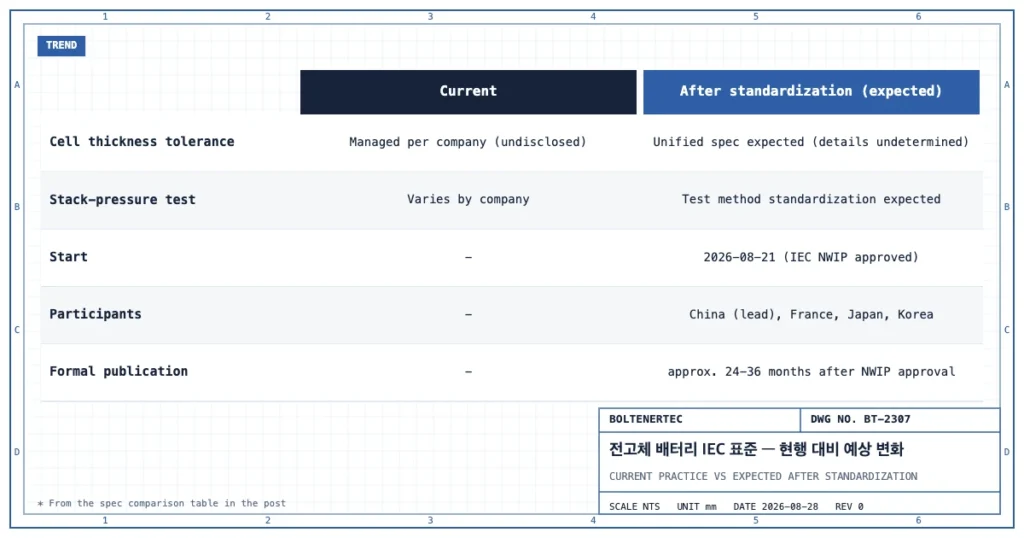
Spec Comparison Table
| Item | Current | Expected After Standardization |
|---|---|---|
| Cell thickness tolerance spec | Managed individually by company (undisclosed) | Unified spec expected (detailed provisions undetermined) |
| Stack-pressure test method | Varies by company | Test-method standardization expected |
| Standardization start date | – | 2026-08-21 (IEC NWIP approved) |
| Participating countries | – | China (lead), France, Japan, Korea |
| Thermal-stability test (Chinese domestic standards, not an IEC clause) | Varies by company | GB comment-draft: <0.5%; CSAE group standard (T/CSAE 434-2025): <1%; IEC text unpublished (needs confirmation) |
| Proposing body | – | China’s SAMR; drafting led by an expert from an unnamed Chinese battery company |
| Estimated time to formal publication | – | Approx. 24-36 months from NWIP approval (2026-08-21) |
Design Reflection Checklist
- Re-check how cell thickness tolerance and stack pressure test methods apply once IEC clauses are published
- Decide platen design changes based on standardization of pressure application (isostatic vs uniaxial)
- Decide inline vs offline placement if thermal stability testing is introduced
- Track the difference in limits between the Chinese GB draft and the CSAE group standard
One-Line Summary: The launch of the IEC solid-state battery international standard is an early signal that the cell-specification reference basis for pressurized stack equipment will change, and it remains a design-change risk for domestic equipment makers until detailed provisions are disclosed.