China Power Construction Corporation (PowerChina) announced it has selected 27 companies as suppliers in its 2025–2026 centralized framework procurement tender for energy storage system (ESS) equipment. The procurement scale is 16 GWh.
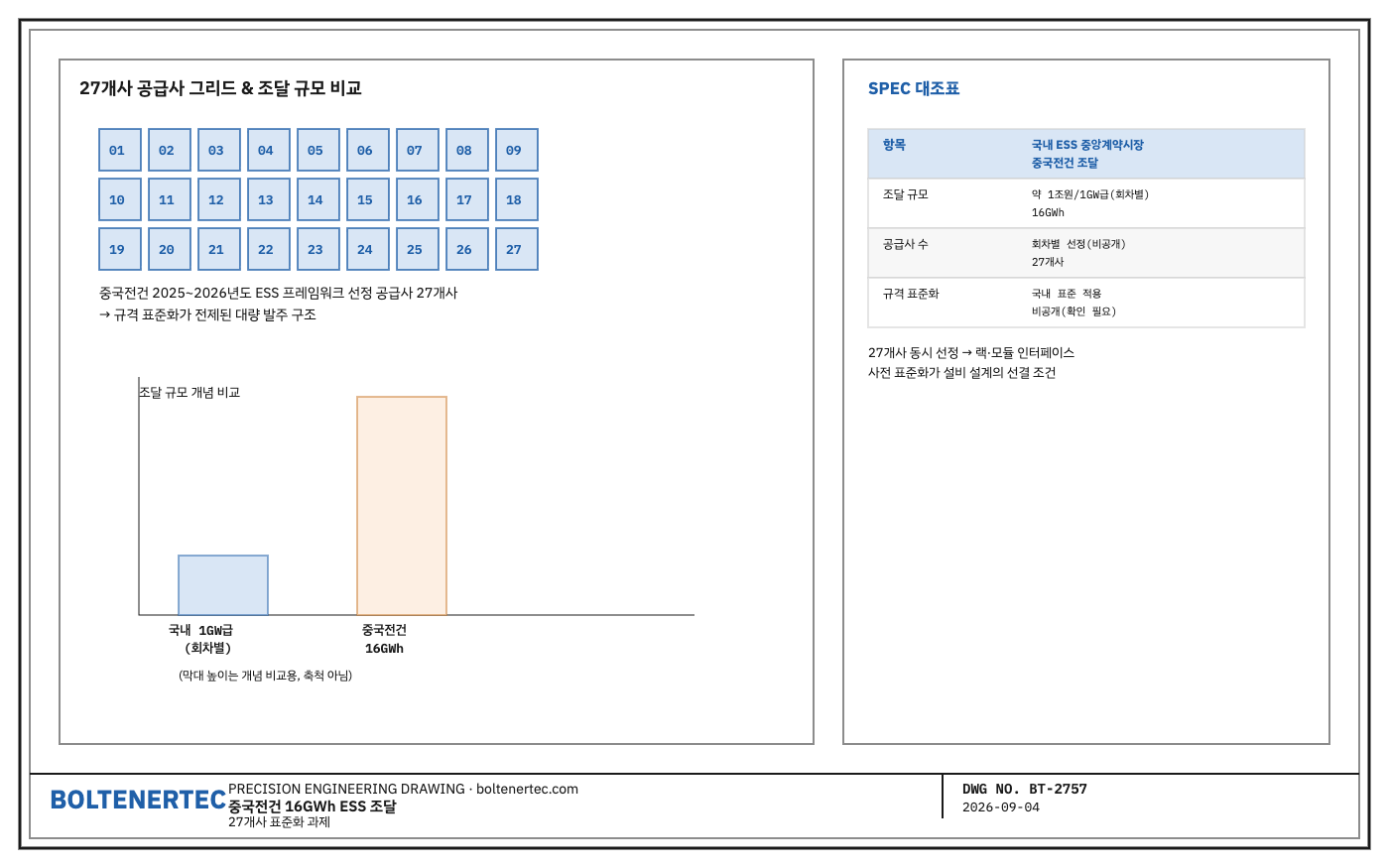
Mechanism-Perspective Impact Analysis
The simultaneous selection of 27 companies as suppliers means this is a mass-order structure premised on specification standardization. If rack/module dimension deviation between suppliers is large, interface mismatches with the containerized ESS housing can occur at the field installation stage. Pre-fixing the standard specifications required by the procuring entity (module width, height, fastening pitch) becomes a prerequisite at the equipment design stage (confirmation needed: whether PowerChina’s standard specification document is publicly available).
Spec Comparison Table
| Item | Domestic Government ESS Central Contract Market (reference) | PowerChina Framework Procurement |
|---|---|---|
| Procurement Scale | Approx. KRW 1 trillion per round | 16 GWh |
| Number of Suppliers | Selected per round (undisclosed) | 27 companies |
| Specification Standardization | Domestic standard applied | Undisclosed (confirmation needed) |
Design Reflection Checklist
- Confirm whether China Power Construction’s standard spec (module width, height, fastening pitch) is published
- Set management criteria for busbar fastening torque and contact surface flatness
- Apply a modular layout that absorbs quarterly volume swings
- Secure room for equipment cost reduction at the design stage against the lowest bid price
One-Line Summary: The 16 GWh procurement structure selecting 27 companies simultaneously shows that pre-standardizing rack/module specifications is a prerequisite for equipment interface design.