The 2026 edition of NFPA 855 has newly established an intentional ignition test requirement in the stationary energy storage system installation standard.
Key News Fact Summary
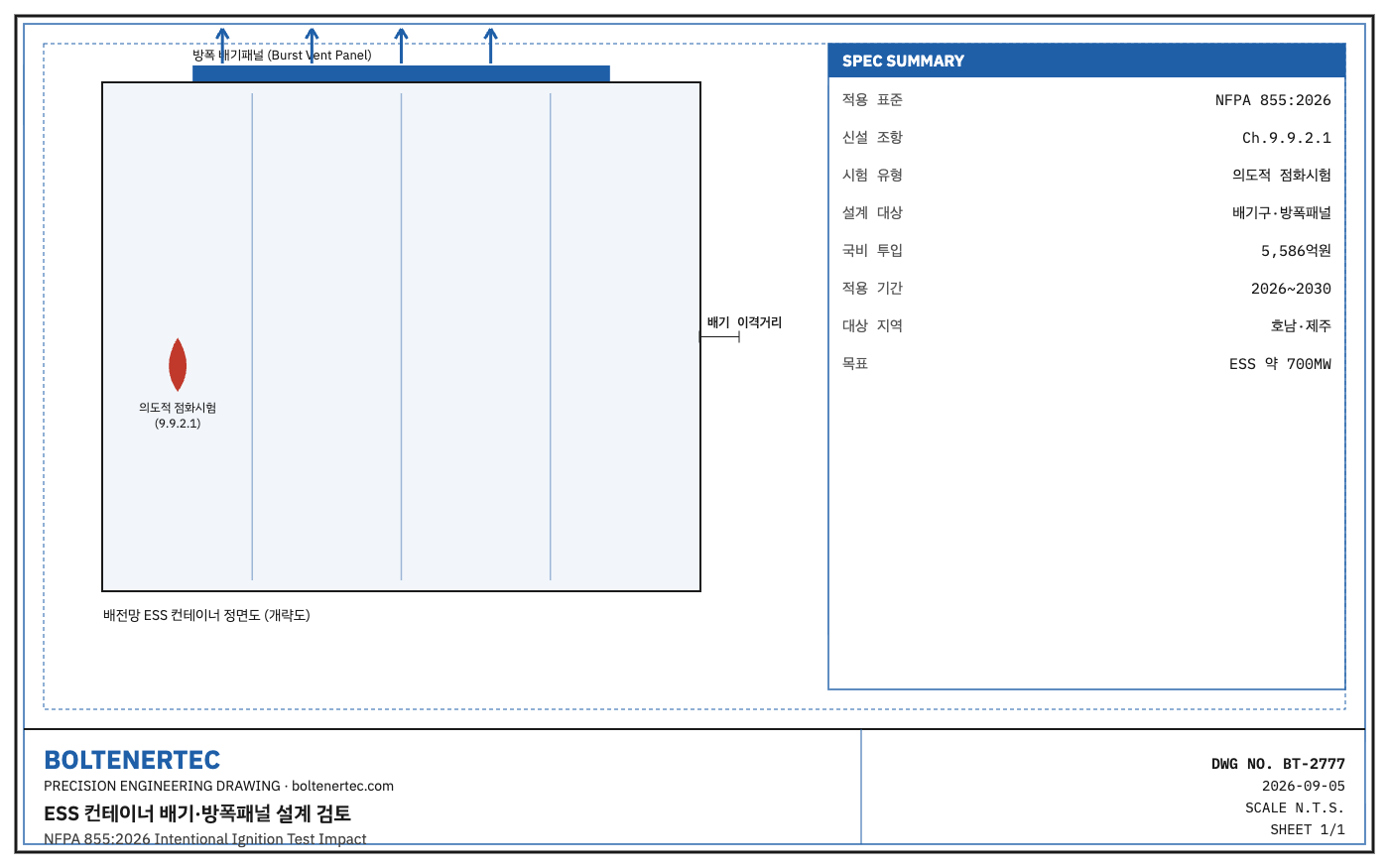
The 2026 edition of NFPA 855 (Standard for the Installation of Stationary Energy Storage Systems) has newly established an intentional ignition testing requirement in Chapter 9.9.2.1. Whereas the existing standard centered on verifying thermal-runaway propagation suppression performance, the revised edition requires testing that assumes an actual ignition scenario. In Korea, the Ministry of Climate, Energy and Environment is investing a total of KRW 558.6 billion in national funds from 2026 to 2030 to promote a distribution-grid ESS construction support project aimed at resolving grid saturation in the Honam and Jeju regions.
Mechanism-Perspective Impact Analysis
The intentional ignition test directly draws the vent location, opening area, and explosion-relief panel burst pressure setting of the ESS container/rack enclosure into the test scope. Since vent path design determines whether the test is passed, container steel plate thickness and stress concentration at the vent opening must be reviewed together. Layout that prevents the vent direction from pointing at adjacent racks or aisles also connects to burn/entrapment-prevention requirements under the Occupational Safety and Health Act, so venting design must satisfy fire safety and worker safety simultaneously.
Spec Comparison Table
| Item | Existing Standard | NFPA 855:2026 Edition |
|---|---|---|
| Test Method | Centered on verifying thermal-runaway propagation suppression | Intentional ignition test added (Chapter 9.9.2.1) |
| Design Elements to Reflect | Separation distance, fire suppression equipment | Vent opening area and explosion-relief panel burst pressure design values must be specified |
| Domestic Applicability | – | Separate review is required |
One-Line Summary: The new ignition test requires specifying vent opening area and explosion-relief panel burst pressure numerically starting from the drawing stage.