High-speed winding for prismatic cells is a process where web acceleration and tension fluctuation frequency hit their limit before the winding needle rotation speed does. New-generation prismatic cell high-speed winding technology unveiled at the 2026 World Power Battery Conference (September 3, Yibin) was announced to raise production efficiency from 4.4 cells/min to 7.5 cells/min. Cycle time drops from 13.6 s to 8.0 s. This article works backward from those figures from the perspective of winding-needle acceleration/deceleration and the tension load path.
Problem Definition
A prismatic winder places 2–3 winding-needle assemblies on a turret, dividing winding, taping, and unloading among them. Within the 8.0 s cycle, non-winding time — turret indexing, head clamping, cutting — remains a fixed item. If non-winding time stays fixed, the winding-needle peak speed must rise by more than the 1.70x cycle ratio. This is where the mechanical contradiction arises. Because a prismatic winding needle has a flat cross-section, web linear velocity oscillates twice per revolution even at the same angular velocity. There is one question: at 7.5 cells/min, which hits its limit first — motor torque or web acceleration?
Kinematic Analysis
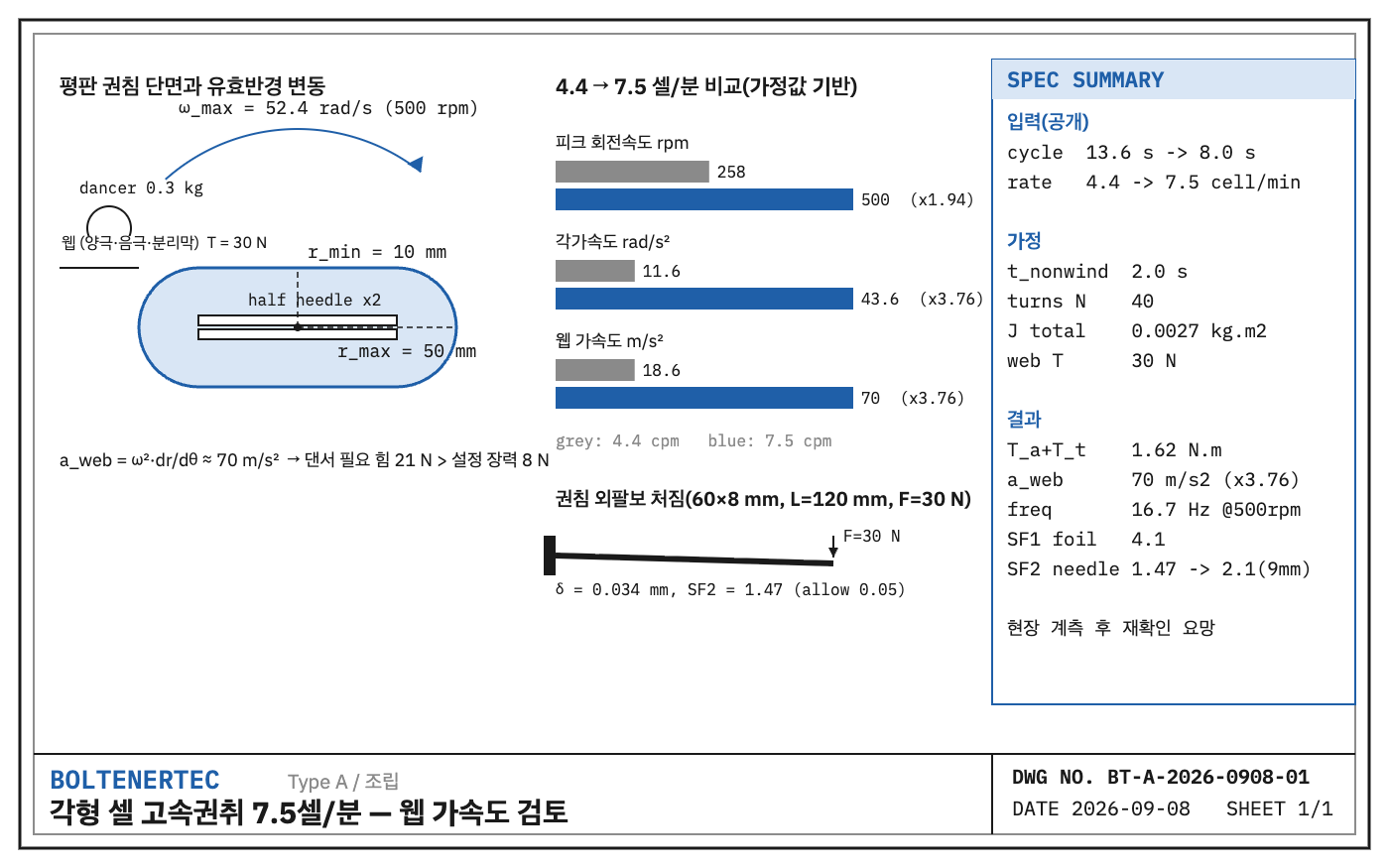
The calculation conditions are assumed as follows. Non-winding time 2.0 s (sum of turret indexing, clamping, and cutting, assumed), winding turns 40 (assumed), the acceleration/deceleration profile is trapezoidal with acceleration and deceleration times each set at 20% of the winding time. Winding-needle assembly moment of inertia is 0.0020 kg·m² (assumed), jelly-roll moment of inertia is 0.0007 kg·m² (mass 0.8 kg, approximated as a 100 mm × 20 mm flat plate, assumed), for a total of 0.0027 kg·m². Total web tension is 30 N (assumed), combining the cathode, anode, and 2 separator sheets. All of these values require on-site measurement and reconfirmation.
| Item | 4.4 cells/min | 7.5 cells/min | Ratio |
|---|---|---|---|
| Cycle time | 13.6 s | 8.0 s | 0.59 |
| Winding available time | 11.6 s | 6.0 s | 0.52 |
| Peak rotational speed | 258 rpm | 500 rpm | 1.94 |
| Angular acceleration | 11.6 rad/s² | 43.6 rad/s² | 3.76 |
| Web peak acceleration | 18.6 m/s² | 70 m/s² | 3.76 |
The table shows two key points. First, if the 2.0 s non-winding time is fixed, the peak rotational speed ratio becomes 1.94, not 1.70. Second, because web acceleration is proportional to the square of angular velocity, it jumps by 3.76x. A design change that raises speed by 70% is transmitted to the tension system as a load fluctuation approaching 4x.
Formula Verification
Peak angular velocity is obtained from the trapezoidal profile as follows.
$$\omega_{max}=\frac{2\pi N}{t_w-t_a}=\frac{2\pi\times 40}{6.0-1.2}=52.4\ \text{rad/s}$$
$N$: number of winding turns, $t_w$: winding available time (s), $t_a$: acceleration time (s). Angular acceleration is $\alpha=\omega_{max}/t_a=52.4/1.2=43.6\ \text{rad/s}^{2}$. Acceleration torque is as follows.
$$T_a=J\alpha=0.0027\times 43.6=0.118\ \text{N}\cdot\text{m}$$
$J$: moment of inertia of the rotating parts (kg·m²). Tension torque at the maximum effective radius of 50 mm is $T_t=30\times 0.050=1.5\ \text{N}\cdot\text{m}$. The combined total of 1.62 N·m is a value handled by a single small servo motor, so motor torque is not the bottleneck.
The bottleneck is web acceleration. On a flat winding needle, the effective radius oscillates twice per revolution between $r_{min}$ and $r_{max}$. Since web linear velocity is $v=\omega r$, web acceleration is as follows.
$$a_{web}=\omega^{2}\frac{dr}{d\theta}\approx 52.4^{2}\times\frac{0.050-0.010}{\pi/2}=70\ \text{m/s}^{2}$$
$r_{min}$: winding-needle thickness-direction radius 10 mm (assumed), $r_{max}$: width-direction radius 50 mm (assumed). For a dancer roller mass of 0.3 kg (assumed) to track this acceleration, 21 N of force is required — greater than the set tension of 8 N (assumed) for a single web sheet. In other words, the dancer cannot keep up with the web, and tension can momentarily exceed 3x the set value. At 500 rpm, this oscillation occurs at 16.7 Hz, which typically overlaps with the dancer system’s natural frequency band of 10–20 Hz (assumed).
Safety factor is verified through two paths. First, the electrode-foil tension path. With aluminum foil thickness 12 µm, width 100 mm, and allowable stress 100 MPa (assumed), the allowable tension is $F_{allow}=100\times 0.012\times 100=120\ \text{N}$. Taking the worst-case tension as the set 8 N plus dancer inertial force 21 N for 29 N total, $SF_1=120/29=4.1$. The foil’s actual yield strength varies significantly by temper, so on-site measurement and reconfirmation is required. Second, the winding-needle stiffness path. During winding, with the combined cross-section of two half-needles at 60 mm × 8 mm (assumed), cantilever length 120 mm, tip load 30 N, and elastic modulus 200 GPa, the following applies.
$$\delta=\frac{FL^{3}}{3EI}=\frac{30\times 120^{3}}{3\times 200000\times 2560}=0.034\ \text{mm}$$
$I=bh^{3}/12=60\times 8^{3}/12=2560\ \mathrm{mm}^{4}$. Taking allowable deflection as 25% of the winding alignment tolerance of ±0.2 mm, i.e. 0.05 mm (assumed), $SF_2=0.05/0.034=1.47$. Both safety factors exceed 1, but SF₂ has little margin. With the half-needles separated (thickness 4 mm), deflection increases 8-fold, so releasing tension first before withdrawal is a required sequence precondition.
Shop-notes
First, switch the dancer roller to a small-diameter hollow aluminum design to lower the equivalent mass to 0.1 kg or less. At a web acceleration of 70 m/s², the required force drops to 7 N, bringing it within the set tension. Second, increasing winding-needle thickness by 2 mm only extends $r_{min}$ by 1 mm and reduces web acceleration by about 2.5% only, so winding-needle thickness should be set by the deflection criterion, and acceleration should be controlled on the dancer side. Third, raising the combined half-needle thickness from 8 mm to 9 mm reduces deflection to 0.024 mm, bringing SF₂ to 2.1. Machinability note: the half-needles are ground-flat SKD11 or SUS440C parts, and a 1 mm thickness increase has no impact on grinding man-hours. The clamping notch area must specify a corner radius of R0.3 or greater after wire EDM, to control stress concentration. An alternative mechanism would be winding on a round needle followed by flat-pressing forming. This eliminates web acceleration oscillation, but was not adopted because it lowers yield in large-format prismatic cells due to electrode cracking and separator wrinkling during forming. A control method that modulates angular velocity by position is mentioned only as a boundary condition.
Design Reflection Checklist
| Item | Criterion | Check |
|---|---|---|
| Non-winding time measurement | Indexing + clamping + cutting total ≤ 2.0 s | On-site measurement |
| Peak rotational speed | Secure ≥ 500 rpm | Motor spec |
| Dancer equivalent mass | ≤ 0.1 kg | Drawing |
| Combined winding-needle thickness | 9 mm, SF₂ ≥ 2.0 | Calculation sheet |
| Foil allowable tension | Recalculate SF₁ using measured yield strength | Confirmation required |
One-line Summary
Raising prismatic winding speed from 4.4 to 7.5 cells/min keeps winding-needle torque at 1.6 N·m, but web acceleration jumps 3.8x to 70 m/s², so the design priority should be dancer mass and winding-needle thickness, not the motor.
Source: China News Network (中国新闻网), September 3, 2026, “2026世界动力电池大会四川宜宾开幕 发布8项创新技术”; IT之家, September 6, 2026, “2026 世界动力电池大会重大标志性技术成果公布”.