CATL confirmed on August 10, 2026 that it will begin small-scale trial production of all-solid-state batteries starting in 2027.
Key News Facts
The product carries CATL’s own brand name, “Ningde Shidai All-Solid-State.” Following BYD, CATL is the second major cell maker to formalize an all-solid-state pilot-production target. Early sulfide-based cells reportedly confirmed a cell-level energy density of 500Wh/kg under laboratory conditions. This is reported to be roughly double the best currently mass-produced lithium-ion pack level, but since the figure is a laboratory-condition value, it requires re-verification when applied to mass production. Toyota and Idemitsu are targeting mass production in 2027–2028, which overlaps in timing with CATL’s 2027 pilot target.
According to TheGuru, CATL’s chairman stated that the company plans to first deploy its solid-state batteries in premium EV platforms priced at RMB 250,000 (roughly KRW 48 million) or higher (source: TheGuru). CATL aims to raise its technology readiness level (TRL) from the current stage 4 to stages 7–8, and projected that mass production at a scale of one million units per year would be difficult to achieve before 2030 (same source). According to StarNews Korea, BYD has registered six patents related to a dual-electrolyte cathode structure combining halide- and sulfide-based solid electrolytes (source: StarNews Korea). CATL’s specific cell structure and patent status were not specified in this report (undisclosed).
According to Global Economic, China’s Tinci (Tianci Materials) has completed a hundred-ton-class pilot line with production capacity of 50 tons per quarter of lithium sulfide and 100 tons per quarter of sulfide-based solid electrolyte, and began trial operation in the third quarter of 2026 (source: Global Economic). Beijing Easpring has reportedly supplied more than 50 tons cumulatively of dedicated all-solid-state cathode material to major domestic and overseas solid-state battery customers including CATL (same source). The fact that the raw-material and material supply chain is forming at pilot scale suggests that CATL’s 2027 pilot target is feasible from a material-supply standpoint (estimated).
Mechanical-Design Impact Analysis
Sulfide-based solid electrolytes react with atmospheric moisture, so pilot lines typically require a dew-point-controlled dry-room specification (the process chemistry mechanism itself is not covered here and is referenced only as a boundary condition). This means the equipment’s sealed-enclosure structure and sealing specifications must be strengthened compared with existing liquid-electrolyte lines. At the pilot stage, the smaller the line scale, the more flexibility is prioritized over equipment standardization, so from a domestic equipment maker’s standpoint, demand may first arise for modular press/stacking equipment capable of handling low-volume, high-mix production (estimated; basis: the industry convention that equipment redesign rates are high when transitioning from pilot to mass production). The pressing-stack equipment needed for the compression/sintering process is expected to differ in load scale from liquid-electrolyte assembly processes, but the specific load values are undisclosed.
The staged rise in technology readiness level (TRL) from stage 4 to stages 7–8 suggests, from an equipment supplier’s standpoint, that equipment specifications may be revised sequentially at each pilot stage (estimated; basis: the common development practice in which process parameters are repeatedly adjusted through stage-by-stage TRL validation). In this case, prioritizing modular equipment that can flexibly respond to parameter changes, rather than fixed dedicated equipment, is advantageous for reducing the frequency of engineering change orders (ECOs) in the early pilot phase.
Shop-notes: Two approaches are considered in parallel at the pilot stage: applying a sealed dry-room structure directly to the pressing/stacking equipment itself, or placing smaller equipment inside a separate glovebox-type isolation chamber. The former offers better maintenance access across the whole line but requires higher initial investment; the latter has lower initial investment but requires chamber redesign when scaling up equipment, which can make it the more reasonable choice for a pilot stage that must handle low-volume, high-mix production (estimated).
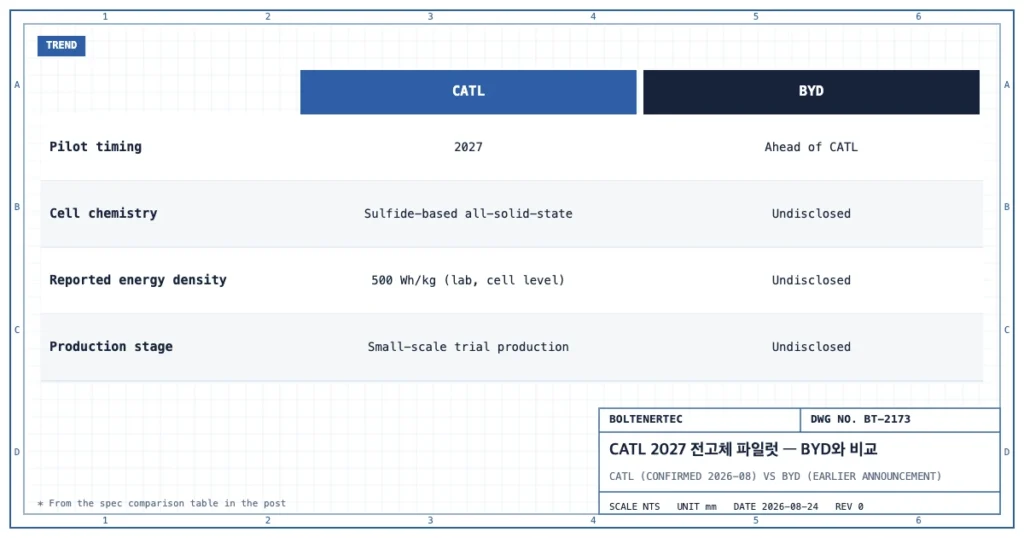
Spec Comparison Table
| Item | CATL (confirmed 2026-08) | BYD (earlier announcement) |
|---|---|---|
| Pilot target timing | 2027 | Ahead of CATL |
| Cell chemistry | Sulfide-based all-solid-state | Undisclosed |
| Reported energy density | 500Wh/kg (laboratory, cell-level) | Undisclosed |
| Production stage | Small-scale trial production | Undisclosed |
One-line summary: For CATL’s 2027 solid-state pilot, changes in dry-room and pressing-equipment specifications are practically a bigger variable than the energy-density figure itself.
Design Reflection Checklist
- Hold equipment orders until the dry-room specification (sealed structure, sealing) with dew-point control is finalized
- Prioritize modular equipment that can accommodate possible spec revisions at each TRL stage
- Specific load values for the pressing/stacking equipment remain unconfirmed — verification needed