Forge Nano held a groundbreaking ceremony on August 19, 2026 for an expansion of its battery gigafactory in Morrisville, North Carolina, USA.
Key News Facts
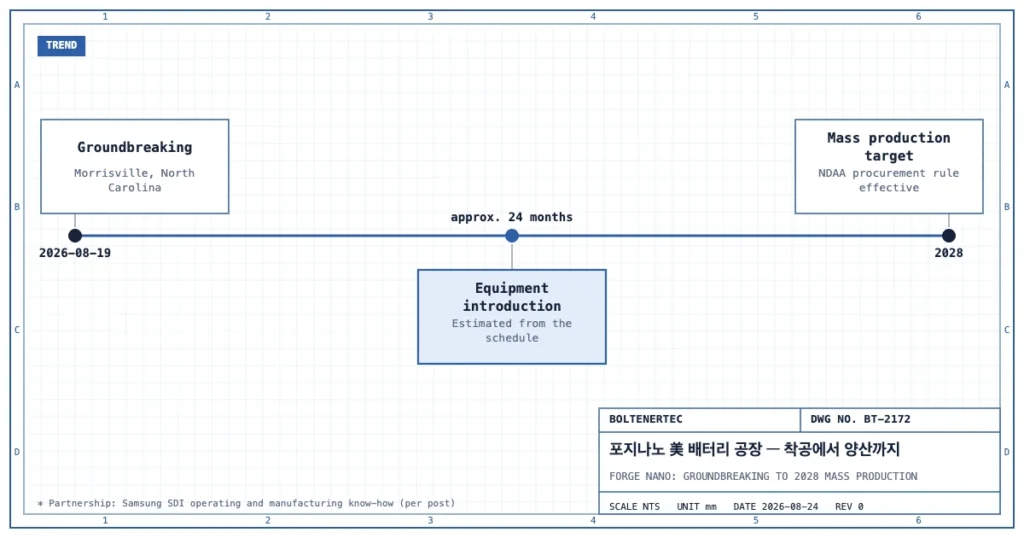
The project is named “America’s Battery Gigafactory.” The target production start is 2028, with manufacturing equipment to be brought in sequentially over the following two years. This schedule is aligned with battery-procurement requirements under the US National Defense Authorization Act (NDAA), effective 2028. Samsung SDI is providing operating/manufacturing know-how for the plant and has signed a conditional agreement to purchase cells produced there starting in 2028. The scale of equipment introduction, number of lines, and production capacity (GWh) were not specifically disclosed in the press release (undisclosed).
According to GlobeNewswire, the expansion is backed by up to USD 100 million in non-dilutive funding from the U.S. Department of Energy (DOE), and Samsung SDI made a strategic investment totaling USD 20 million, combining a USD 10 million Series D investment and a USD 10 million PIPE investment (source: GlobeNewswire). The existing site of 100,000 square feet will be expanded to approximately 315,000 square feet, with a target production capacity of roughly 3 GWh per year (about 150 million cells per year) and more than 250 new jobs (same source). The core coating technology is Atomic Armor®, based on atomic layer deposition (ALD) (same source).
U.S. Department of Energy Assistant Secretary Audrey Robertson attended the groundbreaking, confirming federal-level support (source: GlobeNewswire). The battery-procurement requirement under the National Defense Authorization Act (NDAA), taking effect in 2028, centers on excluding batteries and components sourced from certain countries from defense procurement, suggesting that this expansion is not a purely commercial investment but a project directly tied to supply-chain policy (estimated; basis: the general intent of the NDAA’s battery-procurement provisions).
Mechanical-Design Impact Analysis
The period secured from groundbreaking to the start of mass production is approximately 24 months. This means that, within this period, sequential equipment introduction must occur from material-coating equipment through to back-end assembly equipment. Lines subject to defense-procurement requirements typically have stricter material/component traceability documentation requirements than ordinary commercial lines. Given the structure in which Samsung SDI provides operating know-how, domestic equipment partners could potentially be indirectly incorporated into the overseas line under the same specifications, though the specific vendor list is not confirmed (undisclosed). The short 24-month equipment-introduction schedule may presuppose a standardized modular line design (skid-unit pre-assembly, minimal on-site construction) (estimated; basis: this is short compared with the typical 30–36-month ramp-up period seen at similarly sized gigafactories).
The site area expanding roughly 3.15-fold from the existing footprint (100,000 to approximately 315,000 square feet) suggests that foundation and structural construction for the new building accounts for a substantial portion of the project (estimated). The core atomic layer deposition (ALD) coating equipment requires vacuum chambers and precision gas-supply piping, and because piping inlet locations and vibration-isolation foundations directly affect coating uniformity, equipment layout must be finalized starting from the building structural-design stage (estimated; basis: the process characteristic that ALD processes are generally built around precision vacuum and gas-control equipment).
Shop-notes: An ALD coating line can be implemented as either a batch-chamber method or a continuous (roll-to-roll) method. The batch method has limited throughput per chamber but relatively easier coating-uniformity control, while the continuous method offers higher throughput but makes managing coating-thickness variation during web transport more difficult. At the initial ramp-up stage for a roughly 3 GWh annual scale, the batch method, which prioritizes uniformity verification, may be the more reasonable choice, with a transition to continuous processing to be considered after mass-production stabilization (estimated).
Spec Comparison Table
| Item | Details |
|---|---|
| Groundbreaking | 2026-08-19, Morrisville, North Carolina, USA |
| Target mass production | 2028 |
| Equipment-introduction period | Approx. 24 months (estimated, based on interval between groundbreaking and mass-production target) |
| Regulatory link | US NDAA procurement requirement, effective 2028 |
| Partnership structure | Samsung SDI provides operating/manufacturing know-how; conditional purchase agreement |
| Production capacity / line spec | Undisclosed |
One-line summary: Forge Nano’s gigafactory plan centers on a 24-month equipment-introduction schedule aligned with defense-procurement timing, while specific line specifications remain undisclosed.
Design Reflection Checklist
- Coordinate foundation/structural construction schedule and equipment delivery sequence with the roughly 3.15x site expansion
- Finalize vacuum/gas piping inlet locations for the ALD coating equipment in advance
- Establish per-equipment documentation systems to meet NDAA traceability requirements (verification needed)