A doctor blade is a plate-shaped part that contacts a rotating roll surface at a set angle and line load and scrapes off deposits. On a heated coated roll, the first criterion for blade material is not coating hardness but roll surface temperature. Hardness ranking is the second criterion, and the replacement interval is set from measured initial wear.
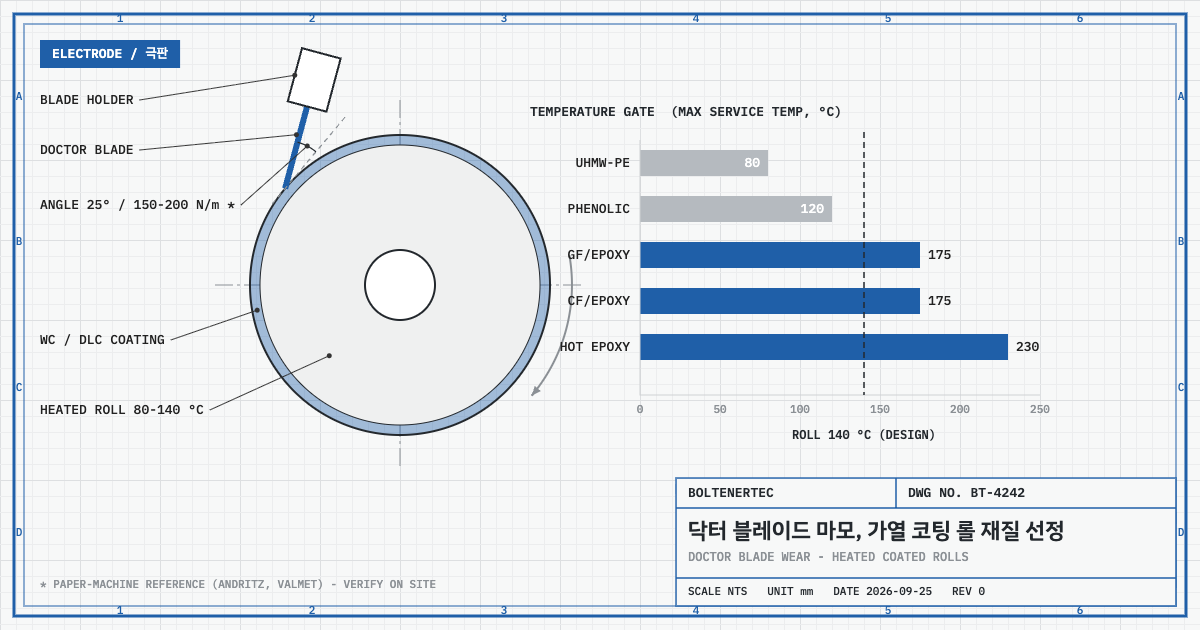
1. Problem Definition — The Blade Must Wear First, but Heat Undermines That Premise
The blade is a consumable and the roll is an asset. Wear must therefore concentrate on the blade. Scrapers are standard parts on electrode roll presses as well. Toyota Industries patent JP6631241B2 claims a structure that detects when the scraper holder comes too close to the roll, as when the scraper wears or is not mounted, and then retracts the holder. Its embodiment is a lithium-ion battery electrode roll press, and the scraper is a thin glass-fibre-reinforced plastic (FRP) plate. LG Energy Solution patent KR102472281B1 (filed by LG Chem) claims a scraper unit that mechanically removes cleaning liquid and foreign matter from the rolling roll, and names synthetic resin, silicone or urethane as the most preferred pad materials. BYD-group patent CN206148549U claims a double arrangement in which the upper scraper spreads the oil film and the lower scraper removes impurities.
The problem is temperature. Sony patent JP3443833B2 sets the heated rolls near 80–140 °C, the softening temperature of the electrode mixture. In this range, polymer blades chosen to protect the roll exceed their service limit first. In what order should blades for heated coated rolls be selected, and how can their life be predicted?
2. Kinematic Analysis — Line Contact Load and Hardness Ranking
The blade makes line contact across the roll width. The contact force is the line load (N/m) times the contact length. Wear concentrates on the softer of the two bodies. Archard’s wear law states that wear volume is proportional to load and sliding distance and inversely proportional to hardness.
$$V=K\frac{F\,s}{H}$$
Here $V$ is wear volume (mm³), $K$ the dimensionless wear coefficient, $F$ the contact force (N), $s$ the sliding distance (mm), and $H$ the hardness of the worn body (N/mm²). $K$ depends on the material pair, lubrication and temperature. That is why a site-measured value must replace handbook values.
| Group | Material | Hardness | Max. service temperature | Source |
|---|---|---|---|---|
| Roll coating | WC-10Co-4Cr thermal spray | HV0.3 750–1,450 | 500 °C | Oerlikon Metco DSM-0221.9 |
| Roll coating | WC 10Co 4Cr, HVOF | HV0.3 1,000–1,400 | 500 °C | Höganäs 3376HOG |
| Roll coating | DLC a-C:H (TRITON) | HV0.05 2,500 | 300 °C | Oerlikon Balzers HQ153EN |
| Roll coating | DLC ta-C (HARD CARBON) | HV0.05 5,000 | 500 °C | Oerlikon Balzers HQ153EN |
| Blade | UHMW-PE | No data | 80 °C | ANDRITZ 2023 |
| Blade | Cotton/phenolic laminate | No data | 120 °C | ANDRITZ 2023 |
| Blade | Fibreglass/epoxy | No data | 175 °C | ANDRITZ 2023 |
| Blade | Carbon fibre/epoxy | No data | 175 °C | ANDRITZ 2023 |
| Blade | High-temperature epoxy | No data | 230 °C | ANDRITZ 2023 |
| Blade | Hardened steel | HV 475–515 | Not stated | ANDRITZ 2023 |
| Blade | Carbide-coated steel | Coating HV 1,050–1,150 | Not stated | ANDRITZ 2023 |
DLC (Diamond-Like Carbon) is a carbon-based film that ISO 20523:2017 classifies by crystallinity, sp²/sp³ bond ratio, hydrogen content and additional elements. Hardness spans 1,500–5,000 HV across DLC grades (HQ153EN table). The test loads differ (HV0.3 and HV0.05), so the table values must not be compared directly.
Setting data also comes only from paper machines. The ANDRITZ selection table gives, for tungsten-carbide-coated calender rolls, a blade angle of 25°, a line load of 150–200 N/m and blade codes B3, B1, C1 and HR (C1 is carbon fibre, HR is high-temperature epoxy). Valmet regards 20–30° as the most effective angle range and advises always using the lowest safe load. No primary source linking these values to electrode calenders was found.
3. Calculation/Formula Verification — Temperature Gate and Dual Safety Factors for Hardness and Life
The first gate is temperature. The design temperature is 140 °C, the upper end of the Sony patent range. Materials are screened by temperature margin.
$$\Delta T=T_{lim}-T_{roll}$$
$$\Delta T_{UHMW}=80-140=-60\ ^{\circ}\mathrm{C},\qquad \Delta T_{EP}=175-140=35\ ^{\circ}\mathrm{C}$$
$\Delta T$ is the difference (°C) between the blade service limit $T_{lim}$ and the roll surface temperature $T_{roll}$. UHMW-PE falls 60 °C short and cotton/phenolic 20 °C short. Fibreglass/epoxy and carbon/epoxy keep 35 °C of margin, and high-temperature epoxy 90 °C. Many polymer blades usually chosen to protect the roll fail at the temperature gate.
The second criterion is hardness ranking. The roll must be harder than the blade so that wear concentrates on the blade. Metal blades are compared with the lower bound of coating hardness.
$$SF_{1}=\frac{HV_{roll,min}}{HV_{blade,max}}$$
$$SF_{1,steel}=\frac{750}{515}=1.46,\qquad SF_{1,carbide}=\frac{750}{1150}=0.65$$
$SF_{1}$ is the hardness-ranking safety factor, $HV_{roll,min}$ the lower bound of coating hardness and $HV_{blade,max}$ the upper bound of blade hardness. The carbide-coated blade falls below 1, which inverts the ranking, because coating hardness can drop to 750 HV depending on the spray process. Even with the HVOF lower bound of 1,000 HV, $1000/1150=0.87$ stays below 1. Polymer blades lack HV data, so they are excluded from this equation and screened by the temperature gate only.
The third criterion is the replacement interval. Since the wear coefficient $K$ is unknown, it is back-calculated from initial operation. The values below are assumed to show the procedure and must be re-confirmed by site measurement: tip wear of 0.4 mm after 100 h, allowable wear of 3.0 mm, and a preventive maintenance (PM) interval of 500 h.
$$L_{blade}=\frac{3.0}{0.4}\times 100=750\ \mathrm{h},\qquad SF_{2}=\frac{L_{blade}}{L_{PM}}=\frac{750}{500}=1.50$$
$L_{blade}$ is the expected blade life (h) and $L_{PM}$ the replacement interval (h). In Archard’s law, wear volume is proportional to sliding distance. At the same $K$, raising line speed by 1.5 times cuts life to 500 h and $SF_{2}$ to 1.00. A speed upgrade requires shortening the replacement interval by the same ratio. Raising the line load from 150 N/m to 200 N/m also multiplies wear by 1.33.
4. Practical Application (Shop-notes)
- Selection order: (1) Measure the roll surface temperature at the blade contact line, not the heater set point. (2) Keep only materials that pass the temperature gate. (3) For metal blades, check $SF_{1}$ with the measured coating hardness from the delivered roll’s inspection report. (4) Back-calculate $K$ from wear after the first 100 h and set the replacement interval.
- Coating inspection report: require the hardness value together with its test load (HV0.3 etc.). Coating hardness depends on the spray process, gun, parameters and thickness (DSM-0221.9 footnote).
- No metal pairs of similar hardness: Valmet notes that carbon steel blades of about 54 HRC used regularly on metal rolls of about 58 HRC can cause massive roll wear over time.
- Alternative mechanism — interposed adhesive tape (LG Energy Solution US12288864B2): a tape between electrode and roll keeps active material from sticking to the roll surface. Reason not adopted: it prevents adhesion but cannot replace the removal function of the blade, and it adds a tape supply/take-up unit with its own tension management.
- Wear detection: a mechanism that detects the holder-to-roll distance and retracts the holder, as in JP6631241B2, prevents the holder from hitting the roll.
- Machinability: the straightness of the blade holder seat governs line-load uniformity across the width. Finish the seat by grinding or precision milling and specify a straightness tolerance on the drawing, using the blade maker’s recommended value.
5. Design Checklist
- Is the roll surface temperature at the blade contact line measured?
- Is the difference between the blade service limit and the measured temperature recorded?
- For metal blades, does SF1 exceed 1 with the measured coating hardness?
- Is the replacement interval back-calculated from initial wear?
- Is the replacement interval scaled when line speed or line load changes?
- Is there a detection/retraction mechanism against holder interference as the blade wears?
Items Requiring Confirmation
- Blade angle and line load for electrode calenders: the only primary sources found give paper-machine values.
- Polymer blade hardness: no HV data, so excluded from the hardness ranking.
- Service temperature limit of metal blades: not stated in maker data.
- Different hardness test loads (HV0.3, HV0.05): direct comparison between coatings is limited.
- Wear, allowable wear and PM interval in the example: all assumed values.
One-line summary: For heated coated rolls, screen doctor blades by temperature first, then by hardness ranking, and set the replacement interval from measured initial wear.
Sources: ANDRITZ Bonetti blade brochure (2023) · Valmet, Doctor Blades (2012) · Oerlikon Metco DSM-0221.9 · Höganäs 3376HOG · Oerlikon Balzers HQ153EN · ISO 20523:2017 · J. F. Archard, J. Appl. Phys. 24(8) 981-988, 1953 (DOI 10.1063/1.1721448) · JP6631241B2 · KR102472281B1 · CN206148549U · JP3443833B2 · US12288864B2