Notching and stacking are the assembly steps that cut a long electrode strip into cell-sized plates and then lay those plates on top of one another.
- A notching machine cuts the electrode1 on the roll into a set shape. A stacking machine layers the cut plates with a separator2 in between.
- On October 6, M Plus said it won a contract from a European battery maker, called “Company A,” to supply notching and stacking equipment for prismatic3 cells.
- The detail worth noticing is the application. Specialty cells for aerospace and defense now appear among the buyers of this equipment.
First, what the two machines do
An electrode that has passed the roll press and the slitter is still a long strip. Its thickness and width are set, but its length runs on without a break until the roll is fully unwound. In that form it cannot go inside a cell.
A notching machine cuts this strip into plates, each sized for one cell. While cutting, it also forms a small projection on one edge for drawing out the current, the tab4. The tab is not welded on after the plate is cut. It is part of the cut shape itself.
You might ask why the strip is cut into separate plates at all. A cell holds several anode and cathode plates. The wider and more numerous the plates, the more charge the cell can store, so making plates of the right size for the cell shape is the same as setting the cell’s frame. Notching is the step that first turns that frame into a visible shape.
Think of pressing a cookie cutter into thinly rolled dough. The cutter has a handle shape built in, so every cookie comes out with one handle attached.
A cookie cutter presses stationary dough, while a notching machine cuts a strip that keeps moving. The machine is also responsible for what is left over and for the condition of the cut edge.
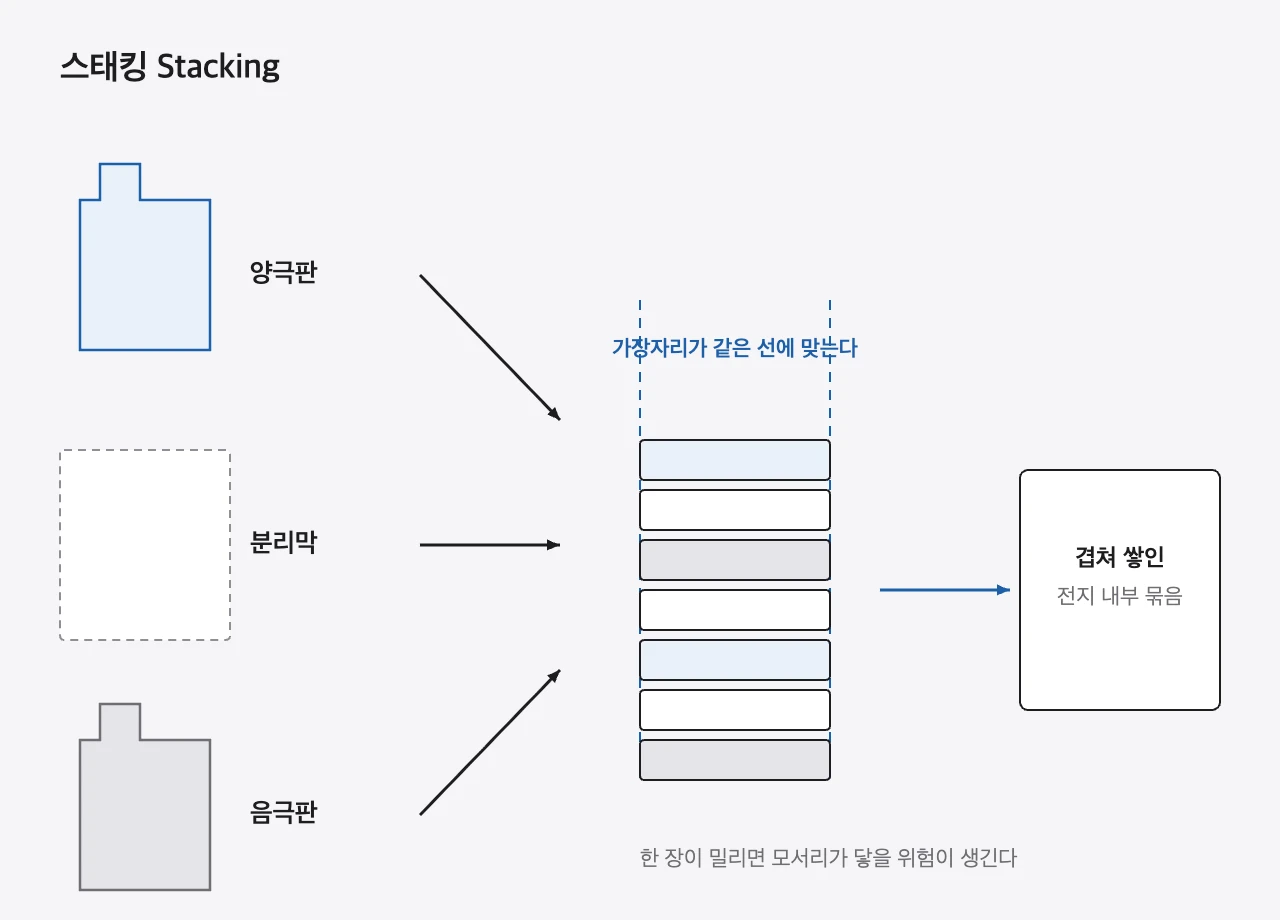
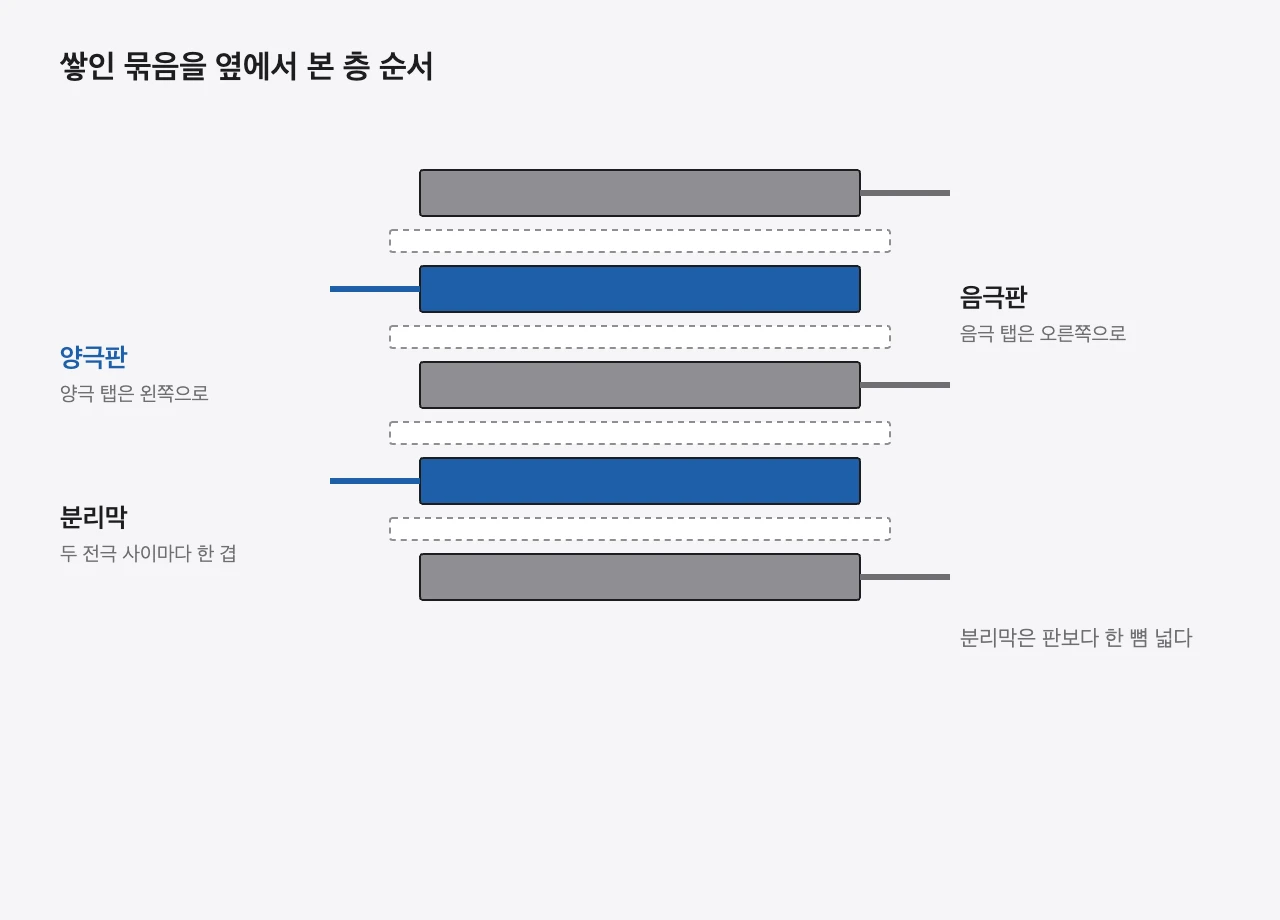
The cut plates move on to the stacking machine. Anode and cathode plates are placed alternately, with a separator between each pair. It resembles laying cards one on top of another, except that if even one plate slips sideways, its edge may touch the neighboring electrode. The separator is the wall that prevents that contact, so the position has to be exact.
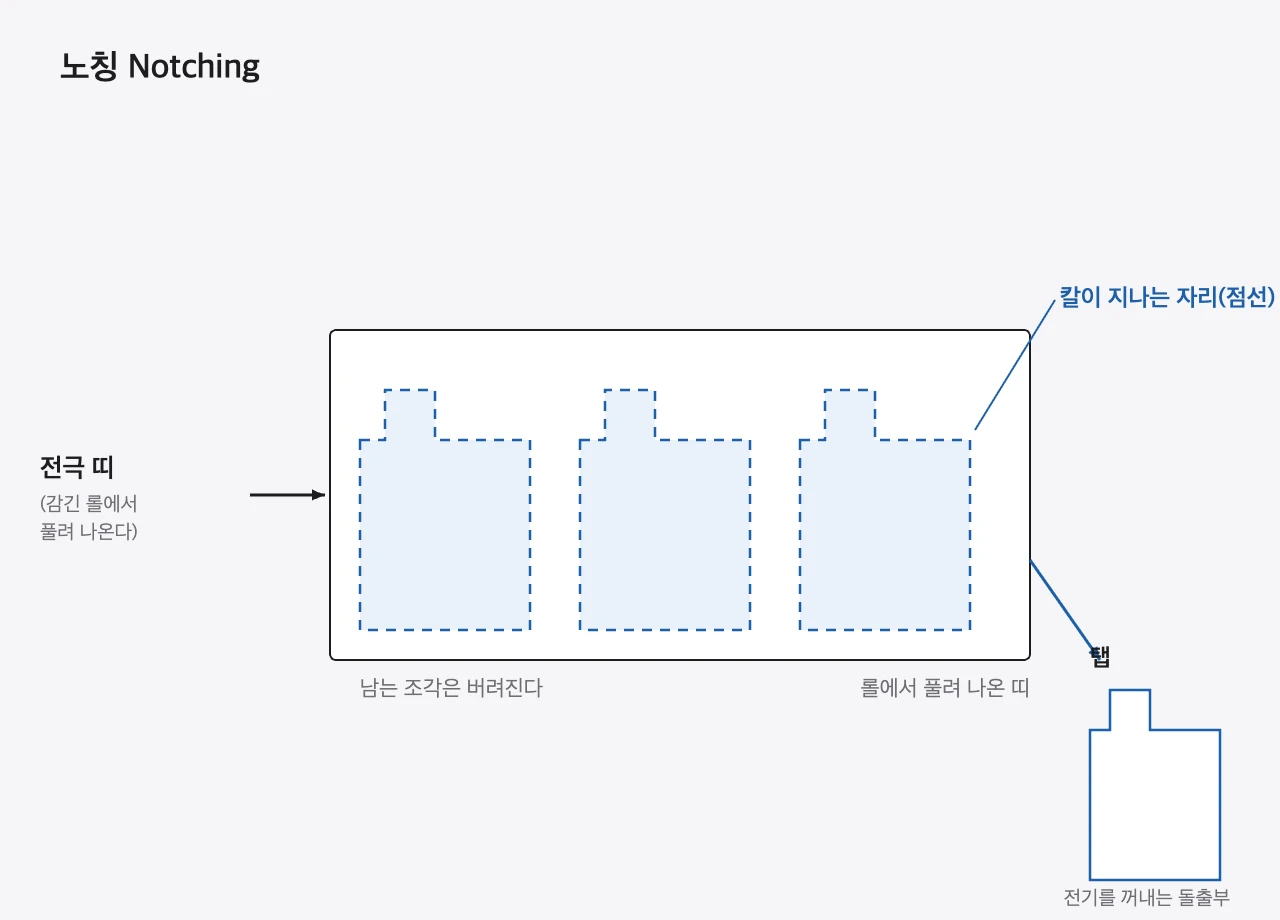
The dashed lines in the figure mark where the blade passes. The offcut between plates is discarded. How the layout reduces that offcut decides how much material is wasted.
Neither cutting nor stacking has a single method
Cutting methods fall into two broad groups: a die that presses through the electrode, and a laser that burns through it. A die is good at stamping the same shape in one stroke. A laser can change the shape without making a new die. Neither is simply better. The answer depends on whether the cell shape changes often or the same shape runs for a long time.
The cut edge is easy to overlook, yet it deserves attention. A rough ridge or a loose particle left on the edge can touch the separator. If the separator is damaged, the anode and cathode meet and the cell fails. For that reason, notching machines are almost always fitted with a device that sucks away the dust from cutting.
Stacking also comes in more than one form. In one, the separator stays a continuous strip that is folded in a zigzag, with a plate slipped into each fold. In the other, the separator is cut into sheets as well and laid alternately with the plates. The first keeps the separator connected, so positions drift less. The second lets each plate be aligned on its own. The report does not say which one is used here.
It is also worth asking where accuracy comes from. A person laying cards lines them up by eye. A machine uses a camera to read the plate edge and corrects the placement from that reading. If the edge the camera reads is blurred, the correction goes wrong, so a clean cut in the earlier step makes alignment easier in the later one. That is why the two machines tend to be sold as a pair.
- UnwindThe roll is unwound and the strip is fed into the machine.
- CutThe notching machine makes tabbed plates.
- StackThe stacking machine lays plates and separator in turn.
What this week’s news said
According to a Newspim report, M Plus announced on October 6 that it had won a contract from a European battery maker, Company A, to supply notching and stacking equipment for prismatic cells. The equipment goes into multipurpose specialty models for defense and similar uses, and it is the first deal with Company A.
| Item | What the report says |
|---|---|
| Announced | October 6, 2026 |
| Equipment | Notching system, stacking system |
| Cell format | Prismatic |
| Use | Multipurpose specialty models for defense and similar fields |
| Customer | European battery maker “Company A” (name undisclosed), first deal |
| Contract value | Not given in the report |
The report says Company A supplies industrial battery solutions to aerospace, defense, medical, telecommunications, oil and gas, transportation, and utility sectors. M Plus said its ultra-high-speed notching and stacking technology can lower capital expenditure (CAPEX)5 and operating expenditure (OPEX). The size of the reduction cannot be confirmed from public information. It should be read as the company’s own claim.
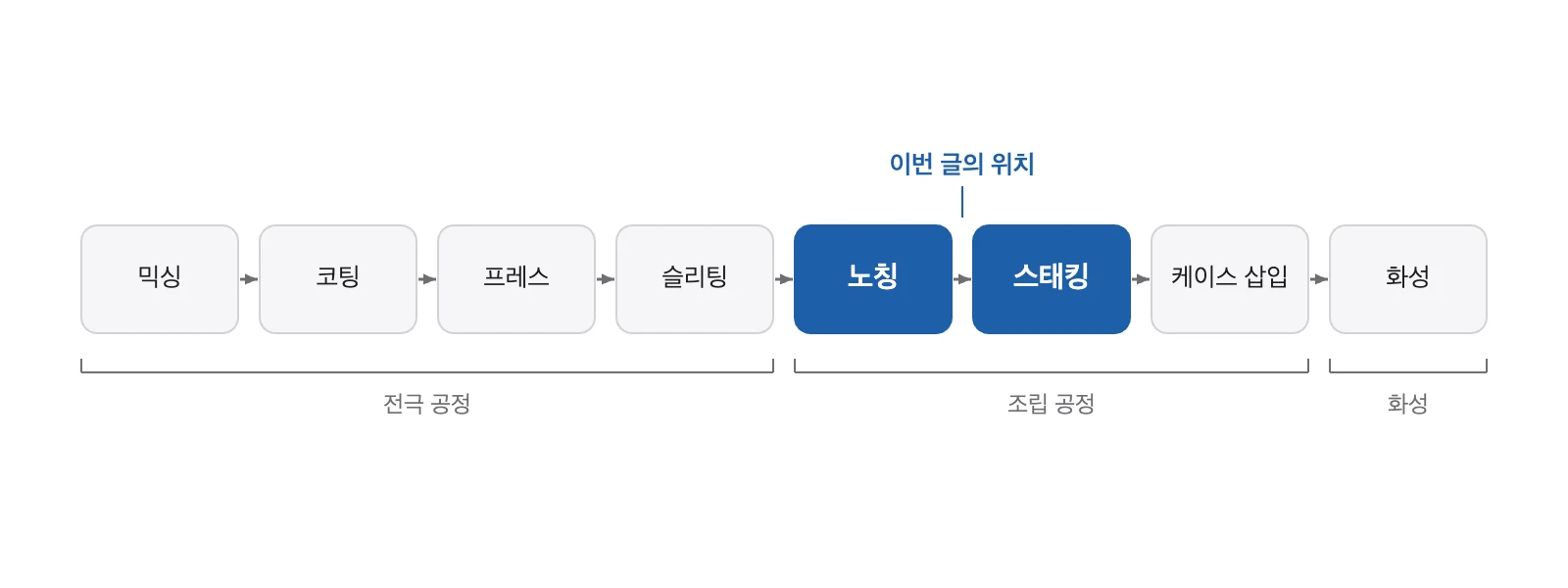
Notching and stacking sit at the boundary where the electrode process ends and the assembly process begins. Upstream is the roll-to-roll (R2R)6 world of continuous strips. Downstream is the world of single plates. Notching is the point where a strip becomes plates.
| Machine | Takes in | Sends out |
|---|---|---|
| Slitter7 | Wide electrode roll | Narrower electrode roll |
| Notching | Electrode roll | Single plates with tabs |
| Stacking | Anode plates, cathode plates, separator | Layered cell interior stack |
The stack in the last cell of the table is what sits inside a cell before it goes into the case. If that stack is misaligned, later steps have little way to fix it.
Consider how prismatic and pouch formats touch this step. A pouch is a soft film bag, so the case cannot hold the stack’s shape, which means the stack itself must be neat. A prismatic case is rigid and holds the shape, but the stack has to fit exactly inside the case’s inner dimensions. Either way, the size and neatness of the stack made by the stacking machine is the starting point for every step after it. When the cell specification changes and the plate size changes, the cut shape and the placement position change with it, so the machine configuration is rebuilt around the new specification.
Looking through a designer’s eyes
When I look at a notching machine, I check how the strip comes in before I look at the blade. The blade cuts only where the strip happens to lie, so if the strip drifts to one side, the tab ends up off position however accurate the blade is. My judgment is that notching quality is decided in the feed section, before the blade.
Boltenertec, R2R equipment designer since 2005
That judgment comes from designing roll-to-roll equipment. The guides and tension layout in the section that unwinds and rewinds the electrode roll work on the same principle for a slitter and for a notching machine.
At the drawing stage, I check things in this order. First, where and how the strip is supported. Second, whether the strip stops or keeps moving at the moment of cutting. Third, what contacts the cut plate when it is handed to the next stage. Fourth, where the dust and offcuts go. The reasoning is simple: instability in an early stage is hard to correct in a later one.
Safety belongs in the same order. The gap between the blade and the feed rolls is a place where a hand can be caught, so the pinch-point protection required under Korea’s Occupational Safety and Health Act has to be on the drawing first. Adding covers and only then thinking about maintenance access is too late. I draw the maintenance path first and fit the cover to it. On this point I work to allow no design change at all, because a safety structure that has gone wrong is the hardest thing to fix on site.
Machinability is weighed at the same point. On the cutting-section frame, I mark on the drawing which faces need precision grinding and which can stay rough. Demanding the same precision on every face only adds machining time and cost without improving performance. Machining the reference faces in a single setup is the surest way to hold tolerance after assembly.
Demand for battery equipment comes only from electric-vehicle plants.
The equipment in this report is for specialty cells in defense and aerospace. M Plus also said it has widened its customer base beyond EV and ESS10.
Most battery news covers EV sales and plant expansions, which creates that impression. Cells for other uses go through the same notching and stacking steps. The quantity and the contract value are not in the report, however, so it cannot be read as a measure of market size.
Equipment orders are easier to read when split into three boxes: which process the equipment serves, which cell format it is for, and who uses it for what. This report fills all three. The contract value and delivery schedule are empty. Reading well means not filling an empty box with a guess. This article likewise uses no figure that the report does not contain.
If you are preparing for a job, these two machines are typical subjects for an equipment mechanical designer. My work runs through design, fabrication, and factory acceptance testing (FAT)8, and at the design stage I use tools such as AutoCAD and Autodesk Inventor. How the feed section and the cutting section are divided on the drawing is a large part of the job. With process knowledge, you can also answer in an interview what a machine takes from the earlier step and hands to the next. Writing down what each machine takes in and sends out, as in the table above, is useful practice.
If you are new to batteries, the word “prismatic” is enough to remember. Unlike the pouch9 format common in electric vehicles, it goes into a rigid metal case, and the cells in this report are of that kind. A different case shape means a different plate size and a different way of stacking inside. It is enough to know that the thin cells in portable devices are also built inside by stacking or winding plates on the same principle.
For readers curious about industry structure, one term helps. An equipment maker takes orders according to the investment plans of cell makers. This article offers no opinion on any stock.
One step further, for engineers
The stacking alignment tolerance and the notching edge criteria depend on the cell design and the customer specification. The figures for this contract are not available from public information. Reconfirm against the specification sheet and on-site measurement before reflecting them in a design.
In feed-section design, I first decide how to guide the strip’s position across its width and how to support it just before cutting. For machinability, machining the guide-roll bearing seats in one pass to keep them coaxial is the better configuration. A split configuration is the alternative, but I do not adopt it because assembly variation grows.
- Notching cuts the strip into tabbed plates, and stacking layers those plates alternately with the separator.
- Notching marks the boundary between processes that handle a strip and processes that handle single plates.
- Demand for cell equipment is widening from electric vehicles to specialty cells.
The stacked plates meet the electrolyte after they go into the case. Notching and stacking are the starting point for everything after them. All that needs remembering is that neat plates let the electrolyte soak in evenly. Understanding the two machines as a pair makes the front half of the assembly process easy to see at a glance.
Glossary
- Electrode: the plate inside a cell that stores and releases electricity. It is made as a strip of thin metal foil coated with powder material. ↩
- Separator: a thin film that keeps the anode and cathode from touching directly while letting ions pass through. ↩
- Prismatic: a cell format in which the electrode stack goes into a rectangular metal case. ↩
- Tab: a projection left on one side of an electrode plate to serve as the path that carries current out. ↩
- CAPEX/OPEX: the cost of buying and installing equipment (CAPEX) and the cost of running it continuously (OPEX). ↩
- Roll-to-Roll: a method that unwinds a long strip from a roll, processes it, and rewinds it. ↩
- Slitter: equipment that cuts a wide electrode roll lengthwise into the required widths. ↩
- FAT (Factory Acceptance Test): an acceptance test run at the fabrication site before the equipment is shipped to the customer’s plant. ↩
- Pouch: a soft cell format in which the electrode stack goes into a thin aluminum-film bag. ↩
- ESS (Energy Storage System): a system that stores electricity and releases it when needed. ↩
Sources
- Newspim, “M Plus supplies prismatic equipment to a European battery maker” (Korean), 2026-10-06, https://www.newspim.com/news/view/20261006000386
This article is information to aid understanding of industry and technology, and it is not a recommendation to buy or sell any stock.