The shift to dry electrodes is not simply a line simplification — it is a change in the load. As the drying-oven burden decreases, an equivalent burden shifts to roll-press pressurization-part rigidity. A reduction in equipment count is a separate matter from lower design difficulty for individual units. Reading only the market-growth outlook misses this structural shift.
Confirmed Facts
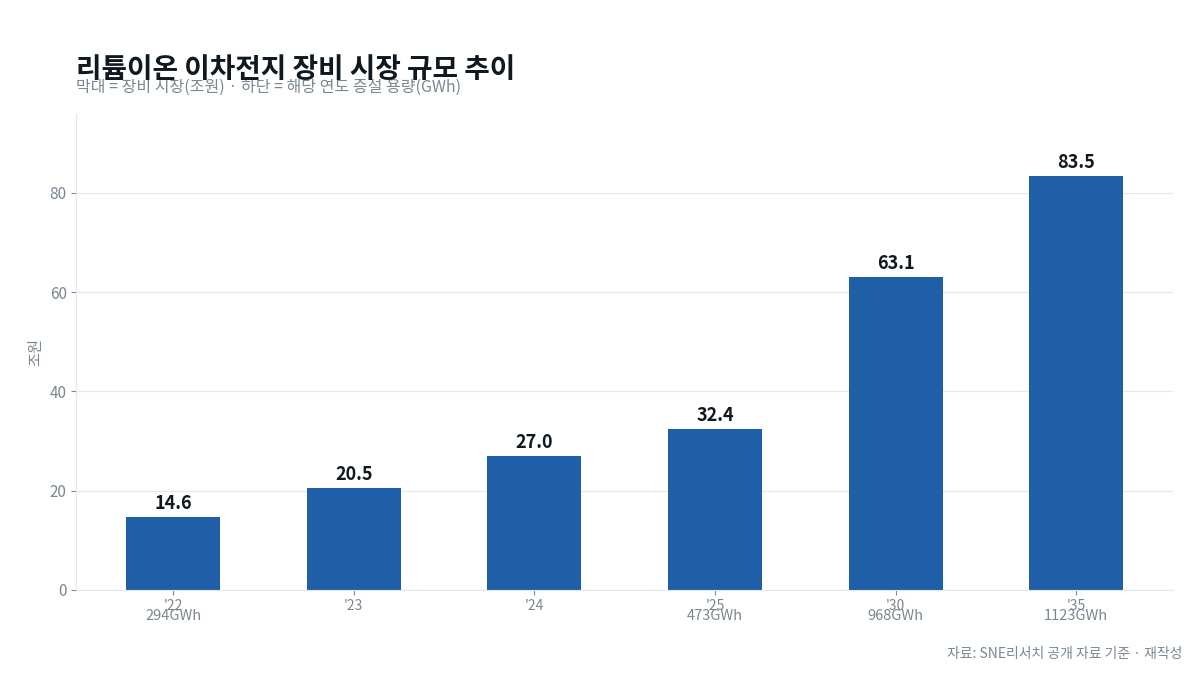
SNE Research projected the lithium-battery equipment market at KRW 63.1 trillion (USD 50.5 billion) by 2030 — roughly 3x the KRW 20.5 trillion recorded in 2023. Over the same period, annual capacity additions were presented as 294GWh (2022), 473GWh (2025), and 968GWh (2030). Regional share by 2035 was presented as China 38%, Europe 31%, and the US 26%. Separately, Korea Institute of Machinery & Materials (KIMM) data cited elsewhere presented KRW 14.5 trillion (2022), KRW 17.0 trillion (2023), and roughly KRW 50.0 trillion by 2030 (14% average annual growth), naming dry-electrode processing and solid-state batteries as next-generation core technologies. The roughly KRW 13.0 trillion gap between the two figures for the same year is grounds for avoiding reliance on a single forecast when setting a project plan.
On the solid-state side, CATL has planned to build a small pilot line by 2027. Its current technology readiness level (TRL) is reported at 4 out of a possible 9, with a 2027 target of level 7–8. Its mass-production target is 2030, currently at the 20Ah-class sample-fabrication stage. CATL’s chairman has stated that internal alignment within the lab sample-preparation process is still loose. From an equipment perspective, this statement reads not as a chemistry problem but as a lamination-alignment and pressure-uniformity problem.
Equipment Perspective Impact Analysis
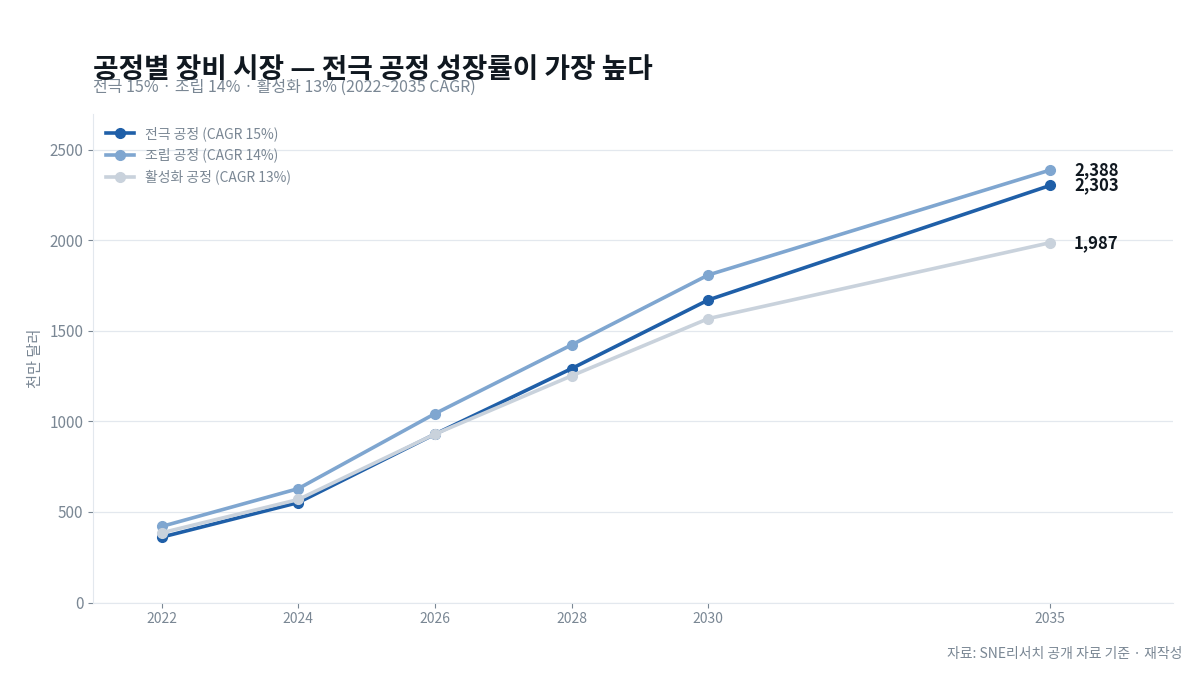
By process, electrode-process equipment shows an average growth rate of 15%, higher than assembly’s 14% and formation’s 13%. In absolute scale, the assembly process leads, but electrode-process equipment is growing fastest. Combined with the fact that the electrode process is the direct target of the dry-electrode transition, the 2-percentage-point growth-rate gap is reasonably read not as market expansion but as demand for process re-design.
First, the dominant load path shifts from tension to compression. In a wet line, the dominant load is web tension and drying-oven heat deformation, oriented horizontally with a comparatively low magnitude. In a dry roll press, vertical compression load dominates, and the frame must be re-designed around a C-frame or closed-section structure that suppresses deflection.
Second, the object of precision management moves from the roll itself to numerical values. What determines the outcome in the constant-pressure pressing process is not the gap value itself but upper-lower plate flatness. The less flat the plates, the greater the thickness deviation as pressing force rises.
Third, the safety-factor check must be split into two. Strength-based safety factor under a static load, and fatigue safety factor against repeated pressing, are managed separately. A dry line is more likely to be governed by the latter (an estimate — based on the process characteristic of the pressure cycle repeating constantly).
Spec Comparison Table
| Item | Wet coating line | Dry electrode / solid-state pressing |
|---|---|---|
| Dominant load | Web tension (N unit, horizontal) | Compression load (kN unit, vertical) |
| Frame requirement | Suppress vibration/thermal deformation | Bending rigidity, suppress deflection |
| Critical tolerance | Roll runout/roundness (mm) | Plate flatness (mm/width) |
| Thermal burden | Dominated by drying-oven heat | Relatively low |
| Public spec | — | Pressing force / flatness rating undisclosed |
Pressing force, flatness tolerance, and roll-crown correction values remain undisclosed in public materials. Field measurement and re-confirmation are required.
Supply Structure Reference
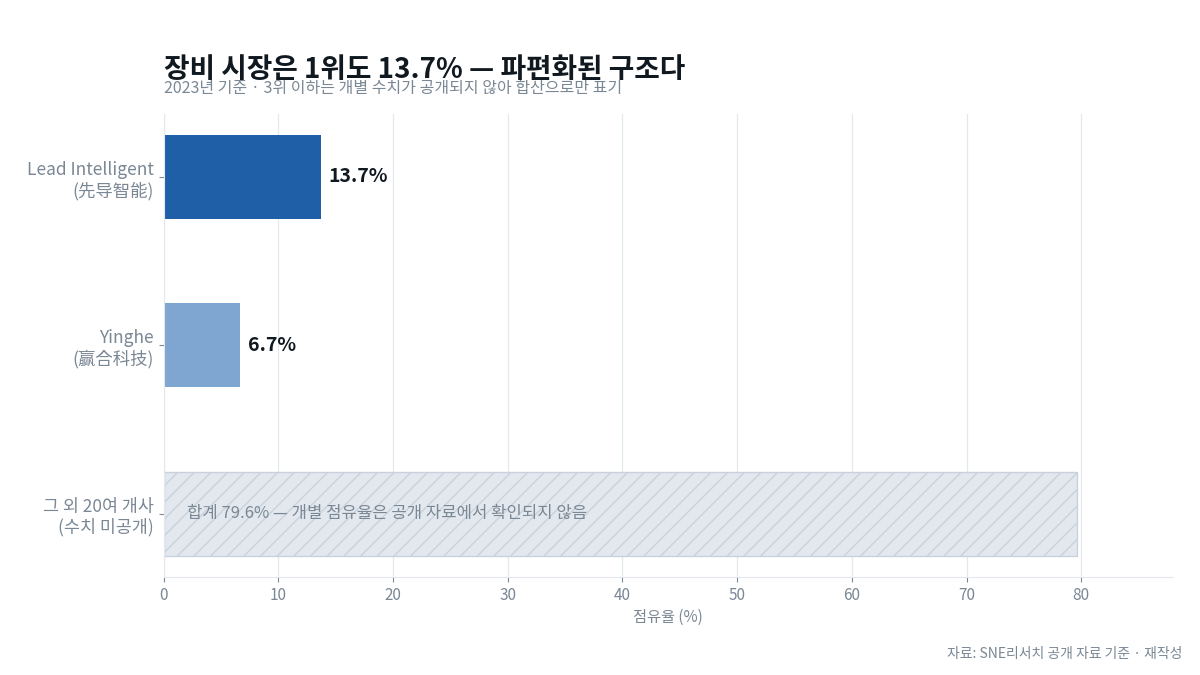
As of 2023, the #1 equipment maker held 13.7% share and #2 held 6.7%. Individual shares for the remaining 20+ makers below #3 are not disclosed in public materials. That the top two combined barely clear 20% means no standardized dominant design yet exists. From a design standpoint, this is a condition under which interface specs must be re-drawn for each ordering customer’s specification every time — and is also the reason the payoff from in-house standardization is that much larger.
Shop-notes
An alternative mechanism — a four-point hydraulic-cylinder pressing scheme — was reviewed but not adopted. The reason: pressure-synchronization deviation between cylinders translates directly into flatness, and the error source moves outside the mechanism (into the hydraulic circuit) where the designer cannot control it. Resolving it through frame rigidity keeps the variable within controllable bounds.
Machinability note: an open-section welded frame is favorable for rigidity but leaves post-weld distortion. Pressing-face machining must always be done as a final finishing pass after stress relief. Whether a large surface-grinding machine is available governs the lead time, so this should be confirmed early in the design.
Design Reflection Checklist
- Was the pressing-part frame re-examined as a compression-dominant load?
- Were strength-based safety factor and fatigue safety factor calculated separately?
- Was plate flatness specified on a per-width basis (mm/width)?
- Was the weld frame’s stress-relief process noted on the drawing?
- Was the unconfirmed pressing-force spec registered as a field-measurement item?
One-Line Summary
The mechanical substance of the dry-electrode/solid-state transition is not a shorter process but stronger vertical compression and tighter flatness tolerance — frame-rigidity design is the task that comes first.