Core News Facts Summary
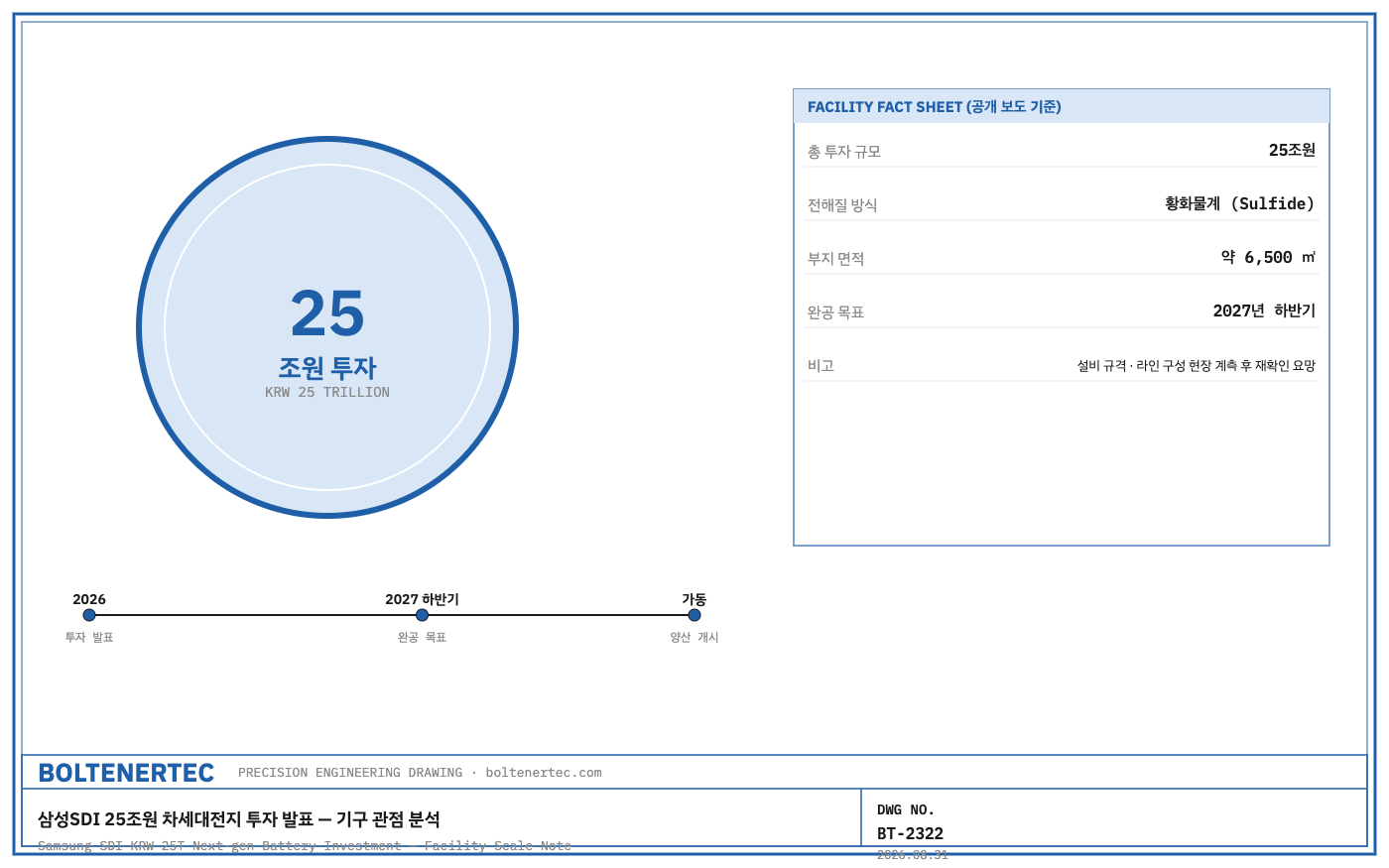
In August 2026, Samsung SDI disclosed a plan to invest a total of ₩25 trillion at its Ulsan and Cheonan sites over 2026–2040. ₩16 trillion is allocated to the Ulsan plant to build production lines for three chemistries: solid-state batteries, ESS-oriented LFP batteries, and sodium-ion batteries. ₩9 trillion will be invested at the Cheonan site, to be operated as a technology development and verification center. At the Suwon R&D center, a 6,500 m² pilot production line has already been built, completing material and process verification multiple times.
The target energy density is above 900 Wh/L, applying a sulfide-based solid electrolyte. Sample cells have been delivered to automakers and humanoid-robot companies, and according to separate reporting, the mass-production target is the second half of 2027. In addition, Samsung SDI has set a target to become the first domestic battery cell maker to mass-produce solid-state batteries in the second half of 2027 (per ZDNet Korea), and the Cheonan site has already been operating a dry-electrode pilot line called ‘DryEV’ to verify the process (per THE ELEC).
Mechanism-Perspective Impact Analysis
To sequentially produce three chemistries — solid-state, LFP, and sodium-ion — at a single site, equipment flexibility becomes the key variable. Since electrode slurry viscosity and coating thickness differ by chemistry, coater slot-die head changeover time governs line uptime. Calender roll gap must also be readjusted to match the target density for each chemistry, and the shorter this readjustment cycle, the higher the effective productivity of a multi-chemistry line. Solid-state batteries add a pressurized sintering and stacking process absent from liquid-electrolyte processes, so how a batch-type process is spliced into an existing R2R line is the real design challenge.
Whether the verification results from the Suwon pilot line (6,500 m²) will be directly reflected in the Ulsan mass-production line’s equipment specifications, or whether scale-up design changes will occur between pilot and mass production, cannot be confirmed from currently disclosed materials. In particular, if the dry-electrode process being verified at Cheonan’s DryEV is transferred to the Ulsan mass-production line, the equipment layout of the coater-to-calender section could itself be redesigned compared to the existing wet-slurry coating line (estimated). However, the transfer timing and the scope of applicable chemistries are not confirmed in publicly available material.
The dry-electrode process forms the active material into a sheet by a rolling method, unlike the wet process, which passes the slurry coating through a hot-air drying oven. From an R2R line perspective, the drying zone and solvent-recovery equipment at the coating section are eliminated, while the requirements for pressing uniformity and slitting alignment precision of the rolling rolls increase. How the process data obtained from the Cheonan DryEV pilot will be specifically reflected in the coater and calender equipment specifications of the Ulsan mass-production line is not confirmed in currently available material.
In addition, detailed metrics such as production capacity (GWh), employment plans, and site area are also not included in this announcement and require separate confirmation (confirmation needed). Also, because sodium-ion batteries have different active-material particle characteristics from lithium-based chemistries, the slurry mixing ratio and coater application speed conditions for the mixing and coating processes must be separately optimized; the equipment specifications for the dedicated sodium-ion line were not specifically disclosed in this announcement (confirmation needed).
Spec Comparison Table
| Category | Disclosed Figure | Note |
|---|---|---|
| Total investment scale | ₩25 trillion (2026–2040) | Ulsan ₩16T + Cheonan ₩9T |
| Target energy density | 900 Wh/L or above | Applying sulfide-based solid electrolyte |
| Pilot line scale | 6,500 m² (Suwon R&D center) | Material/process verification completed multiple times |
| Production chemistries | Solid-state · LFP (ESS-oriented) · sodium-ion | Built simultaneously at Ulsan plant |
| Mass-production target | 2H 2027 | Based on separate reporting |
| Solid-state commercialization target | First among domestic cell makers (2H 2027) | Per ZDNet Korea |
| Cheonan pilot line | Dry-electrode line ‘DryEV’ operating | Per THE ELEC |
One-Line Summary
The real crux of Samsung SDI’s ₩25 trillion investment is not the scale of capital but the equipment changeover time to switch between solid-state, LFP, and sodium-ion on a single line, and the next point to confirm is whether the Suwon pilot’s verified values carry directly over to the Ulsan mass-production specifications.
Checklist
- Confirm whether chemistry-specific measured coater slot-die head changeover times are available
- Establish a benchmark cycle time for calender roll gap readjustment
- Track disclosure of how the solid-state pressurized-sintering process links with the existing R2R line
- Follow up on whether equipment specifications change in the pilot (6,500 m²)-to-mass-production scale-up
- Confirm whether and to what chemistry scope the Cheonan DryEV dry-electrode process transfers to the Ulsan mass-production line
- Separately confirm production capacity (GWh), employment plans, and site area via disclosure materials