SFA Nexcell (formerly CIS) is expanding its position in the battery-equipment market, centered on electrode-process equipment.
SFA Nexcell was founded in 2002 as CIS Co., Ltd. and listed on KOSDAQ in 2017. In March 2023, its largest shareholder changed from GBE Holdings to SFA Co., Ltd., bringing it into the SFA Group. On June 11, 2026, the company formally changed its name from CIS to SFA Nexcell Co., Ltd. (source: Namuwiki, citing disclosures). It expanded production capacity through a 2021 subsidiary, a 2022 U.S. subsidiary, and its 3rd and 6th plants completed in 2023–2024 (same source).
Key News Facts
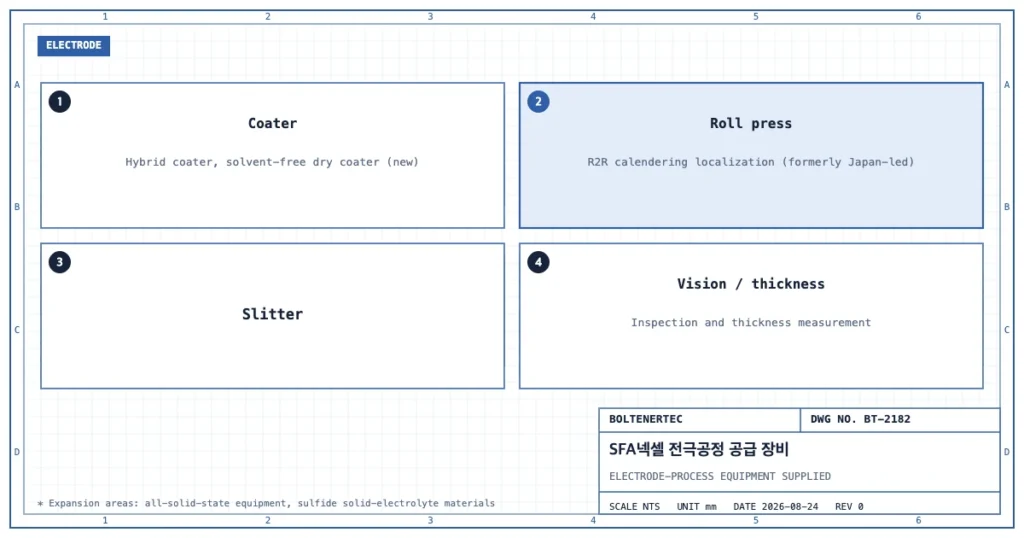
The electrode process consists of coating, calendering, and slitting stages. SFA Nexcell supplies coaters, roll presses, slitters, and vision-inspection/thickness-measurement equipment. It has been reported that the company localized roll-to-roll calendering technology previously led by Japanese firms. It has developed a hybrid coater and a solvent-free dry coater that reduce space and energy burden compared with wet processes, and is conducting mass-production testing with global customers. The company is also expanding into all-solid-state battery equipment and sulfide-based solid-electrolyte material research.
According to Digital Daily (Jun 18, 2026), SFA Nexcell has signed an NDA with a battery cell maker pursuing a large-scale European production project, and the two sides are discussing electrode-process equipment supply and cooperation on next-generation battery process solutions (source: Digital Daily). The cell maker is reportedly expanding capacity with the goal of entering global automaker supply chains; the specific company name and deal size were not disclosed (same source).
Mechanical-Design Impact Analysis
When a single supplier covers all three electrode-process stages (coating–calendering–slitting), that one vendor can integrate the interface design between units (tension zones, web-transport speed synchronization), which is advantageous for securing consistency of the load-transfer path across the entire line. However, bundling three units to the same specification can mean that a specification change in one unit requires a full re-setting of tension-control values for downstream units (estimated; basis: the industry convention that roll-to-roll lines typically have interlocked tension control between units, so an upstream process change propagates downstream). Separate from the rise in the localization rate of components, the localization of roll-to-roll calendering technology means that whether the supply partner has crown-machining and bearing-precision management capability actually governs real quality deviation. Specific specifications for the hybrid/dry coaters (coating-thickness tolerance, drying/pressing load) are undisclosed.
If the European supply deal materializes, it may require design changes to meet local European electrical/mechanical equipment certification (such as CE marking) and shipping/installation standards that differ from domestic requirements (general principle; specific certification requirements are unconfirmed). Whether the discussed expansion into dry-electrode and solid-state battery processes is directly tied to this NDA is also unconfirmed at this time.
Spec Comparison Table
An alternative is to split orders for the coating, calendering, and slitting processes across multiple vendors, but this shifts the burden of integrating interface specs (tension profile, web alignment standard) onto the buyer, which is reportedly why single-vendor integrated supply has become more common in the industry (general industry understanding; actual vendor-selection approach varies by project and buyer policy). Roll-to-roll calendering rolls are typically crown-machined to control cross-web thickness deviation at the micron level as an industry practice, though SFA Nexcell’s actual tolerance figures are undisclosed.
| Item | Details |
|---|---|
| Equipment supplied | Coater, roll press, slitter, vision inspection/thickness measurement |
| Key transition technology | Roll-to-roll calendering localization (previously Japan-led area) |
| New processes | Hybrid coater, solvent-free dry coater |
| Expansion areas | All-solid-state battery equipment, sulfide-based solid-electrolyte materials |
| Specific specs (tolerance/load) | Undisclosed |
One-line summary: SFA Nexcell’s integrated supply of the three electrode processes is advantageous for load-transfer-path consistency across the line, but the burden of upstream process changes cascading into downstream tension control remains.
Design Reflection Checklist
- When adopting single-vendor integrated supply, pre-simulate how upstream (coating) spec changes affect downstream (calendering/slitting) tension control
- For European-bound supply, pre-verify local certification requirements such as CE marking (unconfirmed)
- Re-review load and alignment standards relative to existing wet coaters when expanding into dry-electrode/solid-state processes