Material investment disclosures, read from an equipment perspective, are a notice of the scope of electrode-line redesign.
Key News Facts
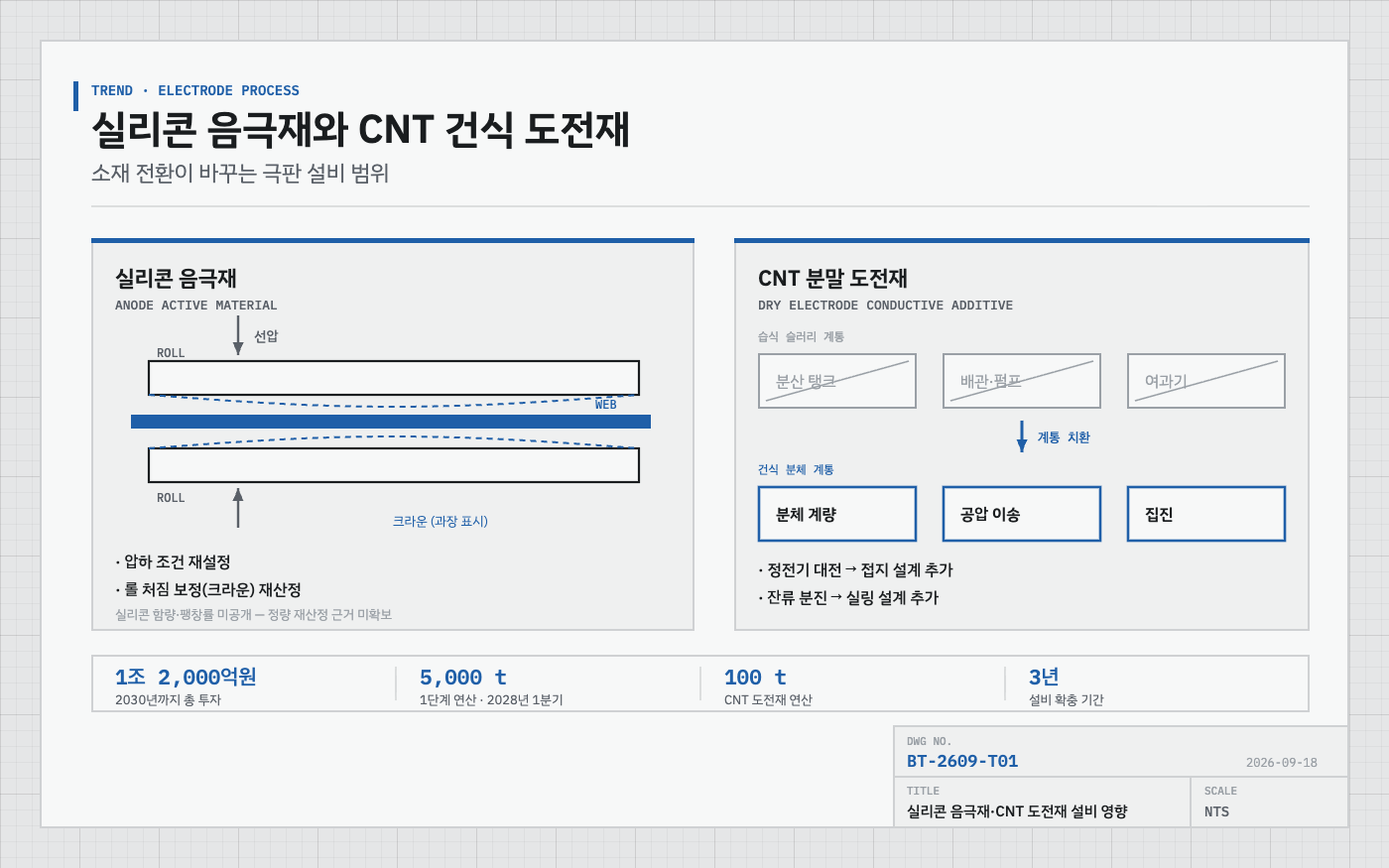
HS Hyosung Energy Solutions Korea, a joint venture between HS Hyosung Group and Belgium’s Umicore, signed an investment agreement with Ulsan City on September 14, 2026 to build a new silicon anode material production plant. The company will invest a total of KRW 1.2 trillion in three phases through 2030 at the Ulsan/Mipo National Industrial Complex, with Phase 1 investing KRW 300 billion to build a silicon anode plant (MPK-1) with an annual capacity of 5,000 tons by Q1 2028 (The Elec, reported 2026-09-14).
Innoplaztech unveiled a plan to mass-produce 100 tons per year of CNT (carbon nanotube) conductive material at the K-Battery Show 2026 materials/parts/equipment conference held at KINTEX in Ilsan, Gyeonggi Province on September 9, 2026. Premised on the fact that conventional dispersion-type CNT conductive materials are difficult to apply in solvent-free dry electrode manufacturing processes, the company disperses CNT in powder form using its own plasma technology. Production equipment will be expanded over the next three years starting next year (The Elec, reported 2026-09-09).
Mechanism-Perspective Impact Analysis
The two cases involve different materials, but they pose the same type of question to electrode-process equipment. When the active material and conductive material change, up to which unit of the electrode line becomes subject to redesign?
For the silicon-based anode material, the calendering process is the primary review target. If the active material’s hardness and compression behavior change, the electrode density obtained at the same linear pressure changes, and the pressing conditions needed to meet the target density must be reset. Since a change in linear pressure also changes the roll deflection, the roll crown correction amount also becomes subject to recalculation. However, neither report discloses the silicon content or expansion ratio figures. Therefore, no quantitative basis for recalculating the pressing amount or crown correction is currently available, and only the direction that resetting is necessary is confirmed.
For the powder-form CNT conductive material, the equipment impact is more direct. The slurry system of a wet line — dispersion tank, piping, transfer pump, filter — is replaced in the dry process by a powder metering system, pneumatic conveying, and dust collection system. This is not a matter of replacing a single unit; the entire system changes. Since powder handling adds electrostatic charging and residual dust management, grounding design and sealing design shift onto the mechanical engineering side. Dust-work zone management standards under the Occupational Safety and Health Act must also be reflected in advance at the line layout stage.
What an equipment company should check first is not the investment amount but the Phase-1 startup timing. If Phase 1 startup is Q1 2028, the equipment specification finalization point comes earlier than that. Since there is a window in which specifications must be set before material property data is disclosed, it is lower-risk in terms of design-change risk to design the pressing-force margin and roll stiffness to an upper-bound standard.
Spec Comparison Table
| Item | HS Hyosung–Umicore Silicon Anode Material | Innoplaztech CNT Conductive Material |
|---|---|---|
| Announcement date | 2026-09-14 | 2026-09-09 |
| Entity | HS Hyosung Energy Solutions Korea (joint venture) | Innoplaztech |
| Total investment | KRW 1.2 trillion through 2030, 3 phases | Equipment expansion over 3 years starting next year (amount undisclosed) |
| Phase 1 target | KRW 300 billion, annual capacity 5,000t by Q1 2028 (MPK-1) | Annual capacity 100t |
| Location | Ulsan/Mipo National Industrial Complex | Undisclosed |
| Position in process | Anode active material | Conductive material (powder) for dry electrodes |
| Equipment impact axis | Calendering pressing conditions / roll crown recalculation | Slurry system → replaced by powder metering/conveying/dust collection system |
| Confirmation needed | Silicon content / expansion ratio undisclosed | Powder bulk density / dispersion degree undisclosed |
One-line summary: Silicon anode material puts calendering pressing conditions under review, while powder CNT conductive material puts the entire slurry system under review; both cases create a window in which equipment specifications must be finalized before material property figures are disclosed.