Key News Facts
SFA and LS Cable & System have begun sequential shipment of submarine-cable turntables to LS Cable’s plant in Virginia, US. Contract value approximately KRW 150.0 billion, with dozens of units to be supplied through the end of 2027. Equipment diameter exceeds 40m at maximum, fabricated domestically in split sections and assembled on-site.
ABACO/ABATEC has started operating a glass-substrate TGV (through-glass via) pilot laser line. Target substrate 515×510mm. Laser processing equipment: AXIUM AP-250K. Target processing speed: 10,000 holes/sec. Target tolerance: ≤5µm (disclosed target value).
According to a report from The Elec (August 11, 2026), the turntables being supplied have a confirmed load capacity of 10,000 tons, functioning to wind and store completed submarine cables while controlling tension and twist to prevent damage during downstream transfer processes (source: The Elec). SFA previously supplied a 3,000-ton VCV (vertical connection vault) tower to LS Cable’s Donghae site, indicating this order builds on prior track record in large industrial equipment (same source). The contract period was confirmed as Q4 2025 through Q1 2026 (same source). According to a Newspim report (August 11, 2026), ABACO/ABATEC’s TGV pilot line integrates laser processing, alkaline wet etching, physical vapor deposition (PVD)/hybrid seed-layer deposition, and automated optical inspection (AOI) into a continuous process (source: Newspim). The target is to complete laser-processed samples by 2026, with expansion to via filling and planarization processes planned for 2027 (same source).
Mechanism-Perspective Impact Analysis
For turntables, load-bearing capacity and rotational stability are the key parameters. At the 40m-diameter scale, self-weight deflection and eccentric loading govern rotational precision, and the split-fabrication/on-site-assembly method itself requires rigidity management at the field joints.
TGV equipment sits on the opposite axis of the problem. The core issue is not load but positional repeatability — maintaining 5µm tolerance at a processing speed of 10,000 holes/sec requires thermal-deformation management across the stage transport system and the optical system to proceed in parallel.
The fact that the 10,000-ton turntable winds and stores completed cable while controlling tension and twist means drive-torque control must respond to a continuously changing moment of inertia as winding progresses, not just deflection from the cable’s own weight. The difference in inertia between the early winding stage (empty drum) and the late stage (fully loaded) is substantial, so without inverter-based torque compensation control, tension fluctuation could lead to cable damage (estimated; exact drive control method undisclosed). Separately, integrating laser processing, etching, deposition, and inspection into one continuous line means alignment error during substrate transfer between individual processes accumulates into downstream precision. In particular, after laser processing requiring tolerance under 5μm, a subsequent wet-etching step could further deform via-hole geometry due to the isotropic nature of the etchant, meaning final tolerance control cannot be guaranteed by the laser-processing spec alone (estimated; actual post-etch shape change undisclosed).
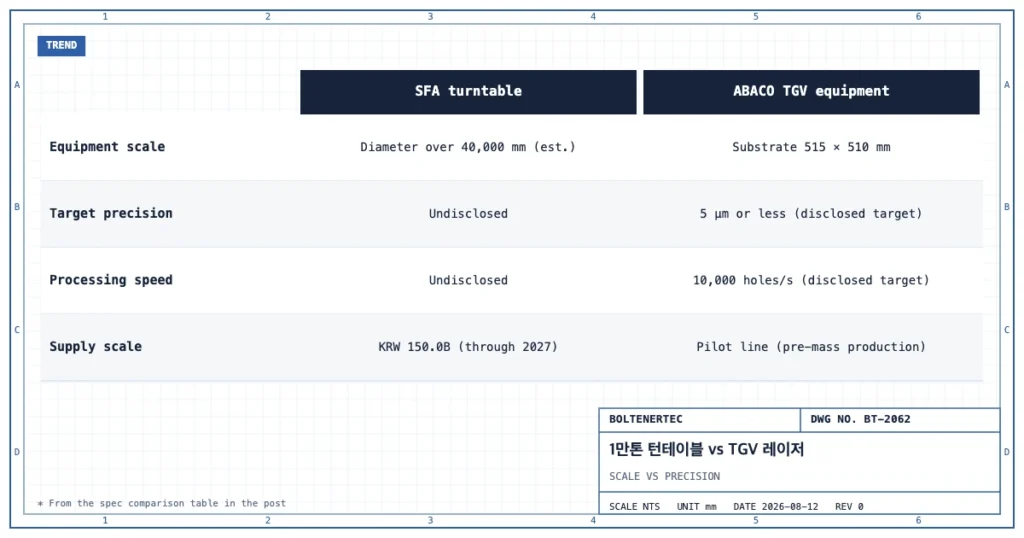
Spec Comparison Table
| Category | SFA Turntable | ABACO TGV Equipment |
|---|---|---|
| Equipment scale | Diameter exceeding 40,000mm (est.) | Substrate 515×510mm |
| Core control axis | Load / self-weight / eccentricity | Positional repeatability |
| Target precision | Undisclosed | ≤5µm (disclosed target) |
| Processing speed | Undisclosed | 10,000 holes/sec (disclosed target) |
| Supply scale | KRW 150.0 billion (through 2027) | Pilot line (pre-mass-production stage) |
Shop-notes
Options for inertia compensation on large winding equipment include a lower-cost, software-based approach that measures winding radius in real time to correct torque commands, versus a higher-cost, hardware-based approach that adds a dedicated inertia-compensation flywheel or damper. The former has a cost advantage with no added components but carries risk dependent on sensor reliability, while the latter requires greater upfront cost but maintains mechanical stability even in the event of sensor failure — for large-scale equipment like a 10,000-ton class turntable where failure losses are high, the latter may warrant parallel consideration (estimated).
Design Reflection Checklist
- Confirm whether inertia-compensation control (real-time winding-radius measurement based) is applied for the 10,000-ton turntable
- Measure actual via-hole geometry change after wet etching following TGV laser processing
- Pre-confirm field-joint stiffness management criteria for the split-manufacture/local-assembly approach
One-line summary: Even under the same label of “precision equipment,” a design that withstands self-weight and a design that repeats position are different problems.