Key News Facts
BOE is pursuing entry as a secondary supplier of OLED panels for a new iPad Air model expected in H1 next year. The target panel is 11-inch/13-inch, hybrid OLED, single-stack emission structure, LTPS TFT, 60Hz spec. Samsung Display remains the primary supplier.
Mechanism-Perspective Impact Analysis
The single-stack structure and the 60Hz de-specification aim at cost reduction, but the resulting reduction in panel thickness and rigidity raises the risk of substrate cracking and chipping during outer-lamination assembly with cover glass. In large-area cover-glass handling processes, managing vacuum-gripping pressure distribution at the pick-up and transfer stages becomes critical.
Subsequent reports indicate that BOE’s sample evaluation and approval decision is expected in November or December 2026, with the new iPad Air launch anticipated for the first half of 2027. Samsung Display, the primary supplier, is reportedly starting mass production at the end of 2026 or the start of 2027. BOE’s volume is expected to be modest at first, with some observers noting it could be limited to China’s domestic market or refurbished devices (reported by MacRumors, 2026-08-11, citing The Elec). The exact volume-split ratio has not been officially confirmed — confirmation needed.
If BOE’s volume is initially limited to a small quantity and specific channels (domestic China, refurbished devices), this also affects handling-equipment investment priorities. Large-area ultra-thin glass handling lines require separate validation of suction-pad layout and vacuum-pressure control by cell structure (single/dual stack), so at the initial low-volume stage, running a separate low-speed pilot line to accumulate yield — rather than sharing the existing Samsung Display line — is likely more favorable from an equipment-investment risk-management standpoint. A common approach is to consider dedicated transport/inspection equipment expansion once volume scales up (estimated to be after 2027). This description is based on general large-area glass handling design principles; BOE’s actual equipment investment plans are undisclosed.
For reference, The Elec has also reported that BOE is using this iPad Air entry as a foothold to pursue OLED panel supply for future MacBook models (reported in 2026, specific timing and models undisclosed). If true, handling-equipment validation experience for tablets could serve as a reference for designing large-area panel handling lines for notebooks, though this is not yet a confirmed plan and remains an estimate.
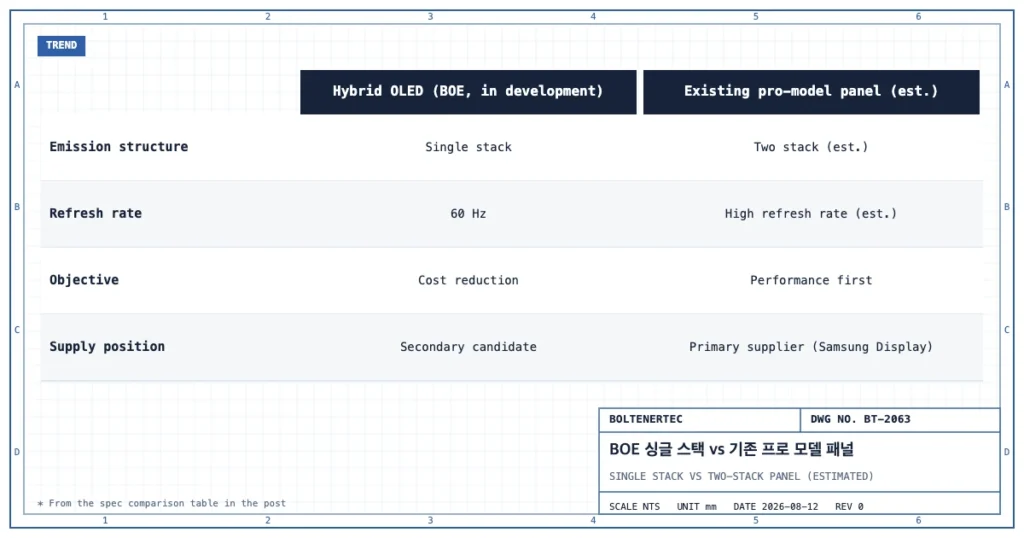
Spec Comparison Table
| Category | Hybrid OLED (BOE, under development) | Existing pro-model panel (est.) |
|---|---|---|
| Emission structure | Single stack | Tandem stack (est.) |
| Drive refresh rate | 60Hz | High refresh rate (est.) |
| Objective | Cost reduction | Performance priority |
| Supply position | Secondary candidate (seeking entry) | Primary supplier (Samsung Display) |
Shop-notes
for ultra-thin panel suction transport, there are two alternatives — keeping the suction-pad layout fixed while lowering vacuum pressure, or subdividing the suction pads themselves (more pads, lower pressure per pad). The former has lower retrofit cost but limited effect on suppressing local deflection, while the latter requires higher upfront investment but is more effective at reducing crack defect rates. A staged approach — the former during the initial low-volume stage, transitioning to the latter after mass-production scale-up — is reasonable from a safety-factor standpoint.
Design Reflection Checklist
- Check whether suction-pad spacing is managed separately by cell structure (single/dual stack)
- Check whether a transition plan exists between the initial low-volume pilot line and future scaled-up line equipment specifications
- Check whether vacuum grip pressure (ΔP) settings are recalculated when panel thickness changes
- Re-check volume allocation after BOE’s sample approval results (November–December 2026) are announced
One-line summary: BOE’s entry into iPad Air OLED is expected to be delayed to H1 2027 with limited initial volume, a signal that handling-equipment investment should be approached in stages.