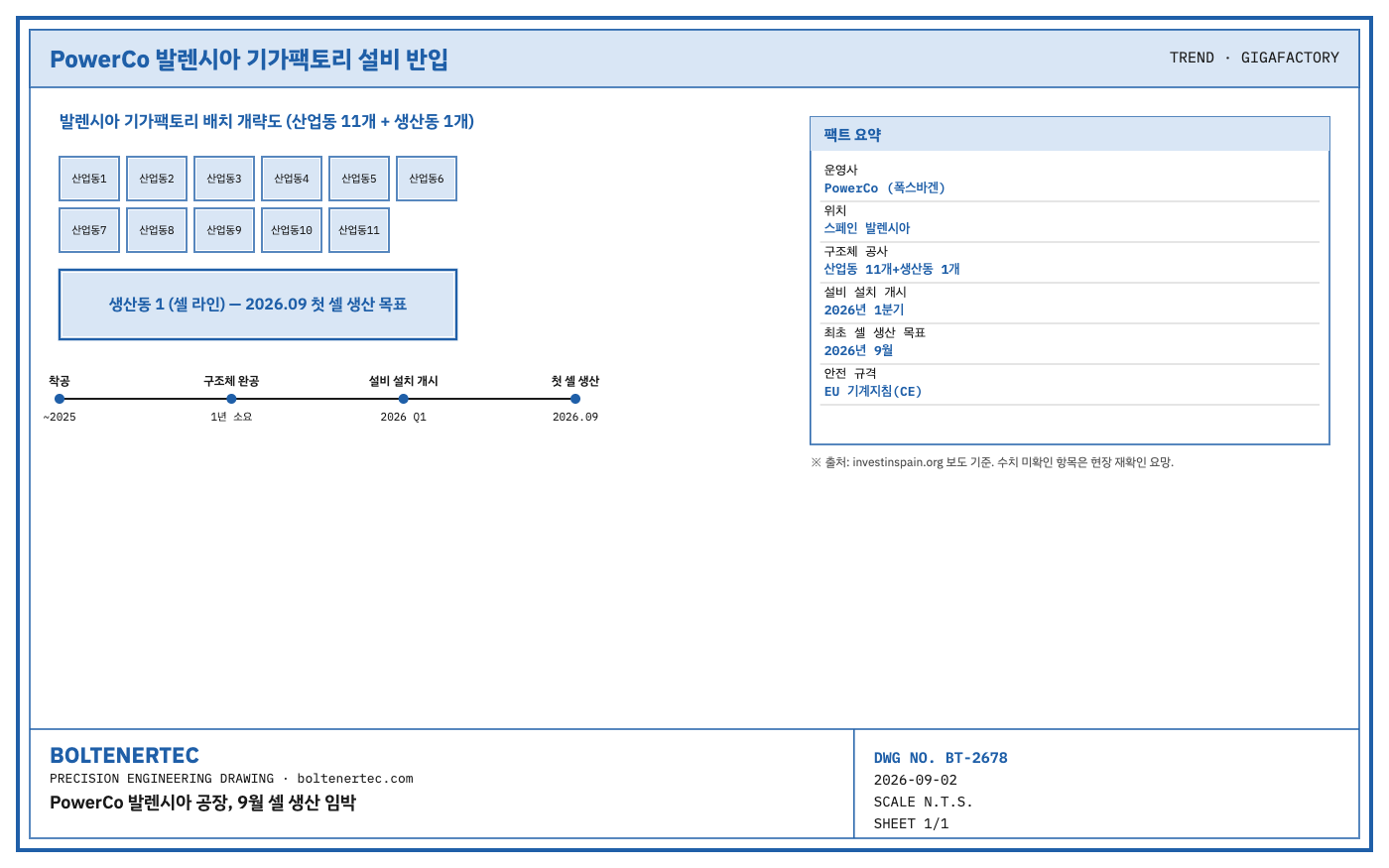
Volkswagen’s battery subsidiary PowerCo’s gigafactory in Valencia, Spain, is targeting first cell production in September 2026. About one year after groundbreaking, structural work was completed on 11 industrial buildings and 1 production building, and production-equipment installation began in Q1 2026 (per investinspain.org reporting).
Mechanism-Perspective Impact Analysis
New gigafactory equipment move-in typically proceeds sequentially through mixing-coating-press-slitting-winding-assembly lines, with cleanroom-grade compatibility of the inter-process transport equipment (conveyors, AGVs) being the key issue. There are differences in safety-device standards (pinch prevention, emergency stop) between European local regulations (EU Machinery Directive) and domestic KS standards, so equipment designed and built domestically often requires additional safety-cover and interlock redesign for CE certification before export to Europe. The key point from a mechanical-design perspective is that the shorter the window from equipment installation start to first cell production, the more this CE-certification design work must be finished in advance to prevent schedule delays.
Spec Comparison Table
| Item | Valencia Gigafactory (PowerCo) | Reference: Domestic Standard R2R Line |
|---|---|---|
| Structural construction | 11 industrial buildings + 1 production building, approx. 1 year | Varies by site |
| Production equipment installation start | Q1 2026 | – |
| First cell production target | September 2026 | – |
| Safety standard | EU Machinery Directive (CE) | Occupational Safety and Health Act / KS |
One-Line Summary
For the European gigafactory startup, the bottleneck is not the speed of equipment move-in but the schedule for safety-device redesign for CE certification.