Key News Fact Summary
CATL announced at a supplier conference in Ningde, Fujian Province, China on December 28, 2025 that it will deploy sodium-ion batteries at large scale throughout 2026.
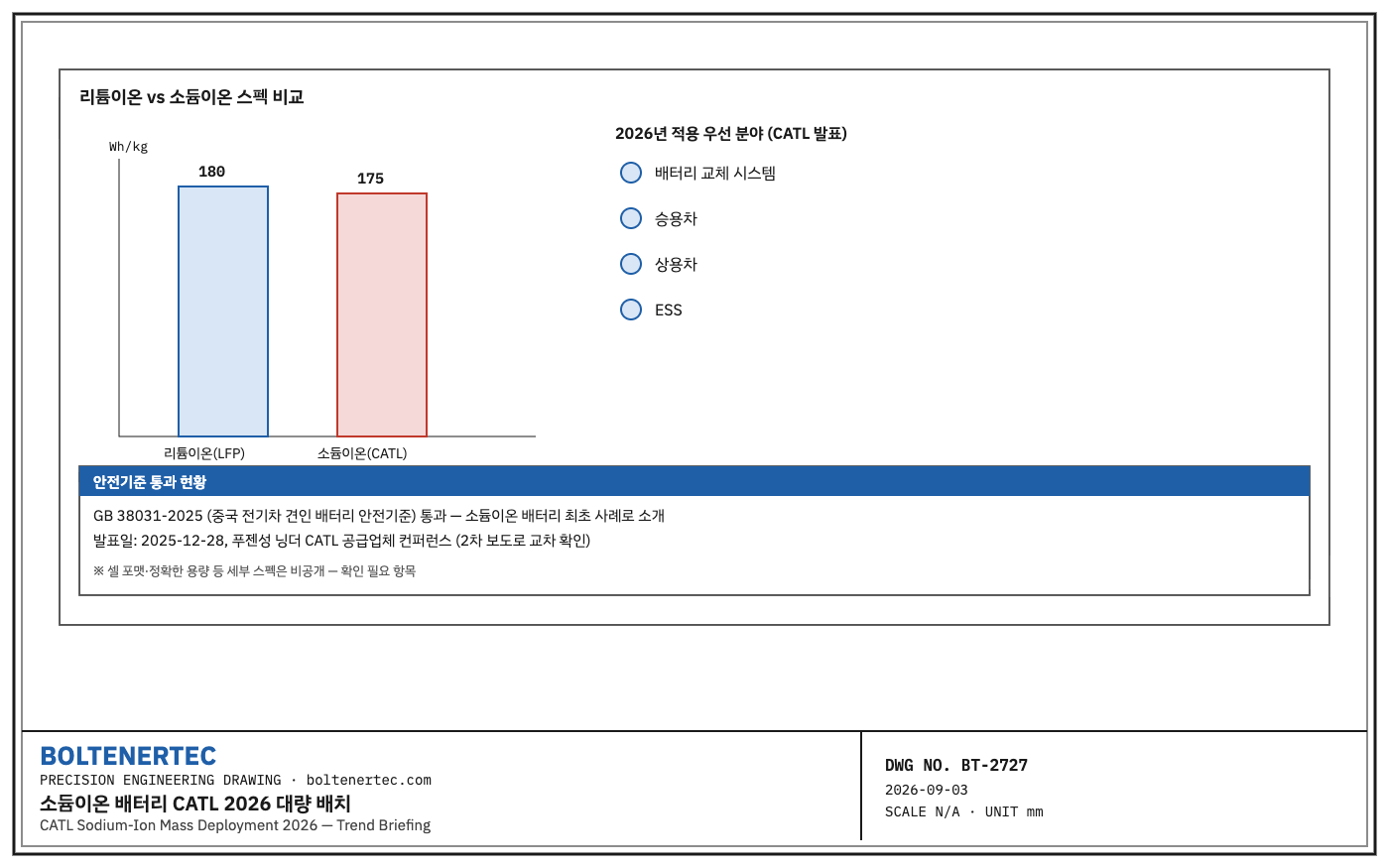
The application fields were specified as battery swapping systems, passenger vehicles, commercial vehicles, and energy storage systems (ESS).
The disclosed energy density is up to about 175 Wh/kg, and it was introduced as the first sodium-ion battery to pass China’s EV traction battery safety standard GB 38031-2025 (primary source: CATL supplier conference announcement, cross-confirmed through secondary reporting).
According to a CarNewsChina report (May 30, 2026), CATL recently signed a 60 GWh sodium-ion battery supply contract, described as the largest of its kind in the world (source: CarNewsChina). CATL Chief Scientist Wu Kai stated the same day that the “manufacturing bottleneck has been resolved,” reaffirming the 2026 mass-production plan (same source). The initial application targets are budget passenger cars and energy storage systems (ESS), with a high-density configuration under development aimed at a 600 km single-charge range (same source). The core competitive advantage was cited as sodium’s abundant raw-material availability and lower production cost compared with lithium (same source). CarNewsChina assessed that the contract could mark a commercialization turning point for the sodium-ion battery industry, noting growing interest from automakers and ESS companies as a hedge against lithium price volatility (same source).
Detailed specifications such as the exact cell format, capacity, and mass-production line location remain items requiring confirmation (undisclosed).
Mechanism-Perspective Impact Analysis
Unlike lithium-ion, sodium-ion cells can apply an aluminum current collector to the anode as well, resulting in different material stiffness and elongation compared to copper foil (Cu Foil).
This means the winding/stacking tension control parameters must be reset, and the tension profile of an existing lithium-ion line cannot be transplanted as-is.
Since the electrolyte also uses a sodium salt series instead of a lithium salt, there is a possibility that the chemically resistant components (gaskets, piping materials) of the electrolyte filling equipment will need to be reviewed (estimate; exact electrolyte composition undisclosed).
For mass deployment to actually occur, equipment flexibility to convert existing lithium-ion lines to dual-use for sodium-ion is key, which could also translate into dual-use line order opportunities for domestic equipment makers.
The phrase “manufacturing bottleneck has been resolved” implies there was a process issue limiting sodium-ion cell mass-production yield, but the report does not specify which process stage (electrode, assembly, or formation) the bottleneck occurred in (verification needed). Fulfilling a 60 GWh supply contract would likely require substantial equipment expansion or conversion relative to existing lithium-ion lines, but whether CATL will build new dedicated lines or convert existing lines for dual use has not been disclosed (undisclosed).
Shop-notes: When converting a lithium-ion line for dual sodium-ion use, there are two options: a low-cost retrofit that only replaces the winder’s tension-control software parameters, and a higher-cost retrofit that also replaces the slitting knife and roller surface treatment due to the current-collector material change (copper foil to aluminum foil). The former has lower upfront investment but retains a break (wire-snap) risk from aluminum foil’s lower tensile strength, while the latter requires greater investment but is more favorable for stable production yield — likely the more rational choice when fulfilling a 60 GWh-scale supply contract (estimated).
Spec Comparison Table
| Item | Lithium-Ion (LFP basis) | Sodium-Ion (CATL Announcement) |
|---|---|---|
| Energy Density | Approx. 160–180 Wh/kg | Up to 175 Wh/kg (announced value) |
| Anode Current Collector | Copper foil (Cu) | Aluminum foil (Al, estimated) |
| Safety Standard Compliance | Multiple models pass GB 38031-2025 | Passes GB 38031-2025 (introduced as first case) |
| Application Fields | EV/ESS broadly | Battery swap, commercial vehicles, ESS prioritized |
| Mass Production Timing | Already in mass production | Targeting large-scale deployment in 2026 |
One-Line Summary
CATL’s sodium-ion mass-deployment declaration is, before cell chemistry, a matter that first requires equipment re-verification of the winding tension and electrolyte filling systems.
Design Reflection Checklist
- Confirm the specific process stage (electrode, assembly, or formation) behind the “manufacturing bottleneck resolved” claim
- Re-review slitting knife and roller surface-treatment specs for aluminum-foil current collectors
- Confirm whether the approach will be retrofitting existing lithium-ion lines for dual use or building new dedicated lines