Key News Fact Summary
It has been tallied that a cumulative EUR 82 billion (approx. USD 96 billion) in gigafactory investment has been executed in Europe’s battery industry (primary source: industry investment tally data, cross-confirmed through secondary reporting).
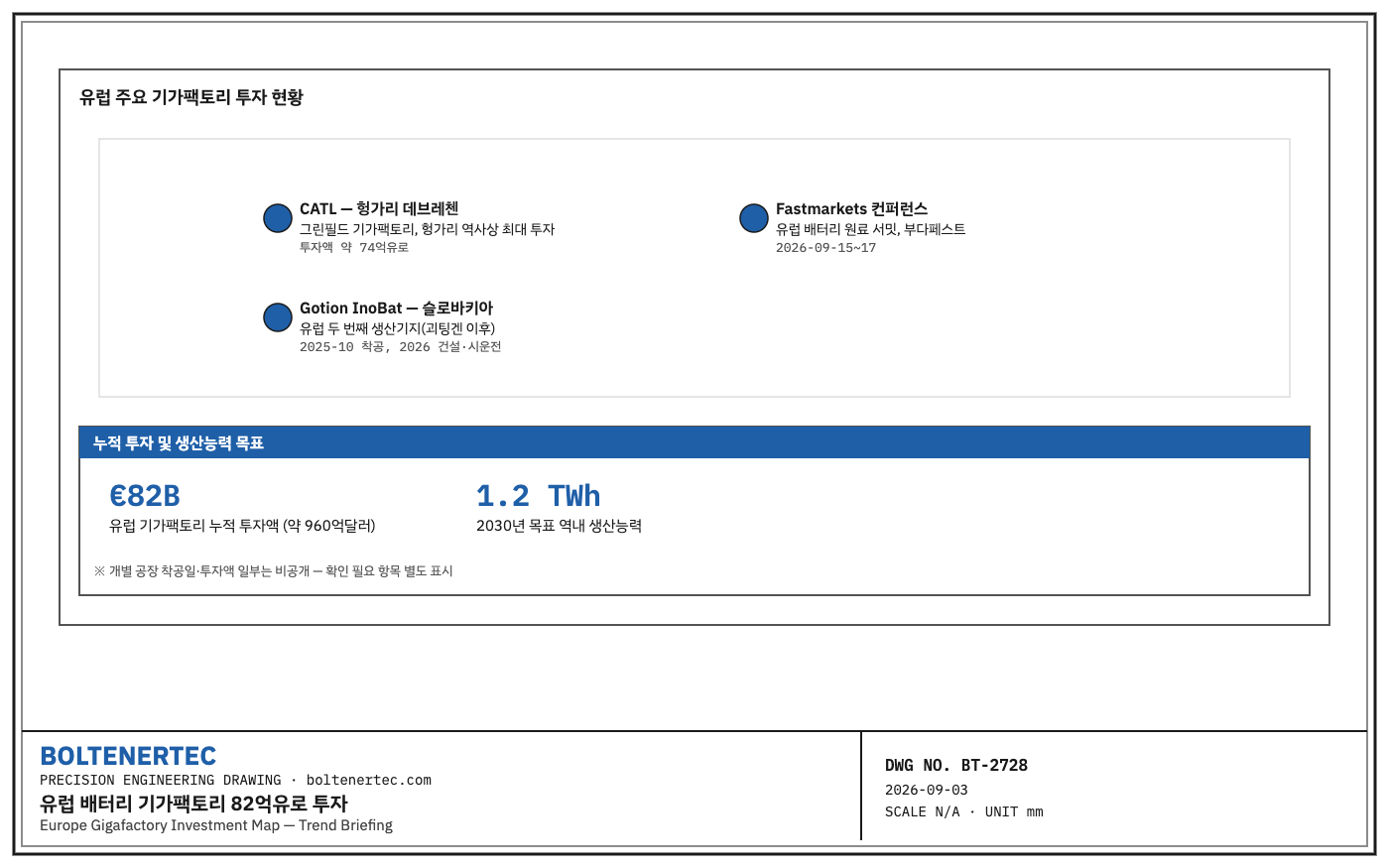
This investment is projected to bring Europe’s regional production capacity to a scale of 1.2 TWh by 2030.
CATL is building a EUR 7.4 billion greenfield gigafactory in Debrecen, Hungary, which was introduced as the largest investment case in Hungary’s history.
The Gotion InoBat Batteries (GIB) plant in Slovakia broke ground in October 2025 and, as of 2026, is in the construction and commissioning stage.
The Fastmarkets European Battery Raw Materials Conference will be held in Budapest, Hungary, September 15–17, bringing together lithium, nickel, cobalt, and graphite supply-chain stakeholders.
According to a CarNewsChina report (September 22, 2026), CATL’s Debrecen, Hungary plant entered trial production that day (source: CarNewsChina). The eventual target capacity is 100 GWh, with the current operating stage confirmed at 34 GWh (same source). The facility has been producing battery modules since autumn 2024, with cumulative output tallied at 537,000 units (same source). According to a report from the same outlet dated September 2, 2026, nine workers were found to have exceeded nickel exposure limits in the laser-cutting, winding, and cell-drying workshops in August 2026, prompting Hungary’s Hajdú-Bihar County government to temporarily suspend operations; the report also cited insufficient protective equipment and inadequate hazardous-waste labeling as environmental violations (source: CarNewsChina). Following safety and health improvement measures, the plant reportedly resumed trial production in September 2026 after confirmation from Hungarian authorities (same source).
Mechanism-Perspective Impact Analysis
When 1 TWh-class production capacity is concentrated in a single region, pressure to standardize core process equipment such as coaters, calenders, and winders increases.
From the equipment maker’s standpoint, since the same equipment specification must be repeatedly supplied to multiple plants with differing per-country power, water availability, and site conditions, design standardization and parts commonality become key to profitability.
New sites in Eastern Europe such as Hungary and Slovakia have relatively weaker equipment-transport logistics infrastructure compared to existing Western Europe, leaving frame stiffness design for R2R equipment transport and confirmation of local crane specifications as preceding tasks (re-confirmation required after field measurement).
For domestic equipment makers, this volume is an opportunity to expand overseas orders, but without a local maintenance response system, it can turn into a post-order risk.
The fact that nickel exposure occurred across laser-cutting, winding, and cell-drying processes suggests all three are processes with potential for dust or fine-particle generation. Laser cutting (notching) can generate metal dust during material cutting; the winding section can shed fine flakes during electrode slitting and winding; and the cell-drying process, involving high-temperature heat treatment, can generate volatile particles. However, the report only cites biomonitoring results (elevated nickel indicators) in workers, without specifying which process’s equipment was the specific source (verification needed).
Shop-notes: Options for reducing dust/fine-particle exposure include a lower-cost approach of installing local exhaust ventilation (LEV) near individual equipment, versus a higher-cost approach of enclosing the coater, winder, and drying-oven sections as a single chamber with negative-pressure ventilation. The former is easier to retrofit onto existing equipment but capture efficiency varies with worker position and airflow, while the latter requires greater upfront investment but offers more reliable dust capture, favoring long-term compliance with workplace-environment measurement standards under occupational safety law. Given the production-disruption cost of a shutdown, as seen in the Hungary case, the latter may be the more rational choice for new large-scale lines (estimated).
Spec Comparison Table
| Item | CATL Debrecen, Hungary | Gotion InoBat Slovakia |
|---|---|---|
| Investment Scale | Approx. EUR 7.4 billion | Confirmation needed (undisclosed) |
| Groundbreaking | Confirmation needed (undisclosed) | October 2025 |
| Current Status (2026) | Entered trial production (Sep 22, 2026; 34 GWh stage of 100 GWh target) | Construction/commissioning stage |
| Note | Largest investment in Hungary’s history | Europe’s second production base (after Göttingen) |
One-Line Summary
The real crux of Europe’s EUR 8.2 billion gigafactory investment is not cell technology but the equipment-transport and maintenance infrastructure gap at the new sites.
Design Reflection Checklist
- Identify the specific nickel-dust source by process (laser cutting, winding, cell drying) (verification needed)
- Evaluate local exhaust ventilation vs. sealed-chamber negative-pressure ventilation for new line designs
- Confirm applicable workplace dust-measurement standards under occupational safety law in advance