CATL has announced that it plans its first shipment of sodium-ion battery–based ESS products for September 2026, targeting gigawatt-hour (GWh)-scale shipment expansion by 2026. The industry’s typical explanation is that sodium-ion batteries have lower raw-material price volatility than lithium and relatively superior low-temperature performance.
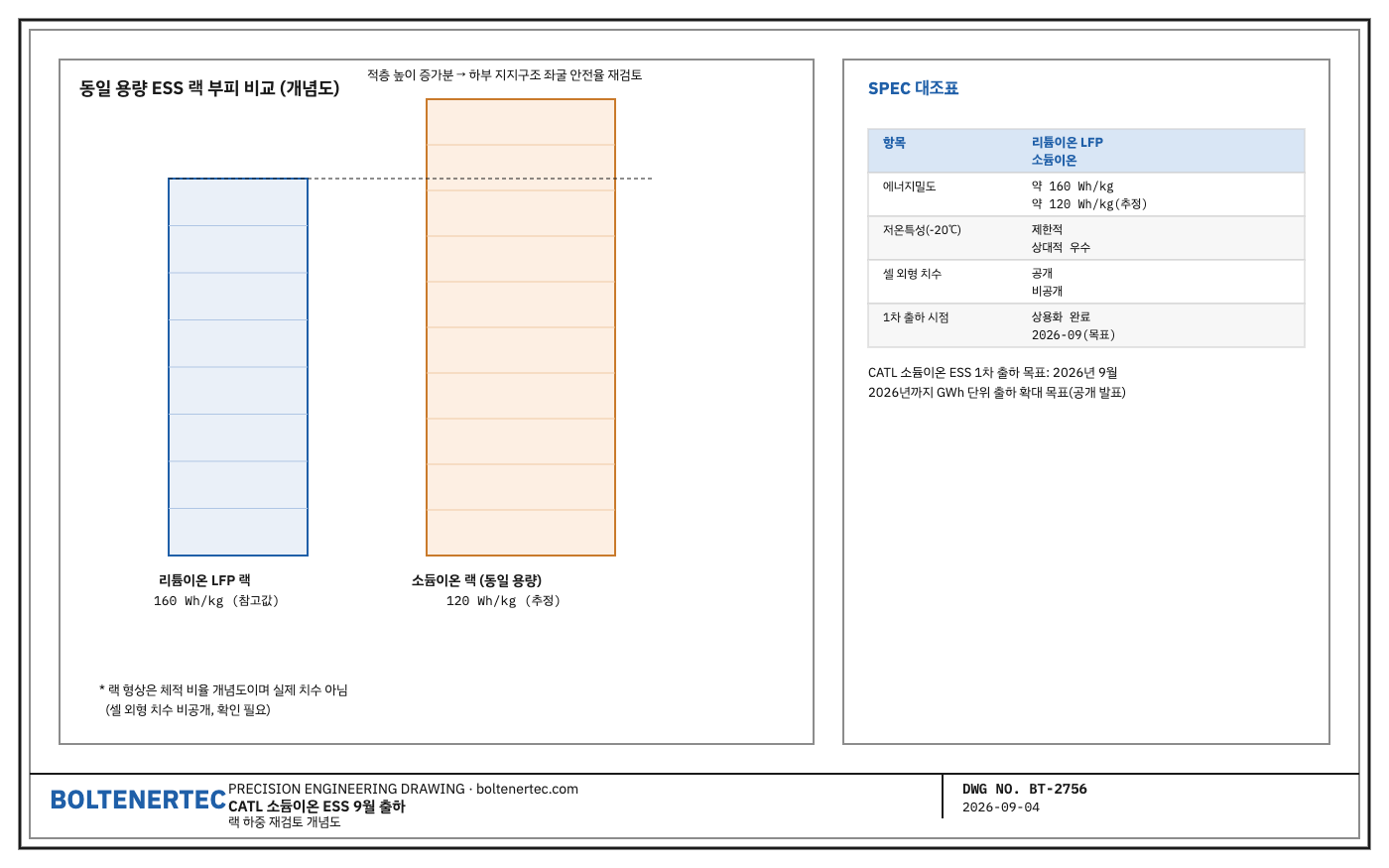
Mechanism-Perspective Impact Analysis
Sodium-ion cells have lower volumetric energy density than lithium-ion, so configuring an ESS rack of equal capacity requires an increased cell count and volume. This means the rack frame’s self-weight load increases, and if module stacking height also increases, the buckling safety factor of the lower support structure must be re-reviewed. If the cell outer dimension standard differs from existing lithium-ion pouch or prismatic formats, it becomes difficult to reuse the existing stacking jig and busbar fastening pitch as-is (confirmation needed: CATL’s sodium-ion ESS cell outer dimensions are undisclosed).
Spec Comparison Table
| Item | Lithium-Ion LFP ESS Cell (reference) | Sodium-Ion ESS Cell |
|---|---|---|
| Energy Density (Wh/kg) | Approx. 160 | Approx. 120 (estimate; typical industry range 100–140) |
| Low-Temperature Discharge Characteristic (-20℃) | Limited | Relatively superior (typical industry explanation) |
| Cell Outer Dimensions | Disclosed | Undisclosed |
| First Shipment Timing | Commercialization complete | September 2026 (target) |
One-Line Summary: With sodium-ion ESS’s first shipment scheduled for September, rack structure design must first account for the increased volume and self-weight relative to lithium-ion.