Cylindrical battery cell winding device patent US12424652B2 claims a device that aligns and winds the separator, cathode material, and anode material into a jelly roll. The applicant is Energy Tech Solution Co., Ltd., and it was registered in the U.S. on September 23, 2025 based on Korean priority (KR 10-2021-0157213) (U.S. Application No. 18/870,820). As demand for cylindrical 46φ cells increases, the alignment precision of winding equipment has emerged as a key variable determining the internal short-circuit defect rate of cells. A comparison of how this patent’s claim elements differ from a general winding equipment structure is needed.
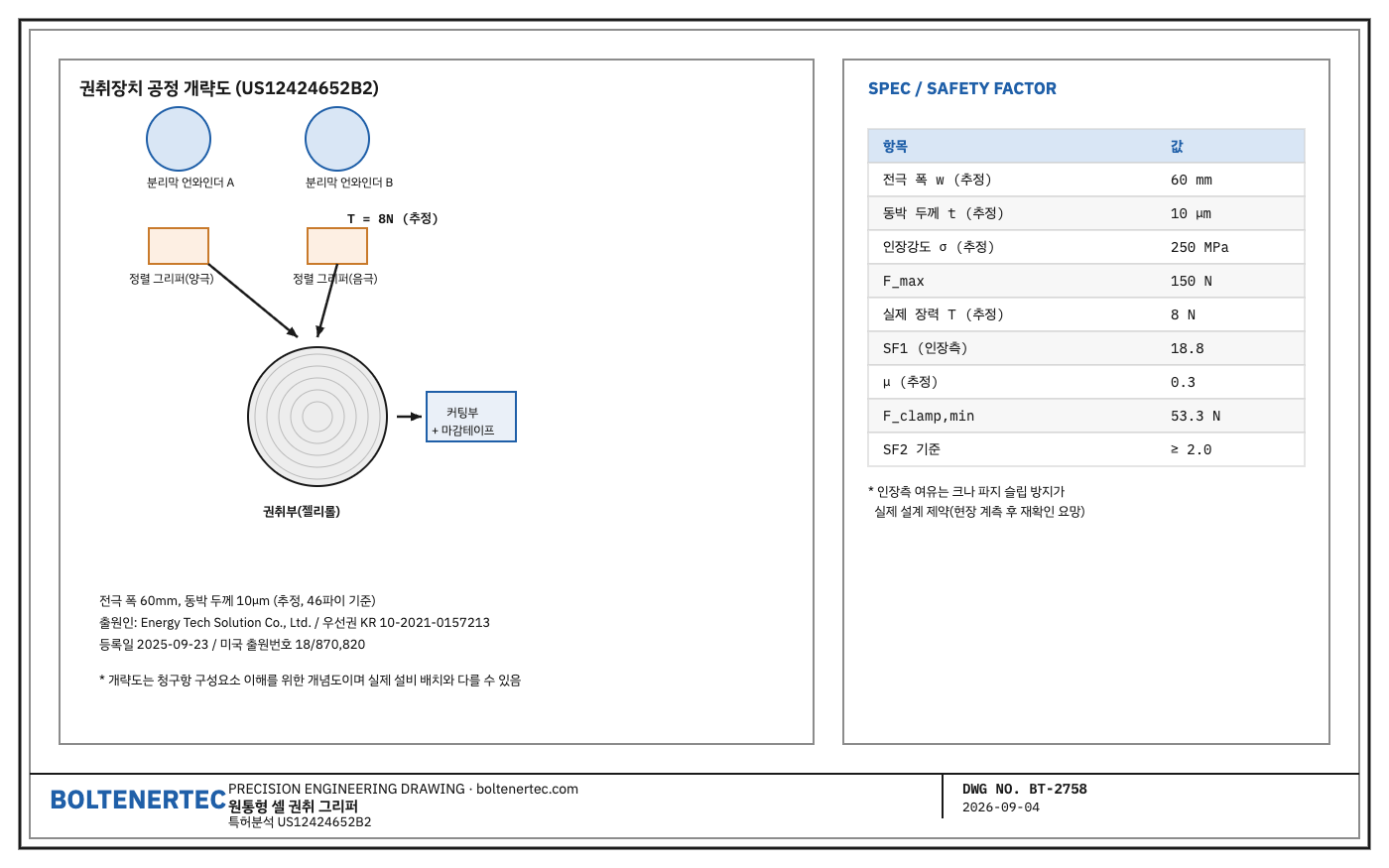
Claim Chart: Claim Elements vs. General Winding Equipment
| Patent Claim Element (US12424652B2) | General Cylindrical Cell Winding Equipment Configuration | Comparison Result |
|---|---|---|
| Pair of separator unwinding units | Upper/lower separator roll unwinder, 2 lines | Same as typical configuration |
| Pair of alignment units including grippers (pulls and aligns cut electrode ends) | Clamp or vacuum pad for electrode leading-edge alignment | The gripper-specific limitation is the claim’s differentiating point |
| Winding unit (forms jelly roll after stacking cathode/separator/anode) | Mandrel rotating winding core | Same as typical configuration |
| Cutting unit (fixes jelly roll via separator cutting and finishing tape application) | Separator cutter + finishing tape application unit | Same as typical configuration; the sequential combination is the claim point |
Calculation and Formula Verification: Alignment Gripper Clamping Force
The electrode current collector foil (anode copper foil) pulled by the alignment gripper is assumed to have thickness $t$ of 10 μm and width $w$ of 60 mm (estimate; typical electrode width for 46φ cells). The copper foil’s tensile strength $\sigma$ is assumed to be 250 MPa (estimate; typical range for electrodeposited copper foil is 200–400 MPa).
$$F_{max} = \sigma \times (w \times t) = 250 \times (60 \times 0.01) = 150\ \text{N}$$
Assuming the actual tensile tension $T$ during the alignment operation is 8 N (estimate; typical tension for thin-film electrode transport), the primary tensile-side safety factor is as follows. This very large value means that the actual constraint on alignment gripper design lies not in tensile rupture but in preventing grip slip.
$$SF_1 = \frac{F_{max}}{T} = \frac{150}{8} = 18.8$$
The secondary safety factor to prevent grip slip is verified via the required clamping force, applying a slip margin factor of 2.0 and a pad-to-copper-foil friction coefficient $\mu = 0.3$ (estimate).
$$F_{clamp,min} = \frac{T \times SF_{slip}}{\mu} = \frac{8 \times 2.0}{0.3} = 53.3\ \text{N}$$
If the gripper actuator’s rated clamping force is 53.3 N or more, the $SF_2 \geq 2.0$ criterion is satisfied (confirmation needed: the actuator rating is not stated in the patent specification; re-confirmation required after field measurement).
Practical Application (Shop-notes)
Vacuum suction alignment could be reviewed as an alternative mechanism, but since the copper foil thickness is as thin as about 10 μm, there is a risk of waviness occurring during suction, so it is not adopted in this design. This is presumed to also be why the claim specifies the gripper method. As a machinability note, the gripper jaw tip requires polyacetal (POM) or urethane coating to prevent copper foil damage, and since a coating thickness tolerance exceeding ±0.05 mm directly translates into alignment error, a polishing process must be added after precision injection molding.
- Compare gripper actuator rated clamping force against the SF2 calculated value
- Recalculate tensile safety factor separately for each anode/cathode foil thickness
- Set gripper jaw coating wear replacement cycle
- Design-around for the cutting-unit/finishing-tape sequential combination claim requires separate legal review (do not conclude on infringement)
One-Line Summary: The gripper alignment claim configuration of US12424652B2 shows that preventing grip slip, not tensile safety factor, is the design priority, and securing a gripper clamping force of 53.3 N or more per the $SF_2$ criterion is the key point.