In an energy storage system (ESS)1 tender, 10 GW and 40 GWh2 are two separate numbers: one says how hard the system can push power out, the other says how much energy it holds. A tender issued by NTPC Green Energy (NGEL) in India on 9 November is a clean example of the difference.
- GW is power at any instant; GWh is the energy stored. Divide 40 by 10 and you get 4 hours.
- The Indian tender covers seven blocks totalling 40.580 GWh of battery containers and power converters, with 15 years of maintenance bundled into the same contract.
- The same document uses “MWh” in two senses, because the energy a site delivers and the capacity printed on the batteries are not the same thing.
- Take one cell as roughly 1 kWh and 40 GWh means about 40 million cells, with the cells alone weighing over 220,000 t (estimate).
The Invitation for Bids (IFB)3 dated 9 November carries a long title: “Supply of Battery Containers and Grid-Forming PCS for 10 GW / 40 GWh BESS Projects.” A PCS4 converts the battery’s direct current to the grid’s alternating current. Grid-forming5 describes a PCS that sets its own voltage and frequency reference instead of only following the grid.
The schedule runs about a month. Bidding documents can be downloaded from 12 to 23 November, and queries close at the pre-bid conference on 24 November. Techno-commercial and price bids are both due by 15:00 IST on 8 December, and the techno-commercial envelopes are opened half an hour later.
NGEL is buying three things in one package: containerized batteries, the PCS, and a Long Term Service Agreement (LTSA)6 running 15 years from each project’s commissioning. The supplier only supervises erection and commissioning, and its scope stops at the PCS output terminals.
A 4,000 MWh qualifying threshold is a tenth of the tender volume, which looks low at first. The catch is in the detail: that record has to come from no more than 10 orders, and at least one order must have delivered 500 MWh or more to a single location. A supplier whose record is spread across many small sites does not qualify on that basis alone. Indian companies with at least 80 MWh of grid-connected experience get another route, provided they sign a joint undertaking with a manufacturer that meets clause 1.1.
The bid security also steps up with the capacity quoted: INR 50 crore up to 5 GWh, INR 100 crore from 5 to 10 GWh, and INR 200 crore above 10 GWh. The IFB lists the dollar equivalents as roughly 5.25, 10.51 and 21.01 million USD. The more blocks a bidder takes on, the larger the guarantee.
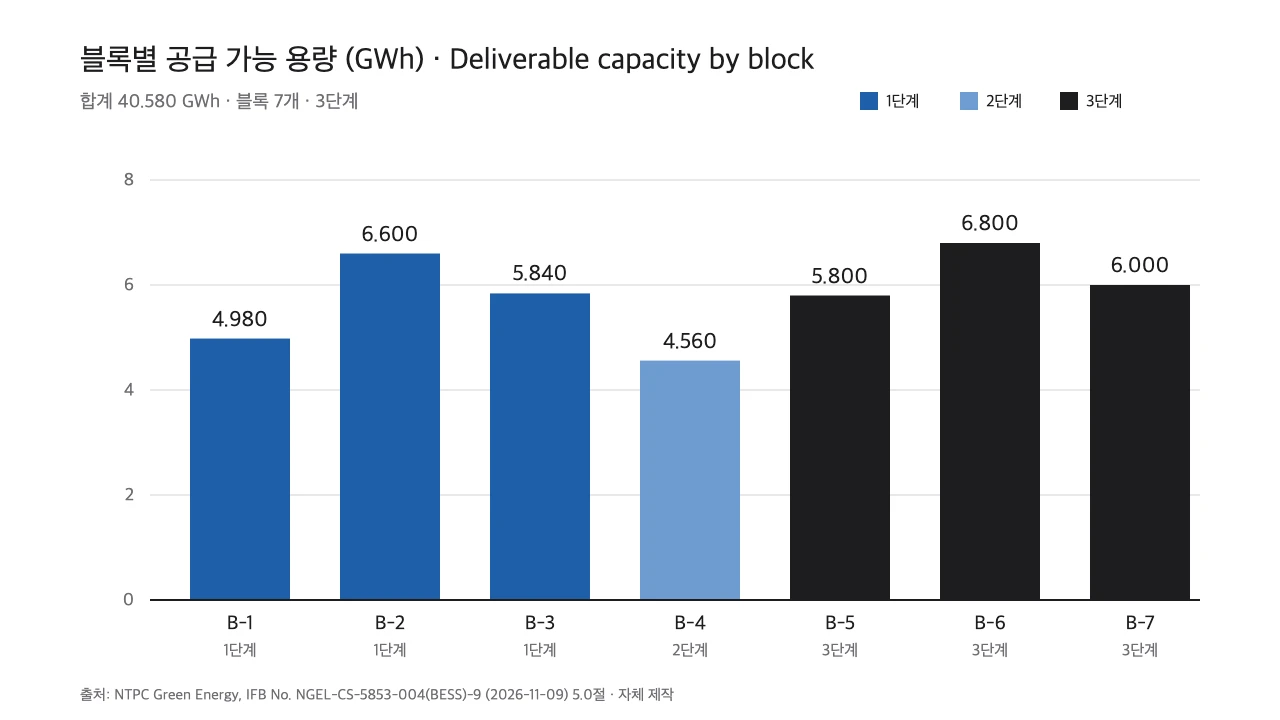
The blocks are uneven. B-4 is the smallest at 4.560 GWh and B-6 the largest at 6.800 GWh. Phase 1 has three blocks totalling 17.42 GWh, Phase 2 a single 4.560 GWh block, and Phase 3 three blocks totalling 18.60 GWh. Bidders must quote whole blocks; a bid for part of a block is rejected. The column heading in that table reads Deliverable Capacity7, and it only makes sense next to the nameplate definition in clause 6.0.
Why write 10 GW and 40 GWh separately?
A watt (W) is a rate: how much energy flows each second. Multiply it by time and you get watt-hours (Wh). A gigawatt is a billion watts. So 10 GW is the instantaneous output, and 40 GWh is the total energy stored.
Think of a bathtub. GW is the width of the drain; GWh is the amount of water in the tub. A wider drain empties the tub faster, and a bigger tub takes longer to empty. Drain a 40 GWh tub through a 10 GW drain and it takes 4 hours.
Water sits still in a tub, but a battery slowly loses charge even when idle and loses some energy every time it charges and discharges. You get back less than you put in.
Figure 2 carries the same picture over to the battery side: cells take the place of the water, and the PCS takes the place of the drain.
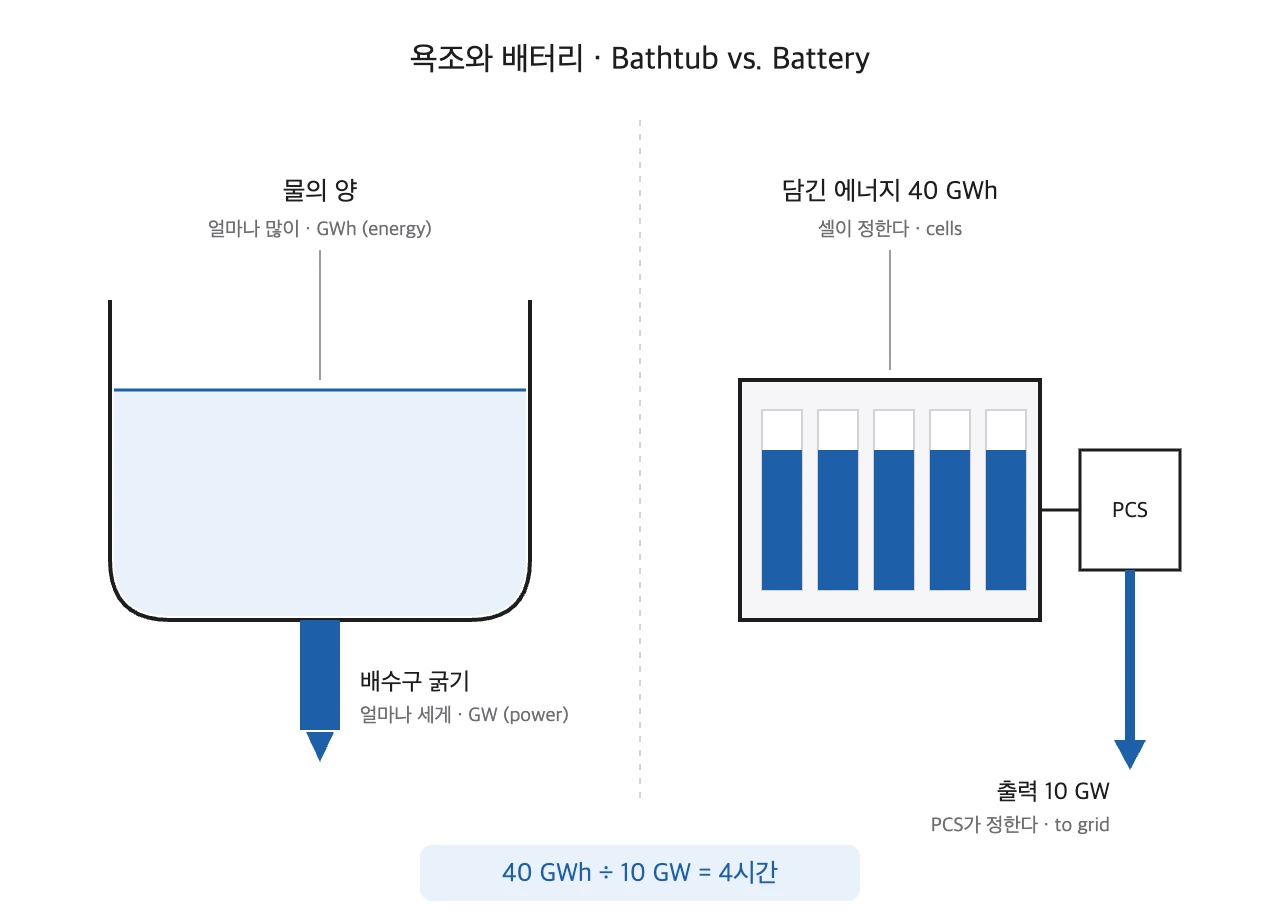
Energy divided by power is called the duration8. The IFB never writes “4 hours.” When I read a tender like this, the first thing I do is that division, because the duration tells you what the system is meant to do. The notes to the qualifying requirements list four BESS uses: renewable integration, time shifting and peak shaving, frequency regulation, and load levelling.
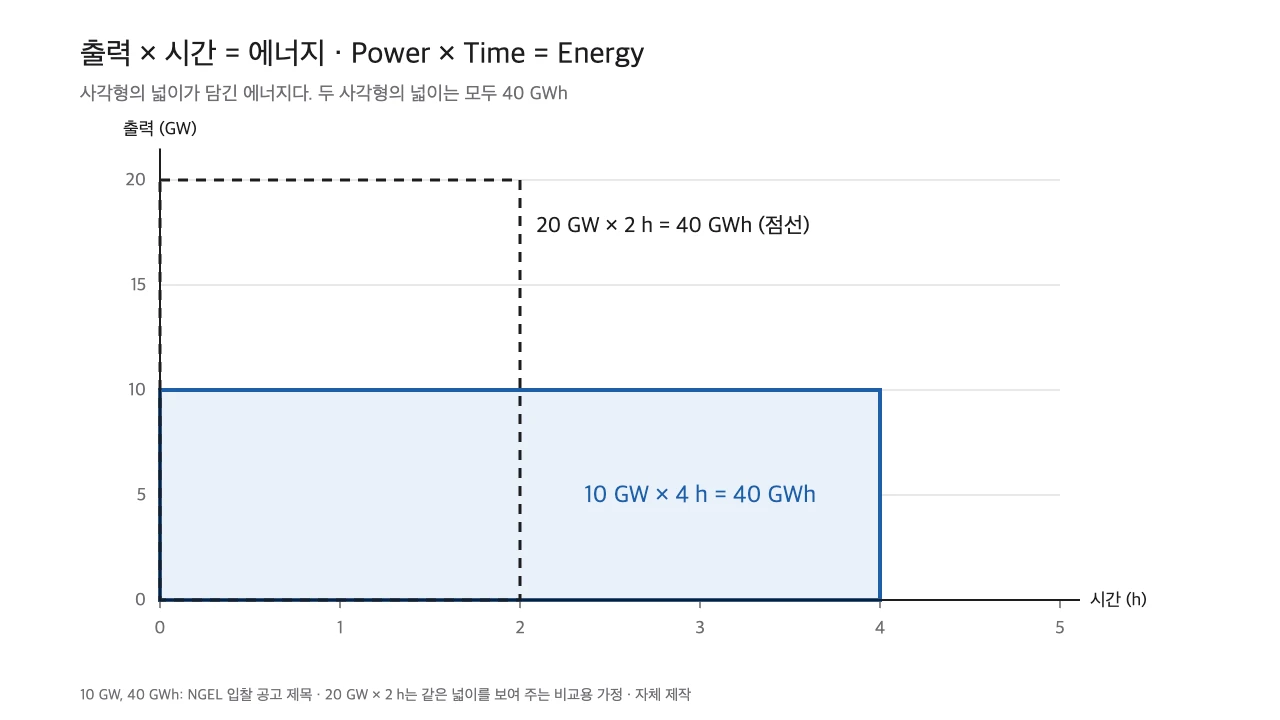
In Figure 3 the solid rectangle is 10 GW for 4 hours. The same area could be drawn as 20 GW for 2 hours. Equal area means equal energy. Quoting GWh alone is like giving the area of a rectangle without its width or height.
Put side by side, the two units answer different questions. When a headline gives only one number, check which one it is.
| Item | GW (power) | GWh (energy) |
|---|---|---|
| Question it answers | How hard, at once | How much, in total |
| Bathtub version | Drain width | Water in the tub |
| Value in this IFB | 10 GW (title) | 40.580 GWh (sum of blocks) |
| Hardware that sets it | PCS rating | Number of containers and cells |
The last row is where the hardware comes in. The PCS sets the power; the cells inside the containers set the energy. That leaves the question of where 40 GWh worth of cells comes from and how they are packed.
Turning 40 GWh into cells
NGEL is asking for an LFP-based9 containerized battery system10. Open a container and you find cells grouped into modules, modules mounted in racks, and racks lined up inside the enclosure. The PCS sits outside and connects to the grid.
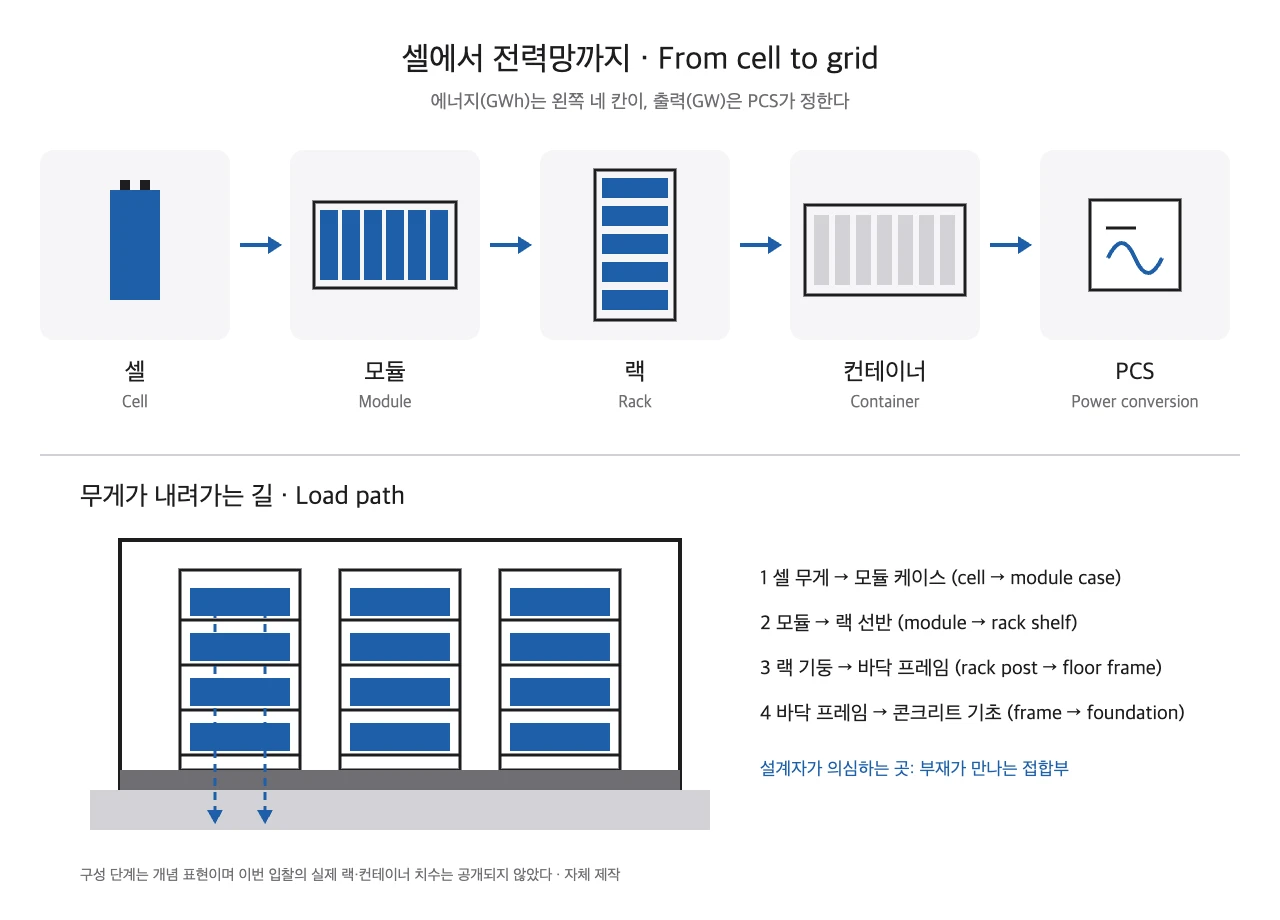
The roll presses, slitters, coaters and winders I have designed sit at the very start of that chain. They make the electrodes that go inside each cell. On the factory map in Figure 5, what this tender buys is the box on the far right. GWh decides how many cells the processes to its left have to turn out.
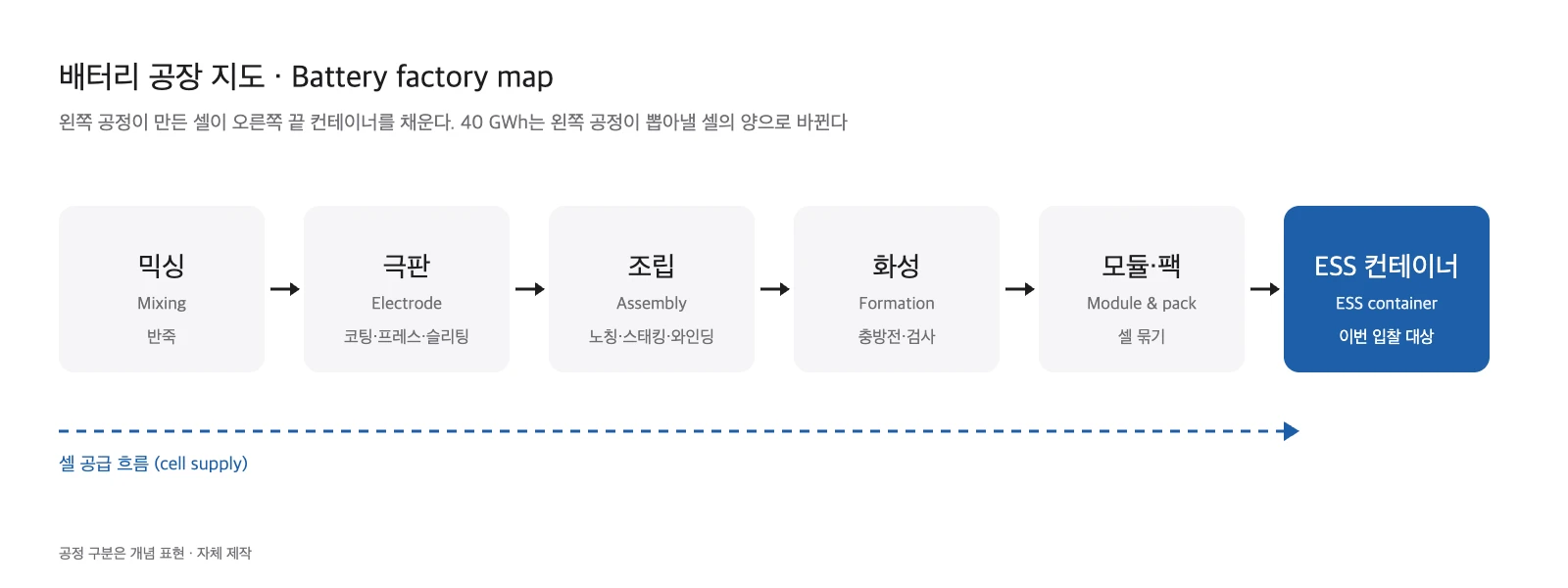
Earlier volumes in this series covered mixing, electrodes, assembly and formation one at a time. Roll press calendering sets electrode thickness, and the cylindrical, prismatic or pouch format splits the lines from there. This IFB does not state the cell format or size.
With no cell specification in the tender, I took one published datasheet for a 314 Ah LFP storage cell as the reference: 1,004.8 Wh rated energy and 5.60 kg. Assuming that single cell type fills all 40.580 GWh, a division and a multiplication give the scale.
| Item | Value | Basis |
|---|---|---|
| Rated energy per cell | 1,004.8 Wh | 314 Ah LFP cell datasheet |
| Mass per cell | 5.60 kg | Same datasheet |
| Cells to fill 40.580 GWh | about 40.39 million | Author’s calculation (estimate) |
| Total cell mass | about 226,000 t | Author’s calculation (estimate) |
Which cells will actually be used has not been disclosed, and the table fixes a single cell type. Swap the cell and the order of magnitude barely moves: tens of millions of cells and hundreds of thousands of tonnes (estimate).
I have been designing rolls and the frames that carry them since 2005, so when I see a GWh figure I picture where the weight goes. Cell weight passes into the module case, the module into the rack shelf, the rack into the container floor frame, and the floor frame into the concrete foundation. That route is the load path11.
As with a roll press frame, the place I distrust most in a structure like this is the joint where members meet. That is where the force changes direction, and if the bolt preload relaxes, sag starts there.
The 15-year service agreement also reads to me as a drawing problem. If the supplier carries maintenance, the first drawing has to leave a path to pull a module from deep inside a rack and room for a tool to reach each bolt. That is part of why I aim for zero design changes after release: one bolt nobody can reach on site eats maintenance hours for 15 years.
Boltenertec, reading an Indian ESS tender with loads in mind
Because the scope ends at supervising erection on site, the containers are built elsewhere and shipped in. Lifting and transport put forces on the structure in different directions from those it sees sitting on its foundation. Working them out needs container dimensions, rack layout and transport conditions, none of which are public.
Two kinds of MWh in one document
It is easy to read the 40 GWh as the sum of the ratings printed on every battery. The IFB itself rules that reading out.
The block table is headed deliverable capacity. The notes to clause 6.0, which set the bidder qualifications, define the MWh in a supply record as nameplate capacity12, and add that it is not the output energy capacity. One document, one unit, two bases.
The reason they differ is the same as the limit of the bathtub comparison. Some energy is lost as it passes through the PCS, and cells are not fully emptied, to protect their life. Meeting 40 GWh at the output terminals therefore takes more nameplate capacity than the table above assumes (estimate). How much more depends on each supplier’s design and cell specification, and public documents do not say.
If you follow this as an investor, note only that articles may write the volume differently. One report says 40 GWh, another 40.58 GWh, and neither contradicts the IFB: one is the rounded title figure, the other the sum of the blocks. Who wins the volume is outside the scope of this article.
If you are preparing for a job in this field, look at the racks, the floor frame and the transport restraints inside the container. An ESS looks like electrical equipment, but it also needs mechanical structure to carry and move its weight. The IFB’s qualifying requirements ask for a record of having manufactured and supplied containerized battery systems directly.
One step further, for engineers
The cell estimate uses one formula.
$$N = \frac{E_{bid}}{E_{cell}} = \frac{40.58\times10^{9}}{1004.8} \approx 4.04\times10^{7}$$
$N$ is the number of cells, $E_{bid}$ the total block energy (Wh), and $E_{cell}$ the rated energy of one cell (Wh). Total cell mass is $N$ times 5.60 kg, about 2.26×10⁵ t. The nameplate-versus-output gap is not included, so this is a lower-bound figure (estimate).
I have not checked the strength of rack shelves or floor frames here, because rack pitch and container dimensions are not public. When that check is done, keep one safety factor for static load and a separate one that includes transport and lifting shocks, and verify both. Each value needs re-confirmation from site measurement.
Further reading: NFPA 855 ignition test and ESS vent design · China Power Construction’s 16 GWh ESS procurement · Waaree’s India BESS MV skid order
When I see GWh in an ESS story, I write down three lines: the duration after dividing by GW, whether the figure is nameplate or deliverable, and what it means in cells and tonnes. For this Indian tender that comes to 4 hours, 40.580 GWh deliverable, and more than 40 million cells (estimate). With those three lines on paper, the next tender headline has something to be measured against.
Glossary
- Energy Storage System (ESS): equipment that stores electricity in batteries and releases it to the grid when needed. Large installations are also called BESS (Battery Energy Storage System). ↩
- Watt (W) and watt-hour (Wh): W is the rate at which energy flows each second; Wh is the energy delivered at that rate over one hour. Giga (G) means a billion. ↩
- Invitation for Bids (IFB): the document in which a buyer states what it will buy, who may bid, and the deadlines. ↩
- PCS (Power Conversion System): equipment that converts battery DC to grid AC and back. It sets the power rating of an ESS. ↩
- Grid-forming: an operating mode in which the PCS creates its own voltage and frequency reference rather than only following the grid. Control details need a separate review. ↩
- Long Term Service Agreement (LTSA): a contract under which the supplier keeps inspecting and repairing the equipment for a set period after handover. ↩
- Deliverable Capacity: the energy each block must be able to deliver under the contract. ↩
- Duration: how long an ESS can deliver its maximum power without stopping; energy (GWh) divided by power (GW). ↩
- LFP (Lithium Iron Phosphate): a battery type that uses lithium iron phosphate as the cathode material, common in ESS. ↩
- Containerized Battery System: battery equipment in which cells, modules, racks and cooling and fire-suppression gear are housed in a shipping-container-sized enclosure and delivered as one unit. ↩
- Load path: the route by which weight or force passes from part to part down to the ground. Where that route is weak or broken, a structure starts to sag. ↩
- Nameplate capacity: the rated capacity marked on a battery product. It is measured on a different basis from the energy drawn at the output terminals. ↩
Sources
- NTPC Green Energy Limited, Invitation for Bids No. NGEL-CS-5853-004(BESS)-9, “Supply of Battery Containers and Grid-Forming PCS for 10 GW / 40 GWh BESS Projects”, 2026-11-09, ntpctender.ntpc.co.in
- Trina Storage, 314Ah Cell Datasheet (rated capacity 314 Ah, rated voltage 3.2 V, rated energy 1,004.8 Wh, mass 5.60 kg), trinasolar.com
This post is meant to help readers understand industry and technology. It is not a recommendation to buy or sell any stock.