A battery cell form factor1 is the combination of a cell’s outer shape and the way its electrodes are packed inside. There are three families: cylindrical, prismatic and pouch.
- Pick the cell shape and you have picked the lead machine of the assembly line. Cylindrical cells are wound, pouch cells are stacked, and prismatic cells are either wound flat or stacked.
- In a wound cell, making the jelly roll n times wider makes the electrode n² times longer. Double the diameter and the strip gets roughly four times longer.
- In one published teardown, a 46 mm cell held an anode strip 3,403 mm long. That is more than 3 m of material inside a can you can hold in one hand.
When a headline says a cell maker is ramping up large cylindrical cells, or switching to prismatic, I picture the assembly line first. Which machines leave the floor, and which ones arrive? To a consumer, cell shape is about looks. To someone who draws the equipment, it decides whether the line layout has to be redrawn.
Taken literally, the names already tell most of the story. A cylindrical cell2 puts its electrodes inside a round metal can. A prismatic cell3 uses a rectangular box. A pouch cell4 seals them in a thin film bag. The bigger difference, though, lies in how the electrodes get into that container.
Wind it or stack it
I still shoot film. Open a film cartridge and you find one long strip coiled around a spool. The inside of a cylindrical cell looks much the same, except that four strips go around together: cathode, separator5, anode, and a second separator.
The industry calls the coiled result a jelly roll6, after the spiral you see in its cross-section. The machine that makes it is a winder7. The other route is stacking8: cut the electrodes into sheets first, then lay them on top of each other like pages of a book.
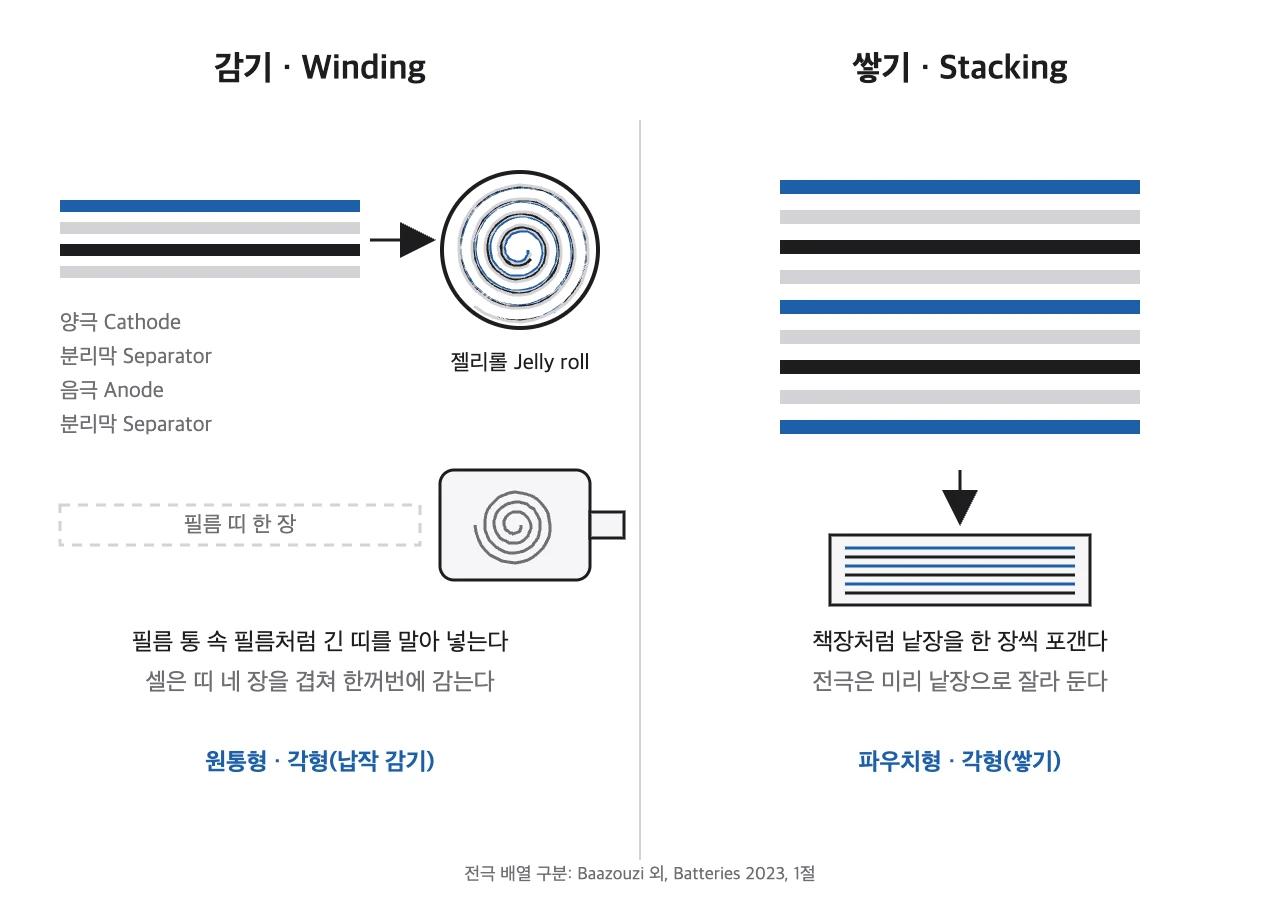
The film comparison breaks down in one place. A film strip has nothing to stay aligned with. In a cell, the edges of all four layers must line up from the first turn to the last. The anode is made slightly wider and longer so that it always covers the cathode edge. In the teardown, the anode was 136 mm longer than the cathode (Ank et al., 2023).
Shape and method come in fixed pairs. A German team that reviewed cylindrical cells put it this way: prismatic cells use flat jelly rolls or stacked electrodes, and pouch cells use stacking only. Cylindrical cells are wound. The same paper describes winding as simpler and more continuous than stacking, which is why it calls cylindrical cells cost-effective, durable and relatively easy to scale.
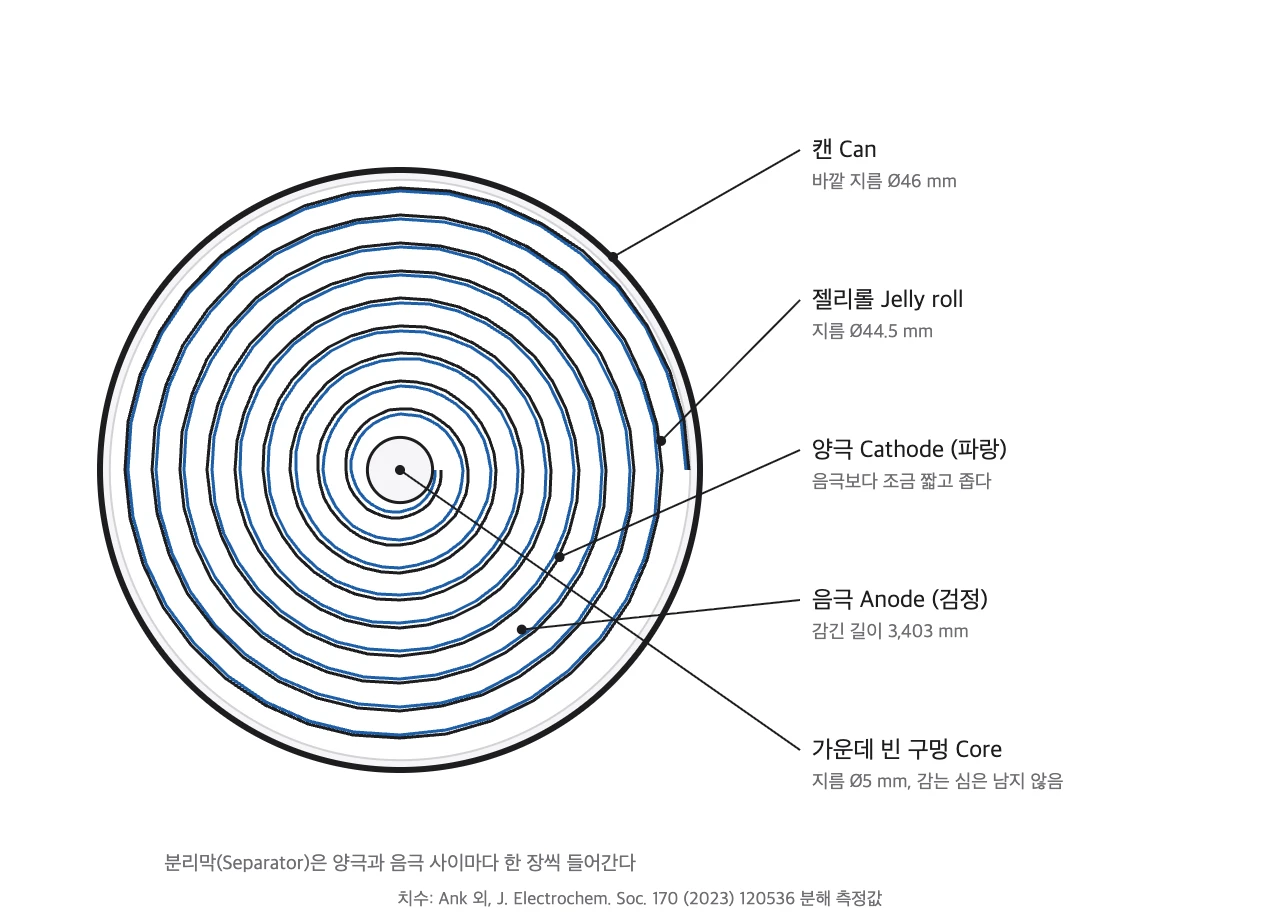
The dimensions in Figure 2 come from a university group that took apart a commercial large-format cylindrical cell. Inside a can 46 mm across and 80 mm tall, the jelly roll measured 44.5 mm in diameter and 71 mm in height. At the center there was an empty hole 5 mm wide, with no winding mandrel left behind. I read that as the roll being pulled off its winding shaft before it went into the can.
The path that carries current out of the electrode is the tab9. The review paper notes that tab design becomes more critical as the winding diameter grows. If current is collected at a single point on the strip, the charge at the far end has that much farther to travel.
Twice the diameter, how much more strip?
One calculation trips people up more than any other when they read about cell sizes. It is the link between diameter and strip length.
Double the diameter of a cylindrical cell and the electrode inside gets about twice as long.
When the jelly roll diameter grows by a factor of n, the electrode length grows by n² (Baazouzi et al., 2023). Twice the diameter means four times the length.
Thinking only about circumference, twice sounds right. One outer turn is proportional to diameter. But a wider roll also holds more turns. Longer turns multiplied by more turns gives a square law. An easier way to see it: the cross-sectional area grows with the square of the diameter, and the strip has to fill that area.
I reran the numbers with the center hole included. The teardown cell had a 44.5 mm jelly roll around a 5 mm hole. Suppose the same strip thickness is wound to half the diameter, 22.25 mm. The length ratio equals the ratio of the ring areas, which comes to about 4.2 (my own calculation). The hole is the reason it lands slightly above 4.
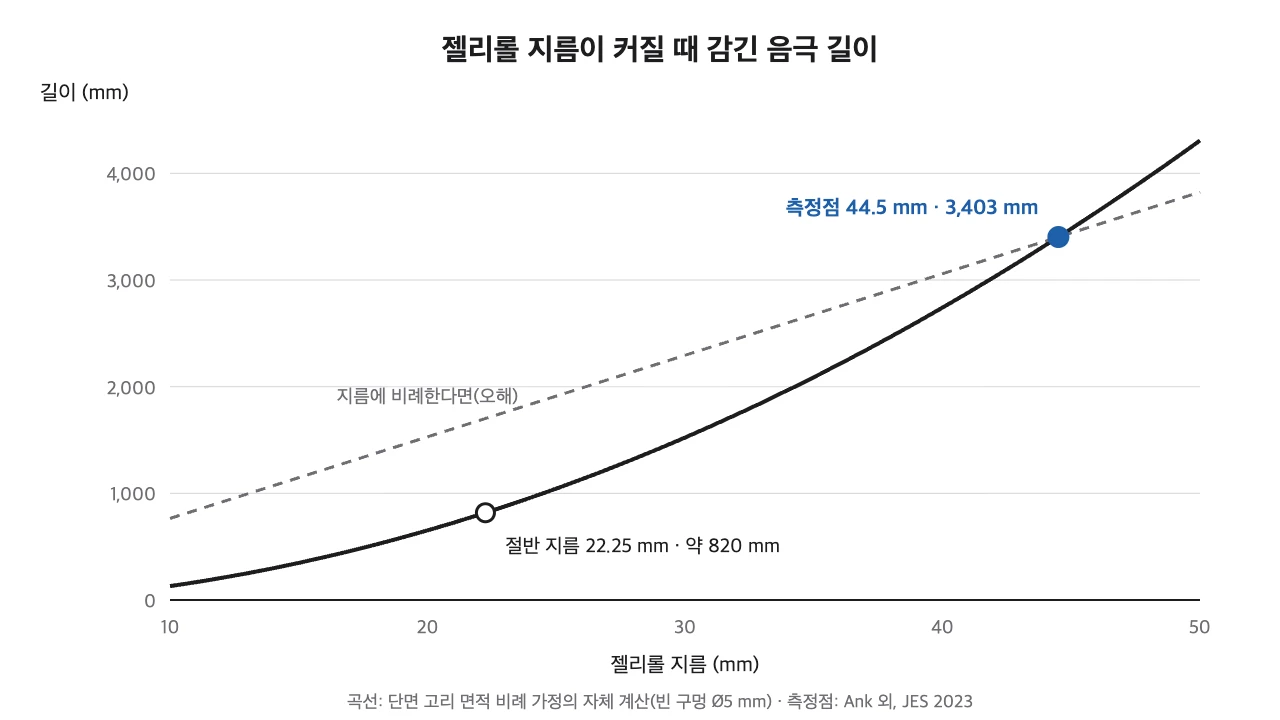
Keep the upward bend of that curve in mind and stories about bigger cells read differently. A larger cell means fewer cells, but each one needs a strip that grows with the square of its size. Winding time goes up, and so does the distance over which tension and edge alignment have to be held. How winding torque changes as the roll grows is covered in this series’ winder torque post.
When I look at a large cylindrical cell, the three numbers I reach for are its size, its strip length and its heat.
A 5.5-fold volume means that many fewer cells to fill the same space. Fewer cells mean fewer repetitions of can insertion, welding and inspection. From the equipment side, that drop in repeated motions is the real benefit of a large cell. The teardown measured an average capacity of 22.078 Ah10 for this cell.
The cost shows up in numbers too. As a cell grows, its surface area shrinks relative to its volume. The review paper puts the surface-to-volume ratio of the 46 mm cell at half that of an 18650 cell, so heat has relatively less area to escape through. In the same paper’s test, the 46 mm cell’s surface temperature rose by 8.2 °C.
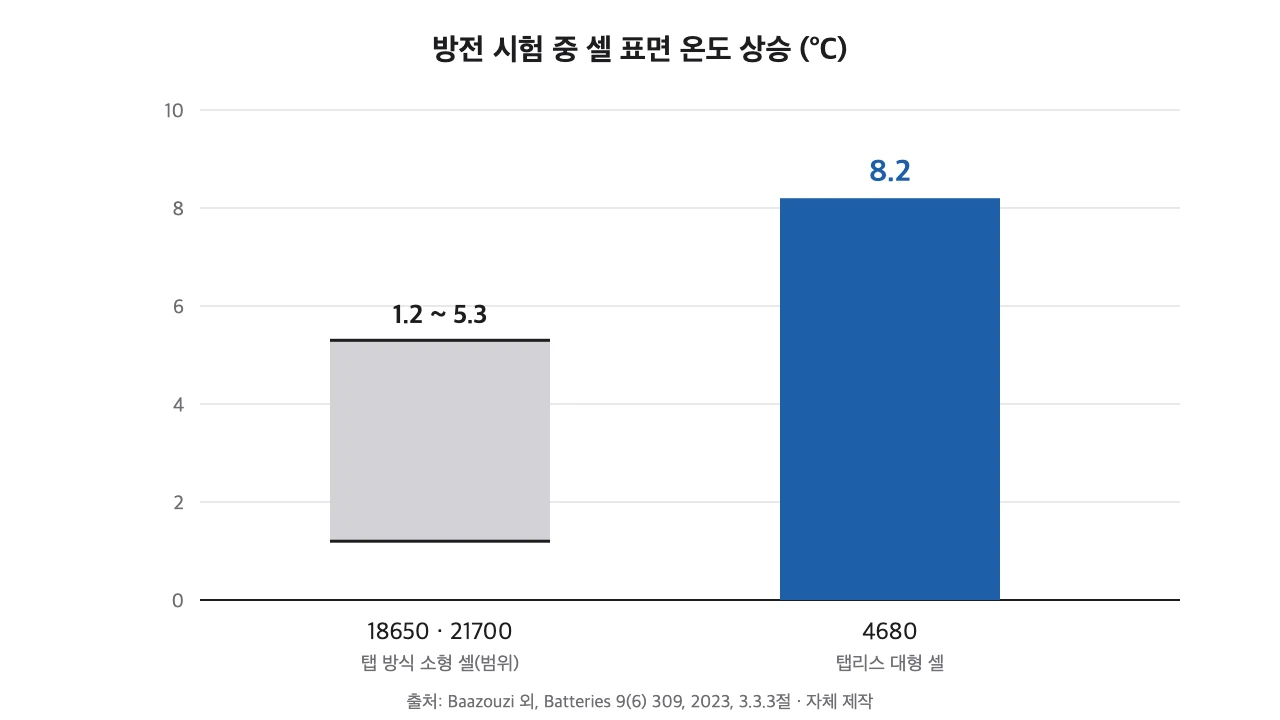
The two smaller cell types in the same study rose by 1.2 to 5.3 °C, so the large cell sits highest. It also uses a tabless11 design, where one whole edge of the strip serves as the current path, while the two small cells use attached tabs. Size and tab design changed at the same time in this comparison. I would not use this chart alone to declare one shape better than another.
When a cell format story breaks, the first number I look for is cell height. In a wound cell, the jelly roll height sets the width of the electrode strip. The slitter12 at the end of the electrode line cuts the wide coated web into lanes of exactly that width. Change the cell height and, in my judgment, the knife spacing, the winder’s edge guides and the can size all have to follow.
Boltenertec, roll press and slitter design
After width comes edge alignment. Table 4 of the cylindrical cell review lists the distances between anode and cathode edges at the top and bottom of the jelly roll. The ranges run from 0.10 to 1.15 mm. Put plainly, several strips more than 70 mm wide are wound through dozens of turns while their edges stay within about a millimeter. On any winding machine, this alignment is the value I check before speed.
There are speed figures as well. Citing interviews with equipment makers, the same paper says winding 1 m of electrode takes about 1.25 s, and 5 m takes under 3 s. The roughly 3.4 m anode of the large cell falls inside that range. In practice, cutting, taping and unloading before and after the wind often set the cycle time more than the winding itself.
Where a cell format story becomes an equipment story
A cell plant runs in three broad stages: electrode production, cell assembly, and formation. Cell shape changes the machine list in the middle stage. Upstream, mixing, coating and roll pressing produce a wide coated web whatever the final shape. The split happens where that web is cut to cell size and put into its container.
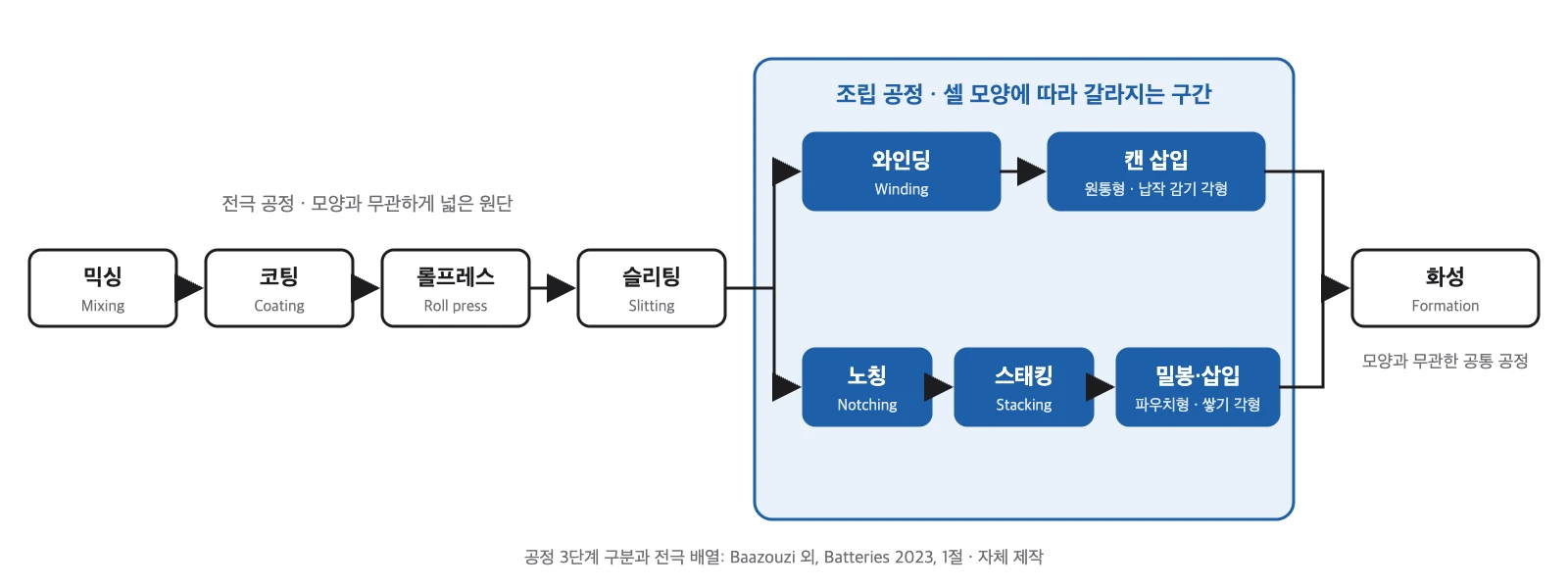
The blue zone in Figure 5 is what changes with cell shape. A stacking line adds notching, which cuts single sheets out of the strip, and a stacker that piles them up. Both machines are covered in this series’ notching and stacking post. A winding line keeps the strip continuous, feeds it to the winder, and then inserts the finished jelly roll into a can.
| Cell shape | How electrodes go in | Container | Assembly machines I watch |
|---|---|---|---|
| Cylindrical | Wound | Round metal can | Winder, can inserter |
| Prismatic | Wound flat, or stacked | Rectangular case | Flat winder or stacker, case inserter |
| Pouch | Stacked | Film bag | Notcher, stacker, pouch sealer |
Prismatic is the only shape that uses both methods. Two news items that both say “prismatic” can therefore call for different assembly machines. When a cell maker’s announcement says only “prismatic,” I check first whether the electrode arrangement has been disclosed. If it has not, the equipment setup cannot be confirmed from public information either.
For investors outside the industry, a simple habit helps: translate the cell shape into machine names. “More cylindrical” reads as a bigger share for winding and can handling. “Less pouch” reads as a smaller share for stacking. Which company benefits is outside the scope of this post. The word cylindrical points to the winder’s place on the floor, and the word pouch points to the stacker’s. The layers where materials and equipment sit in the wider industry are mapped in the value chain post.
If you are preparing for a job in this industry, start with the fact that assembly equipment differs by cell shape. Winding equipment lives on strip tension and alignment. Stacking equipment lives on sheet placement accuracy and repetition speed. Two people with the same mechanical design title can spend their days on very different numbers depending on which line they join.
One step further, for engineers
Treat the jelly roll as a ring of strip with constant thickness and no gaps. The wound length is then the ring area divided by the thickness of one layer set.
$$L=\frac{\pi\left(D^{2}-d^{2}\right)}{4\,t}$$
$L$ is wound strip length (mm), $D$ is jelly roll outer diameter (mm) and $d$ is center hole diameter (mm). $t$ is the thickness of one set of cathode, anode and two separators (mm). With the teardown values $D=44.5$ mm, $d=5$ mm and $L=3403$ mm (anode), $t\approx0.45$ mm. The number of turns is $(D-d)/(2t)\approx44$ (my calculation assuming zero gaps; estimate). Real cells have interlayer gaps and thickness variation, so this needs confirmation by measurement.
By the same relation, a larger final roll diameter means higher spindle torque at the same web tension. Torque and shaft strength checks should confirm the safety factor separately against static and fatigue criteria. Motor size and winding tension are not set in this post and must be fixed by on-site measurement.
Machinability note: because the jelly roll has to slide off, the winding mandrel is made as a split or tapered pin, with the step at the split face controlled by grinding. The alternative is to leave a center pin inside the cell. That removes the extraction motion and shortens the cycle, but it takes up cell volume and adds a part, so I do not use it as the baseline design.
Related in-depth posts: High-speed prismatic winding and web acceleration, Cylindrical cell winding gripper patent review, Winder roll diameter and torque
Cell shape comes down to winding or stacking, and that choice writes the assembly line’s machine list. Wound cells carry a strip that grows with the square of the diameter. Stacked cells repeat a motion for every sheet. Next time a cell format story comes out, ask which of those two burdens the cell maker chose.
Glossary
- Form factor: the shape and size standard of a product. For batteries, it covers both the outer shape of the cell and how the electrodes are held inside. ↩
- Cylindrical cell: a cell whose wound electrode roll sits in a round metal can, much like a household battery. ↩
- Prismatic cell: a cell whose electrode assembly sits in a flat rectangular case with square corners. ↩
- Pouch cell: a cell made by placing stacked electrodes in a thin film bag and heat-sealing the edges. ↩
- Separator: a thin film placed between cathode and anode so they never touch. If they touch, the cell shorts internally. ↩
- Jelly roll: cathode, separator and anode layered and rolled up together. The cross-section looks like a rolled sponge cake. ↩
- Winder: a machine that coils long strip onto a spindle. In a cell plant it layers electrodes and separators into a jelly roll. ↩
- Stacking: laying pre-cut electrode and separator sheets on top of each other, one at a time, in alternating order. ↩
- Tab: a short metal strip that carries current from the electrode to the cell’s external terminal. ↩
- Ah (ampere-hour): a unit for the amount of charge a cell holds. One Ah is the charge delivered by 1 A of current for one hour. ↩
- Tabless: a design that connects one whole edge of the electrode strip to the terminal instead of using separate tabs, so current has a shorter path. ↩
- Slitter: a machine that cuts a wide web lengthwise into several narrow strips. ↩
Sources
- Baazouzi, S., Feistel, N., Wanner, J., Landwehr, I., Fill, A., Birke, K. P. (2023). Design, Properties, and Manufacturing of Cylindrical Li-Ion Battery Cells: A Generic Overview. Batteries, 9(6), 309. Sec. 1 (cell formats and electrode arrangement), Sec. 3.2.2 (diameter and electrode length), Sec. 3.3.3 (temperature rise), Sec. 3.4 (winding speed), Table 4 (jelly roll dimension ranges).
- Ank, M. et al. (2023). Lithium-Ion Cells in Automotive Applications: Tesla 4680 Cylindrical Cell Teardown and Characterization. Journal of The Electrochemical Society, 170, 120536. Cell dimensions, jelly roll dimensions, anode length, average capacity.
- The curve in Figure 3, the 22.25 mm calculation, and the thickness and turn count in the engineering box are my own calculations using values from the two papers above.
This post is meant to help readers understand industry and technology. It is not a recommendation to buy or sell any stock.