Awesomeray, a company developing CNT (carbon nanotube)-based membrane and fiber materials, has secured a Series B bridge investment of KRW 7.5 billion from eight investors including S&S Investment.
Fact Summary
Awesomeray is a company developing CNT-based membrane and fiber materials. This investment is a Series B bridge round joined by eight firms: S&S Investment, Woorik Investment Partners (원익투자파트너스), Hanwha Investment & Securities, Re-Investment (리인베스트먼트), L&S Venture Capital, K-Net Investment Partners, Union Investment Partners, and Ascendo Ventures. The investment size is KRW 7.5 billion; the specific use of funds and production capacity expansion plans are not confirmed.
According to MoneyToday (Aug 10, 2026), the investment was directed to a clean-room production line for EUV-pellicle CNT membranes built in Anyang, Gyeonggi Province (source: MoneyToday). In other words, the confirmed primary application is EUV pellicles used in semiconductor lithography, and whether the material will be directly applied to battery electrode processes is not confirmed by public information. Awesomeray is separately carrying out a KRW 3.6 billion R&D project in the pellicle category under the Ministry of SMEs and Startups’ Deep-Tech Challenge program (same source).
Impact Analysis from a Mechanical Design Perspective
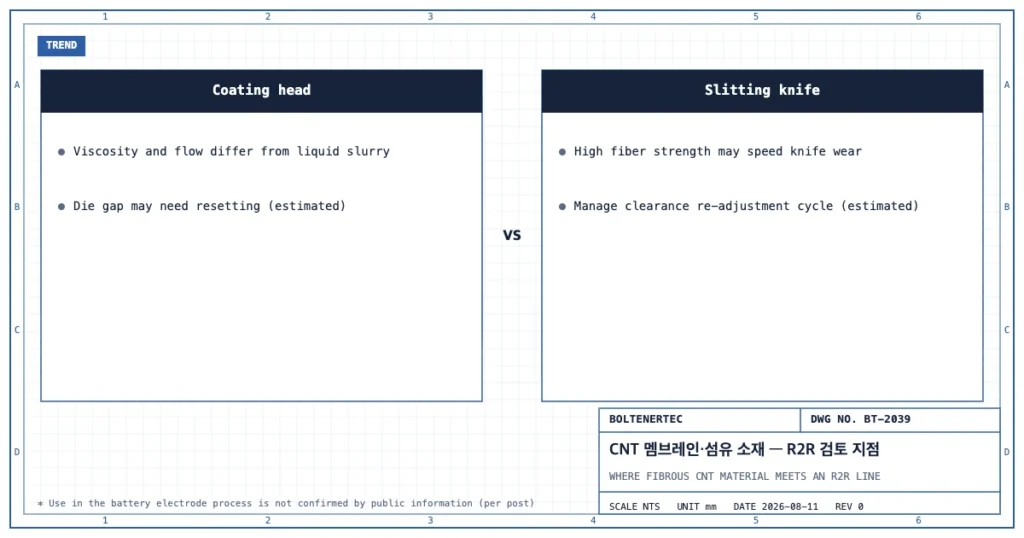
CNT materials can enter the R2R process either as a conductive-material dispersion or as a fiber/membrane-type intermediate material. If fiber/membrane-type CNT material is introduced into an R2R line, mechanical design review is needed at the following two points.
- Coating head — fibrous materials have different viscosity and flow characteristics compared with liquid slurry, which may require resetting the die gap (estimated).
- Slitting knife — materials with high fiber strength may affect the rate of knife wear, requiring the clearance re-adjustment cycle to be separately managed (estimated).
However, Awesomeray’s current business area is the material itself, and whether it will be directly introduced into the battery electrode process cannot be determined from publicly available information alone.
The confirmed application being a semiconductor clean-room process carries a separate implication from an R2R equipment perspective. EUV pellicle membrane production lines typically operate in semiconductor-grade clean-room environments, which may require stricter selection of low-wear materials and sealed housing design for R2R roller/bearing sections to suppress particle generation, compared with a typical battery electrode line (estimated; basis: the industry convention that semiconductor clean-room processes have higher particle-control standards than general industrial equipment). However, the actual clean-room grade of Awesomeray’s production line has not been disclosed (verification needed).
Shop-notes: When introducing fibrous CNT material into an R2R coating line, a gravure coating method, less sensitive to foreign-particle contamination than a slot-die method, could be considered as an alternative. However, gravure coating makes it relatively harder to secure coating-thickness uniformity, so maintaining the slot-die method, which allows precise die-gap control, remains the more reasonable choice for ultra-thin pellicle membrane coating (estimated).
Spec Comparison
| Item | Detail |
|---|---|
| Company | Awesomeray |
| Material category | CNT-based membrane/fiber |
| Investment stage | Series B bridge |
| Investment size | KRW 7.5 billion |
| Participating investors | 8 firms (including S&S Investment) |
S&S Investment is a CVC affiliated with a photomask/EUV-pellicle manufacturer, and its participation carries a strong character of securing a strategic raw-material supply chain (source: KHARN). Awesomeray has secured a KRW 600 million grant and up to KRW 20 billion in technology-guarantee eligibility under the Korea Technology Finance Corporation’s Unicorn Bridge program, and is targeting a technology-track IPO in 2028 (same source). From an R2R equipment supplier’s perspective, with a strategic investor already confirmed, orders for clean-room-grade R2R lines could be customized to a specific customer’s material specifications once mass production begins (estimated).
Design Reflection Checklist
- Re-review R2R roller/bearing particle-control standards after confirming the clean-room grade (verification needed)
- Establish a pre-test plan for die gap and knife clearance when introducing fibrous CNT material
- Application to the battery electrode process remains unconfirmed by public information; continue monitoring further disclosures and press releases
One-line Summary
CNT fiber/membrane material company Awesomeray raises KRW 7.5 billion — there is room for reviewing the die gap and knife clearance of R2R coating/slitting equipment (estimated).