Key Patent Information
Application Number: PCT/CN2022/108955
Invention Title: Sodium-ion Battery Electrolyte, Secondary Battery, Battery Module, Battery Pack, and Electric Device
Applicant: Contemporary Amperex Technology Co., Limited (CATL)
Inventor: Mengdan Huang et al.
International Publication Date: February 1, 2024
Source: The application number, title, applicant, and publication date were confirmed through SMM (news.metal.com) reporting and WIPO PCT publication information. The detailed composition ratios in the full claims are undisclosed material and remain an item requiring confirmation.
Within the scope of publicly available information, this patent is understood to have a 5-tier hierarchical claim structure spanning electrolyte composition, secondary battery, battery module, battery pack, and electric device.
The detailed chemical composition (solvent/additive ratios, etc.) is outside the scope covered by this persona (equipment/mechanical design), so it is left as an area requiring separate review.
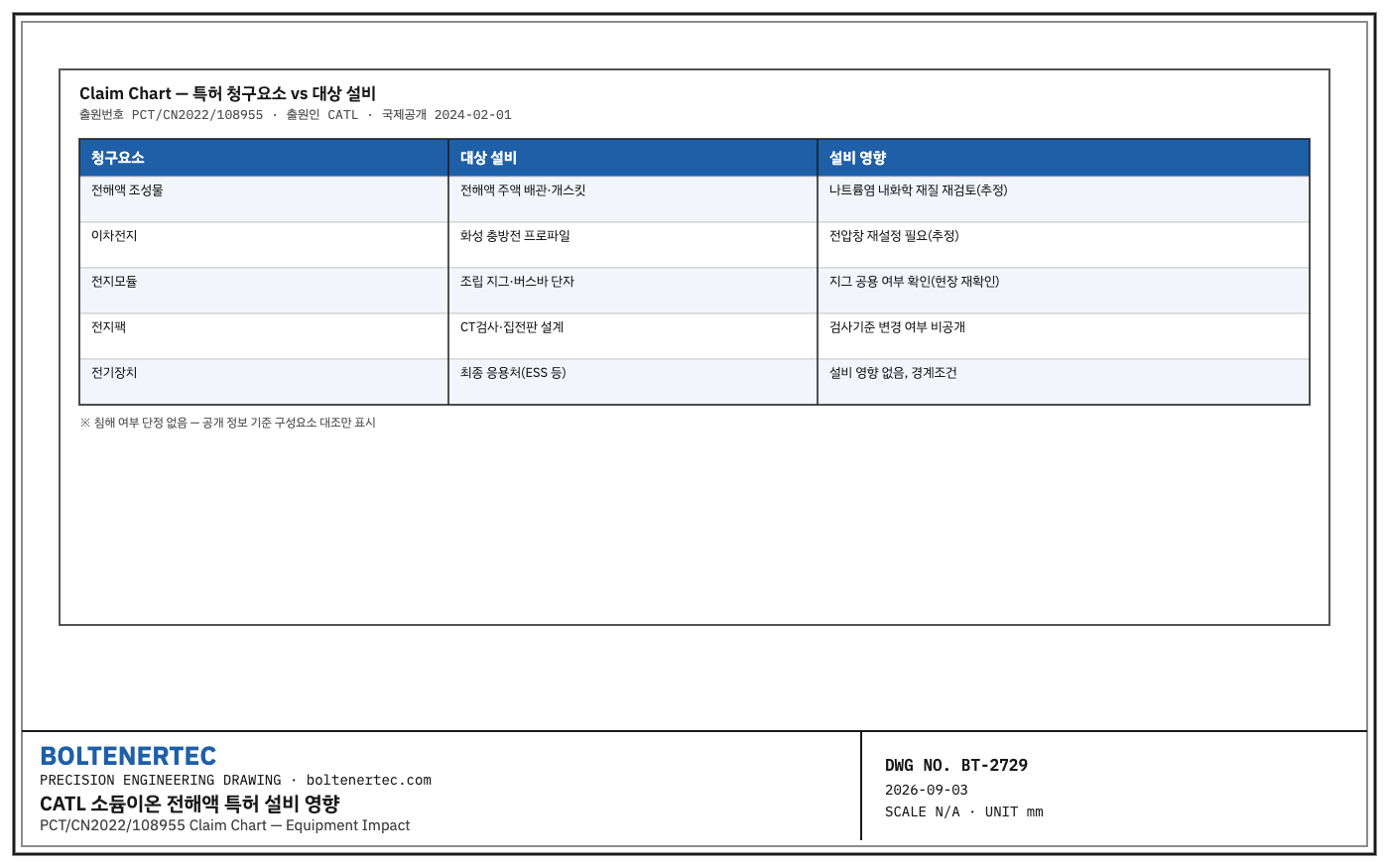
Claim Chart — Patent Claim Elements vs. Target Equipment Impact
| Patent Claim Element | Target Equipment (boltenertec Perspective) | Equipment Impact Analysis |
|---|---|---|
| Sodium-Ion Electrolyte Composition | Electrolyte Injection Equipment Piping/Gaskets | Chemical-resistant material review needed due to corrosivity/viscosity differences of sodium salt vs. lithium salt (estimate) |
| Secondary Battery | Formation Process Charge/Discharge Profile | Charger/discharger voltage window reset needed as sodium-ion voltage profile differs from lithium-ion (estimate) |
| Battery Module | Module Assembly Jig/Busbar Terminal | Need to confirm whether existing jig can be shared, depending on cell voltage/capacity deviation (re-confirmation required after field measurement) |
| Battery Pack | Pack Assembly Line CT Inspection/Current Collector Plate Design | Whether pack-level inspection criteria change is undisclosed |
| Electric Device | Final Application (ESS, commercial vehicles, etc.) | No direct impact on equipment design; reference as boundary condition only |
Whether patent infringement exists can only be determined by reviewing the full claims and prosecution history; this article deals only with an element-level comparison based on publicly available information.
No conclusion is made regarding the validity or infringement status of the competitor’s patent.
Practical Application — Shop-notes
As alternatives, converting the existing lithium-ion electrolyte injection line to dual-use versus building a new sodium-ion-dedicated line were compared.
Dual-use conversion has lower initial investment cost, but the burden of piping cleaning and cross-contamination prevention verification is the reason it was not adopted; a new dedicated line has higher initial investment cost but lower quality risk.
Machinability note: chemically resistant piping for sodium salt requires review of PTFE lining or Hastelloy material, and piping weld joints must be checked for corrosion-resistance degradation via visual inspection and penetrant testing (PT) (exact material specifications require re-confirmation after field measurement).
Design Reflection Checklist
- Review chemical-resistant materials for electrolyte injection equipment (sodium salt corrosivity vs. lithium salt)
- Review resetting the formation process charger/discharger voltage window
- Confirm whether module assembly jig sharing is possible
- Confirm whether pack-level inspection criteria change (undisclosed, further confirmation needed)
- Review full patent claims and prosecution history (do not conclude on infringement)
One-Line Summary
The equipment ripple effect of CATL’s sodium-ion electrolyte patent begins not with chemistry, but with the chemical resistance of the injection piping and the resetting of the formation voltage window.