Cylindrical cell press patent US11695149B2 is held by Terawatt Technology Inc. The invention title is “Isostatic Press Devices and Processes for Cylindrical Solid-State Batteries.” It is an actually granted patent with a priority date of May 14, 2019, filing date of February 19, 2021, and issue date of July 4, 2023. Claim 1 claims a compression mechanism in which a halo-shaped (ring) cross-section buffer material wraps around the outside of a cylindrical cell, then one edge is moved toward the opposite side to reduce the inner cylindrical space. Claim 9 specifies a pressure range of 0.1–10MPa, and Claim 11 specifies a heating range of 60–250°C.
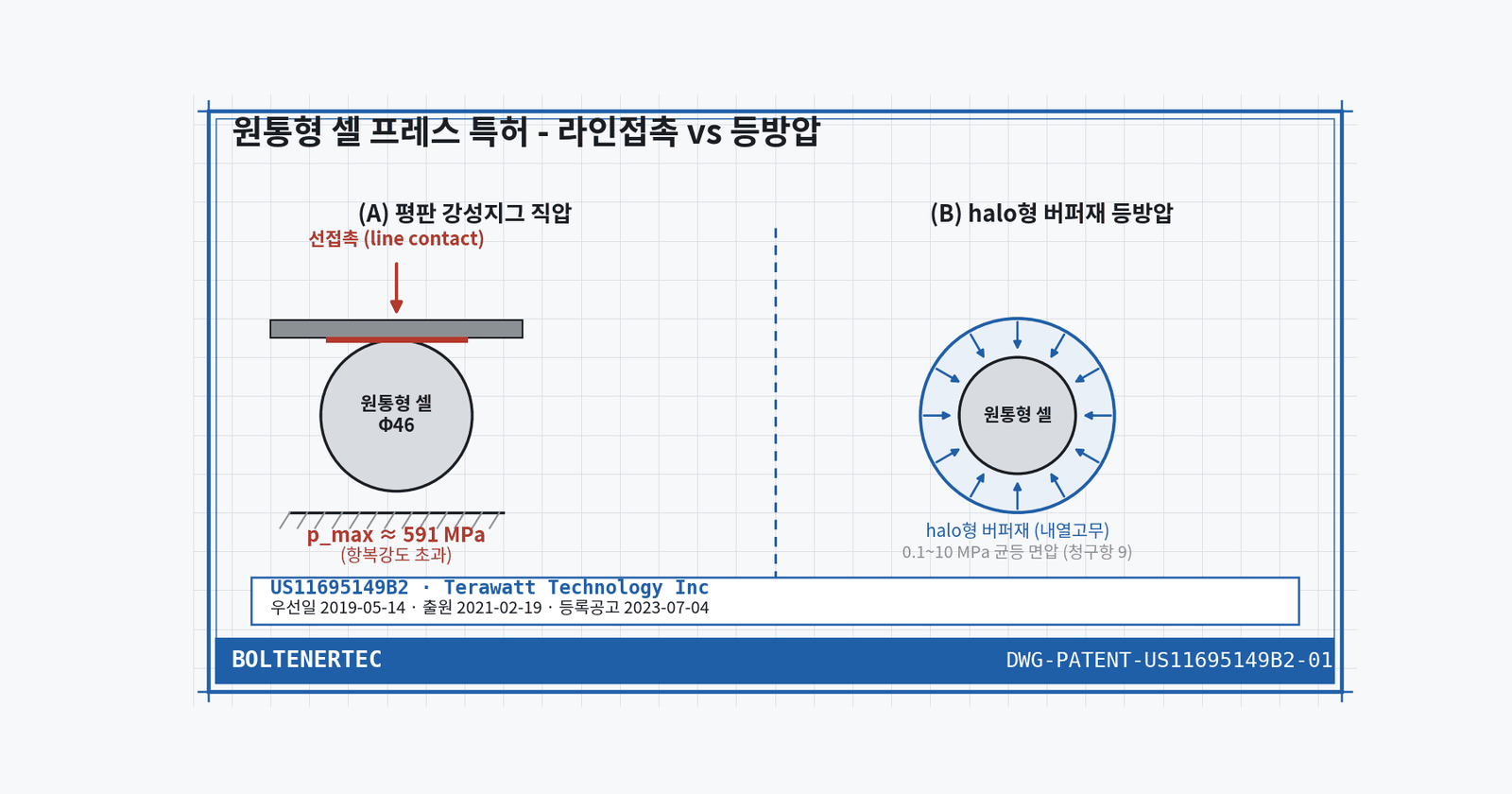
Kinematic Analysis
The core of this patent lies in “why a flat rigid jig should not directly press a cylindrical cell.” Cylindrical all-solid-state cells are the format CATL, BYD, Honda, and others are targeting for 2027 pilot mass production, with a 46-phi (46mm diameter) cylindrical form factor considered likely. Pressing a cylinder directly with a flat jig narrows the contact surface to a line, causing localized stress to spike sharply. The halo-shaped buffer material wraps the entire circumference, converting the line contact into area contact.
Calculation Verification
The maximum contact stress of flat-plate-to-cylinder line contact follows the Hertz formula.
$$p_{max} = \sqrt{\frac{F’ \cdot E^*}{\pi \cdot R}}$$
Setting the cell diameter at 46mm ($R=23$mm, estimated: based on the 46-phi cylindrical form factor) and the target average pressure at 5MPa (estimated: midpoint of Claim 9’s 0.1–10MPa range), the load per unit length is $F’ = 5\text{MPa} \times 46\text{mm} = 230\text{N/mm}$. Assuming both the cell case and jig are steel, the effective elastic modulus is as follows.
$$\frac{1}{E^*} = \frac{2(1-\nu^2)}{E} = \frac{2(1-0.3^2)}{200{,}000} \Rightarrow E^* \approx 109{,}900\text{MPa}$$
Substituting gives the following.
$$p_{max} = \sqrt{\frac{230 \times 109{,}900}{\pi \times 23}} \approx 591\text{MPa}$$
591MPa greatly exceeds the yield strength of the cell-case material (steel or aluminum can). This means that even when the target average pressure is only 5MPa, directly pressing a cylindrical cell with a flat jig can cause localized plastic deformation of the case or damage to the electrolyte layer. The halo-shaped buffer material distributes the load across the entire circumference (approximately $\pi \times 46 = 144$mm), converting the same load-per-unit-length into surface pressure. The practical scope of this patent’s claims lies not in chemical composition but in this load-transfer path itself (line contact → area contact).
Shop-notes
- Practical implication: when designing a cylindrical all-solid-state pilot line, the pressing jig must not simply be repurposed from a flat jig designed for prismatic or pouch cells. A shape-specific jig must be separately designed.
- Alternative mechanism (reviewed, not adopted): a V-block-type multi-segment jig, in which multiple rigid segments wrap the circumference, was reviewed, but it was not adopted because pressure discontinuity remains at segment boundaries, giving lower uniformity than the halo-type continuous buffer.
- Machinability note: the halo-type buffer material (Claim 6, heat-resistant rubber) can be manufactured by injection molding, giving lower initial tooling cost than a segmented metal jig. However, compression-set management of the heat-resistant rubber under repeated 60–250°C heating conditions is required, and this should be confirmed after field measurement.
- No determination of infringement is made. When designing a similar domestic jig, a design-around review is needed at the shape-design stage to avoid directly adopting the Claim 1 element of “a second cylindrical space defined by a halo-shaped cross-section buffer material.”
One-Line Summary
The calculation showing that contact stress spikes to 591MPa when a flat jig presses a cylindrical all-solid-state cell explains why the halo-type buffer-material patent exists.