Six additional BYD all-solid-state patents were published between August 6–7, 2026. This follows an earlier cathode composite-structure patent approved by China’s National Intellectual Property Administration (CNIPA) in late July. BYD stated its goal of starting small-scale trial production in 2027 using a dual-electrolyte cathode cell design. CATL also confirmed, around the same time in an investor Q&A, its plans to build a 2027 pilot production line and begin small-scale all-solid-state trial production.
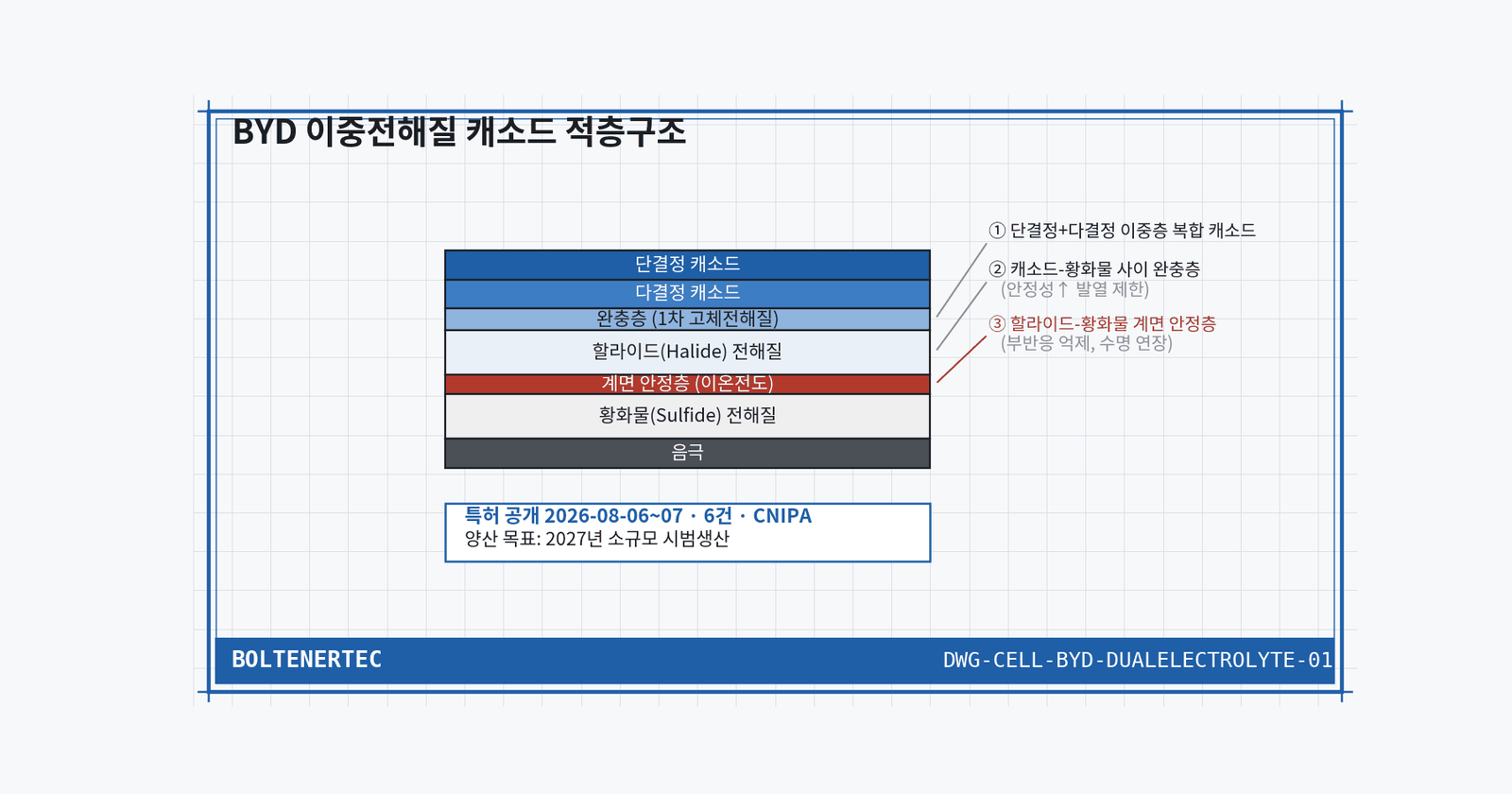
Key News Facts
- Publication date: August 6–7, 2026, 6 patents published (cumulative count separate if including the cathode composite-structure patent approved in late July)
- Core technology 1: a structure inserting an ionically conductive, electrochemically stable interfacial layer between halide and sulfide electrolytes to suppress side reactions and extend cycle life
- Core technology 2: a structure placing a primary solid electrolyte as a buffer layer between the active-material cathode and the sulfide electrolyte, improving stability and limiting heat generation
- Core technology 3: a dual-layer composite cathode combining single-crystal and polycrystalline cathode materials with different solid electrolytes
- Mass-production target: small-scale trial production in 2027 (both BYD and CATL)
No determination is made regarding patent infringement or the likelihood of successful commercialization. The items above summarize only the facts based on the published applications and primary reporting.
Mechanical-Design Impact Analysis
The dual-electrolyte/buffer-layer structure is a cell-chemistry design, but from a manufacturing-equipment standpoint it means stacking-precision requirements become far stricter than for existing liquid-electrolyte cells. Applying and stacking the dissimilar-electrolyte interfacial layer to a uniform thickness requires managing slot-die coating-gap deviation more tightly than for existing wet electrodes, and calendering-roll line-load deviation must also be reduced together to suppress interfacial-contact-resistance deviation. This means isostatic press equipment and dry-room dew-point control equipment must be verified together starting from the pilot-line stage, and locking down equipment specifications before the cell chemistry is finalized carries significant risk.
Spec Comparison Table
| Item | BYD | CATL |
|---|---|---|
| Electrolyte strategy | Dual electrolyte (halide + sulfide) cathode | Sulfide-based all-solid-state (estimated, details undisclosed) |
| August 2026 development | 6 patents published (8/6–7) | 2027 pilot plan reaffirmed (investor Q&A) |
| Mass-production target | Small-scale trial production in 2027 | 2027 pilot production, TRL 7–8 target |
| Notes | Second major announcement after BYD, by industry sequencing | Also states internally that “mass-market commercialization is still years away” |
One-Line Summary
Both BYD and CATL have set 2027 trial-production targets, but the dual-electrolyte interfacial structure increases equipment risk by requiring isostatic-press and dry-room specifications to be finalized simultaneously with the cell chemistry.