K-BATTERY SHOW 2026 runs from September 9 to 11, 2026 at Hall 7 of KINTEX Exhibition Center 2. Its official blog introduced ‘MicroKnox,’ described as the world’s first 3,500bar ultra-high-pressure dispersion technology.
Key News Summary
MicroKnox was revealed as applying 3,500bar-class ultra-high-pressure dispersion technology to the battery slurry dispersion process. Quantitative spec figures (flow rate, feed rate, throughput) are not included in the public materials.
Equipment Perspective Impact Analysis
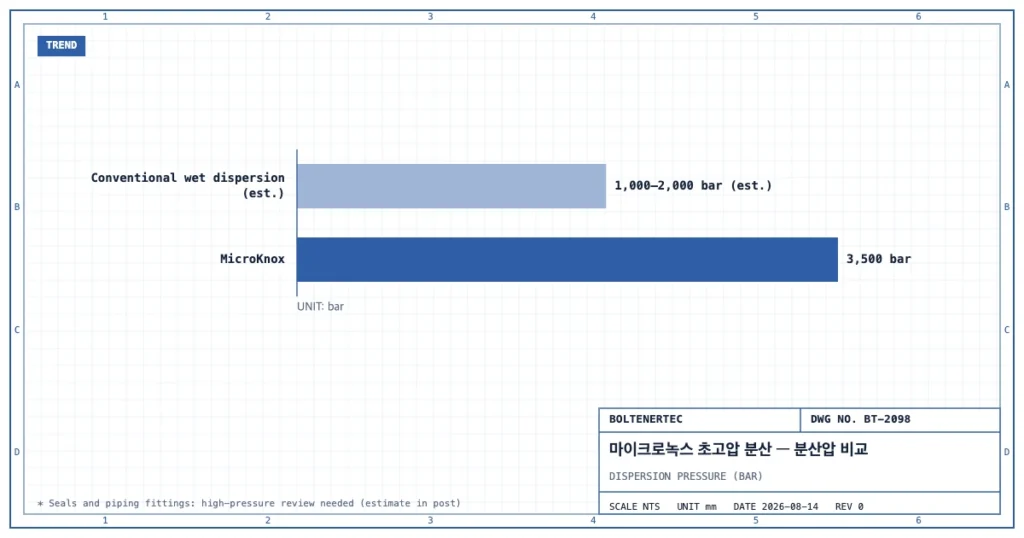
A dispersion pressure of 3,500bar is a high-pressure regime relative to conventional wet dispersion. It requires re-examining the internal-pressure design of the dispersion head and seal, along with the piping rating spec. The pressure increase directly affects the selection of pipe wall thickness, flange class, and gasket material. Improved dispersion uniformity is presumably linked to downstream coater die-discharge stability, but this is (an estimate), and no quantitative source data exists.
Spec Comparison Table
| Item | Conventional wet dispersion (est.) | MicroKnox |
|---|---|---|
| Dispersion pressure | 1,000–2,000bar (est.) | 3,500bar |
| Seal rating | Standard | High-pressure-rated review required (est.) |
| Piping rating | Standard grade | High-pressure-grade review required (est.) |
Design Reflection Checklist
- Recalculate pipe wall thickness and flange pressure class (KS B 1500 series) for 3,500 bar
- Verify pressure resistance of dispersion head seals and gasket materials
- Confirm nozzle orifice erosion replacement interval and wear-resistant coating spec
- Request measured flow rate, final particle size and cathode application conditions
One-Line Summary
Adopting ultra-high-pressure dispersion requires a preliminary review of the slurry line’s piping and seal internal-pressure specs.