Key News Facts
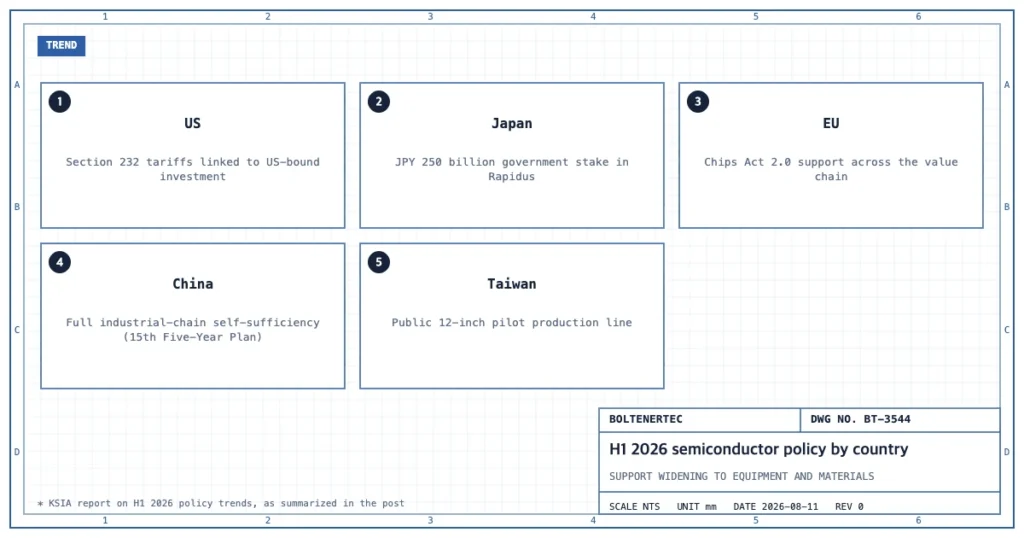
The Korea Semiconductor Industry Association (KSIA) released a report on major-country semiconductor policy trends for H1 2026. The U.S. is linking Section 232 tariffs to U.S.-bound investment, Japan has confirmed a 250 billion yen government stake in Rapidus, and the EU has broadened Chips Act 2.0 support to cover the entire value chain. China is pursuing full industrial-chain self-sufficiency under its 15th Five-Year Plan, while Taiwan is advancing a public 12-inch pilot production line.
Mechanism-Perspective Impact Analysis
What the battery equipment industry should watch is the direction of expanding support scope. Every country is widening support from finished-product production facilities to equipment, materials, parts, and back-end processes. The EU’s ESTI (European Semiconductor Technology Initiative) has expanded its scope of recognition from wafer manufacturing to design, materials, equipment, PCBs, and advanced packaging, and U.S. CHIPS support is also shifting from large-fab-centric to supply-chain-bottleneck sectors.
This trend playing out in the semiconductor industry has room to apply directly to the battery equipment industry as well. It can be read as a signal that countries are shifting focus from competing to attract finished-cell plants toward competing on localizing equipment, materials, and parts.
A similar trend is emerging domestically. Korea’s Ministry of Trade, Industry and Energy (MOTIE) announced a call for candidates for the “2026 Materials-Parts-Equipment (소부장) Cooperation Model” on February 3, 2026, with applications due by April 9. This round shifts from supporting individual items to supporting ecosystems centered on “game-changer items,” and introduces two new types: an “ecosystem-completion type,” where a demand-side company acts as ecosystem designer while the government provides large-scale R&D funding and policy finance, and a “region-led type,” centered on materials-parts-equipment specialized clusters. Localizing secondary-battery pouches was cited, alongside rare-earth permanent magnets, as a representative past success of the cooperation model (reported by Asiae, 2026-02-02). However, whether this round specifies new battery-related support items needs to be confirmed once application results are announced.
From an R2R equipment standpoint, the notable point is that secondary-battery pouches are cited as a representative past success of materials-parts-equipment localization. Pouch film has a multilayer aluminum-foil/nylon/PP structure, and in deep-drawing forming, the corner thickness-reduction ratio and the heat-sealing width of the sealing area govern cell hermeticity. When pouch material is localized, downstream forming-press and sealing-machine orders are often redesigned to match the domestic material’s properties, so material localization and forming-equipment specification changes tend to move together. This description is based on general pouch-forming process principles; specific equipment order plans tied to this policy round are undisclosed (confirmation needed).
Like the semiconductor industry’s ESTI case, the trend of widening support scope from finished-product production facilities to equipment, materials, parts, and back-end processes has room to repeat in the battery industry. However, semiconductors and batteries differ in where their supply-chain bottlenecks lie. Semiconductors concentrate bottlenecks at a small number of equipment makers (e.g., EUV lithography), whereas battery R2R equipment — coaters, slitters, winders — is relatively diversified, so localization support tends to be designed at the level of a materials-equipment linked ecosystem rather than a single piece of equipment. This is a general industry-structure comparison; specific budget allocations for individual support programs need to be confirmed once application results are announced.
Shop-notes
when pouch material changes, existing forming-press drawing depth and punch radius (R) values often cannot be reused as-is. If material properties (elongation) change before and after localization, corner-crack occurrence rates can differ at the same drawing ratio, so when switching to a domestic material, re-verifying the drawing ratio at the prototype stage should precede mass-production application.
Design Reflection Checklist
- When switching to localized pouch material, check whether existing forming-press drawing ratio and punch radius (R) values have been re-verified
- Check whether heat-sealing width and temperature profile have been re-set to match the new material properties
- After the Materials-Parts-Equipment Cooperation Model application results are announced (after the April 9 deadline), check for new battery-related support items
- Monitor whether related R2R equipment specifications change when game-changer items are designated
One-line summary: the 2026 Materials-Parts-Equipment Cooperation Model cites secondary-battery pouches as a past localization success, which is a signal that could lead to future changes in pouch-forming equipment specifications.