Key News Facts Summary
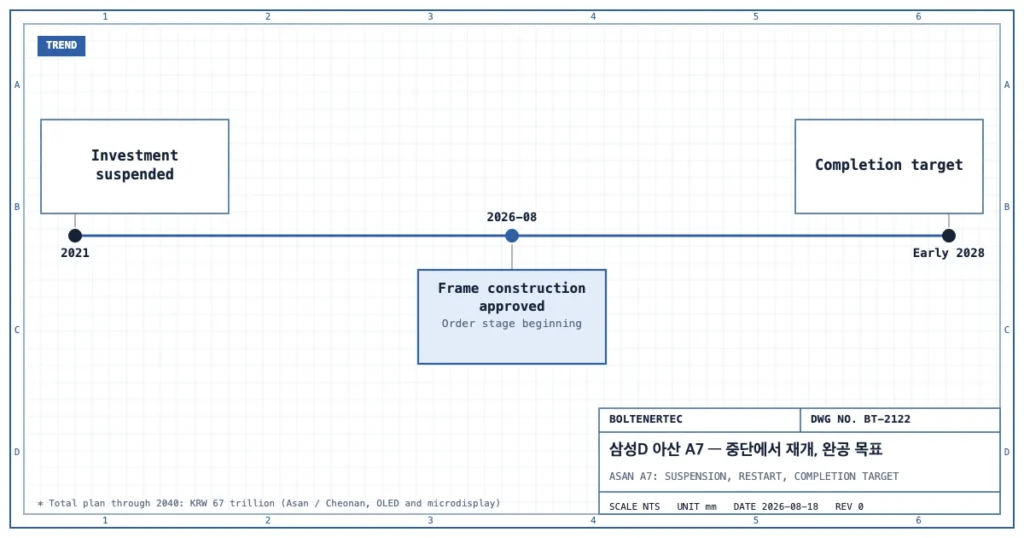
Samsung Display is resuming construction of its new A7 OLED plant at the Asan Campus 2 site in Chungcheongnam-do. On August 7, its investment review committee approved the frame construction, with orders set to begin this month, full-scale construction from next year, and completion targeted for early 2028. The investment responds to growing foldable smartphone sales and expanding OLED adoption in IT devices (tablets, laptops). The existing A3 line lacks spare capacity, as it is occupied producing the Galaxy Z series and other products.
Equipment Perspective Impact Analysis
Approval of the plant’s frame construction is a leading signal for equipment order timing. As with battery R2R equipment, display deposition and encapsulation equipment is brought in only after the cleanroom frame is completed, so if the completion target is early 2028, equipment orders are likely to concentrate in the second half of 2027 through early 2028 (estimated). Since this is still the frame-construction stage, detailed equipment specifications are judged not yet finalized.
Samsung Display decided to resume A7 construction after suspending it for about five years since 2021 (source: Edaily, Aug 18, 2026). The company’s investment plan totals KRW 67 trillion through 2040 for the Asan and Cheonan area, focused on advanced OLED and ultra-high-resolution microdisplays (source: ZDNet Korea, Aug 18, 2026). The new Asan plant is expected to comprise multiple lines for smartphone/IT, XR/automotive, and humanoid/wearable OLED applications (same source).
The immediate driver behind the investment restart is rising foldable smartphone sales. Domestic pre-orders for the Galaxy Z8 reached 1.44 million units, up 38.5% year-on-year (source: Edaily). Cited market forecasts put the foldable OLED market at roughly USD 3.0 billion in 2023, growing to about USD 6.3 billion by 2030, while the IT OLED market is cited as growing from roughly USD 4.1 billion in 2023 to USD 13.8 billion by 2030 (same source). An industry source noted, however, that “a new OLED line increase isn’t needed for the next one to two years,” suggesting the frame construction is a preemptive move ahead of future demand (source: ZDNet Korea).
Another indicator for gauging equipment order timing is deposition and exposure equipment lead time. Large-scale vacuum deposition equipment for semiconductor and display fabs is generally understood in the industry to require 12–18 months from order to delivery (estimate, based on working backward from fab construction schedules to equipment delivery timing), which would place orders as early as late 2026 to early 2027 if the early-2028 completion target holds (estimate). The exact order timing and volume require confirmation through Samsung Display’s official disclosures or supplier contract announcements.
The existing A3 line reportedly produces OLED panels for the Galaxy Z series, Galaxy S series, and Apple iPhone lineup concurrently (source: Edaily), and with this mixed high-volume workload, capacity to absorb new demand is likely to remain limited until the A7 plant is completed.
Spec Comparison Table
| Category | Details |
|---|---|
| Location | Asan Campus 2, Chungcheongnam-do |
| Process stage | Frame construction approved (order stage beginning) |
| Completion target | Early 2028 |
| Investment background | Growing OLED demand for foldables and IT devices |
| Suspension-to-restart gap | About 5 years (suspended 2021 → resumed Aug 2026) |
| Total investment plan (through 2040) | KRW 67 trillion (Asan/Cheonan, OLED & microdisplay) |
| Foldable OLED market outlook | ~USD 3.0B (2023) → ~USD 6.3B (2030) (cited estimate) |
| IT OLED market outlook | ~USD 4.1B (2023) → ~USD 13.8B (2030) (cited estimate) |
Design Reflection Checklist
- Confirm vibration criteria (VC rating) for deposition/encapsulation equipment during cleanroom frame design
- Cross-check the equipment lead-time-based order schedule (12–18 months, estimate) against actual supplier disclosures
- Monitor follow-up disclosures and contract announcements from Samsung Display and equipment suppliers (on-site verification required)
One-Line Summary
The start of frame construction is a leading indicator of equipment order timing, and the exact order volume and schedule should be reconfirmed through supplier disclosures.
Source: battery-news.de (2026-08-17)