Knife clearance is the radial gap between the upper and lower circular knife blades of a slitter. When this clearance deviates from its specified range relative to material thickness, the cut-edge burr height exceeds spec, leading to a risk of interlayer shorts after winding.
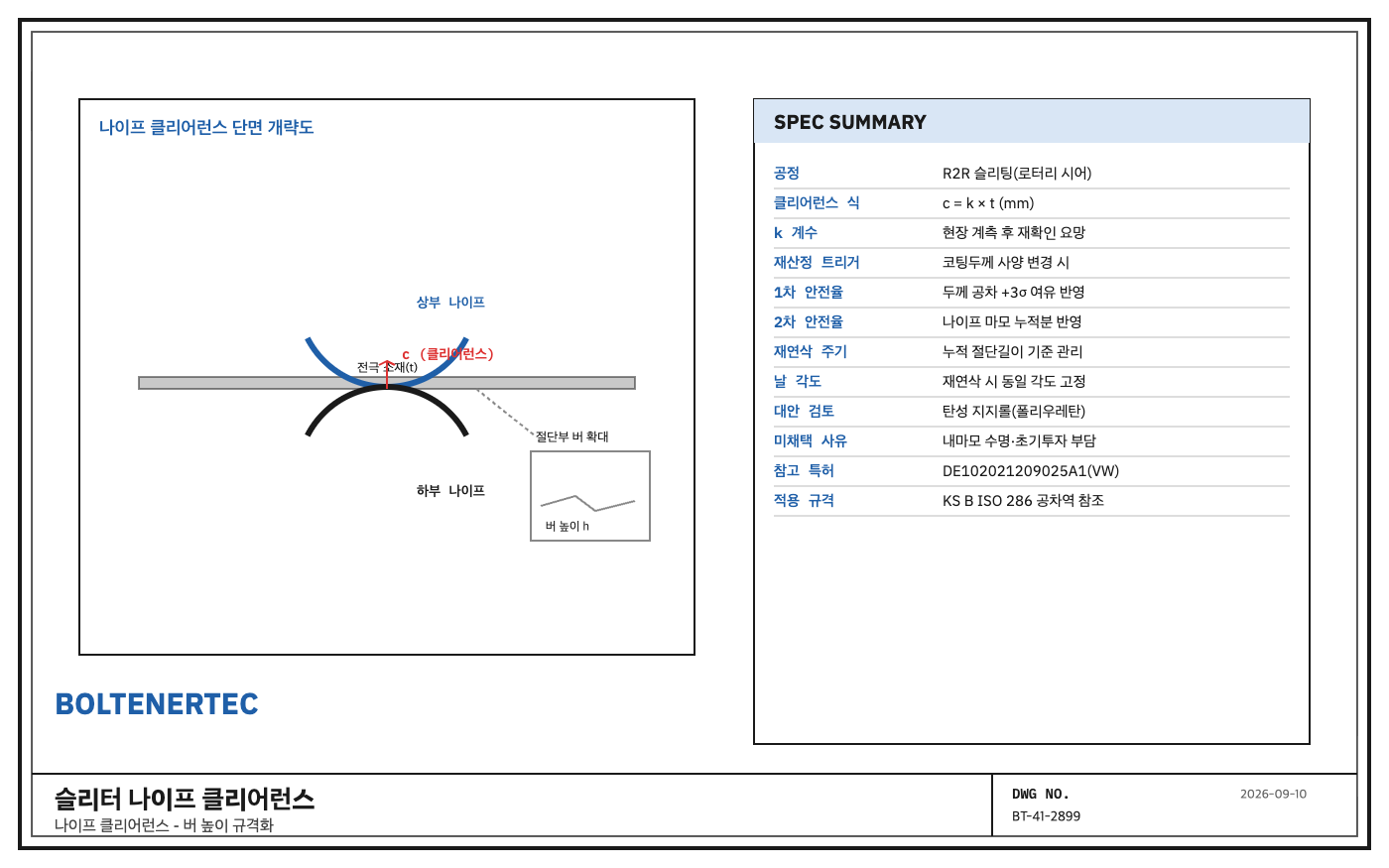
Problem Definition
There are cases where an electrode coating-thickness specification changes on the same slitter equipment. For example, if material specified at 18 µm single-side coating thickness is fed into a line set up for a 12 µm specification, keeping the existing clearance setting unchanged shifts the shear angle, increasing the tensile component at the cut. As the tensile component increases, instead of being sheared cleanly between the knife blades, the material is pulled in and torn, and burr height grows during this process. The question that remains is whether the existing setting can be kept without recalculating clearance.
Kinematic Analysis
Slitting standardly uses the rotary shear method. The upper and lower knives have separate rotation axes, and the combination of radial overlap and axial clearance between the two blades shears the material. Excessive overlap accelerates knife wear rapidly; excessive clearance lets the material get pulled into the gap between blades, causing tensile fracture. Conversely, insufficient clearance causes the knives to contact each other directly, causing uneven wear and chipping.
The relationship between clearance and material thickness is formalized as follows.
$$c_{mm} = k \times t_{mm}$$
Here, $c_{mm}$ is the knife clearance (mm), $t_{mm}$ is the material thickness (mm), and $k$ is a dimensionless coefficient. Because the coefficient $k$ varies with knife material, coating active-material type (NCM-based, LFP-based), and knife wear progression, it cannot be fixed as a constant value without line-specific measured data. This value is separated out as an item requiring on-site measurement and reconfirmation.
When recalculating clearance, a dual safety-factor verification is applied. First, secure clearance margin based on the upper tolerance limit of material thickness (+3σ); second, add a wear margin to the initial clearance reflecting the radial reduction (wear) accumulated over the knife re-grinding cycle. If only one of these two verifications is applied, cases arise where the line is within spec at initial startup but burr height exceeds spec again later, as knife wear progresses.
Shop-notes
- Clearance adjustment must be recalculated at every coating-thickness specification change; exclusive reliance on the existing setting is prohibited.
- Establish a knife re-grinding cycle (e.g., based on cumulative cutting length) and standardize clearance remeasurement before each cycle is reached.
- Machinability note: the knife edge bevel angle must be kept identical at every re-grinding to ensure clearance reproducibility. If the angle changes, shear characteristics change even at the same clearance setting, so fixing the grinding jig angle is a precondition.
- Alternative mechanism: an elastic support roll design absorbs clearance through the material’s compression deformation, improving reproducibility, but was not adopted for this line due to the wear-life management burden of the polyurethane support surface and its higher initial investment cost compared to a rigid knife.
Design Reflection Checklist
- Whether the clearance recalculation procedure is documented for coating-thickness specification changes
- Whether the knife re-grinding cycle is linked to the clearance remeasurement cycle
- Whether the re-grinding jig angle is fixed
- Whether a winding-line stop interlock is set for burr height spec exceedance
One-line summary: Knife clearance must be recalculated at every material thickness change, and without dual safety-factor verification that accounts for knife wear progression, burr height spec cannot be consistently satisfied.