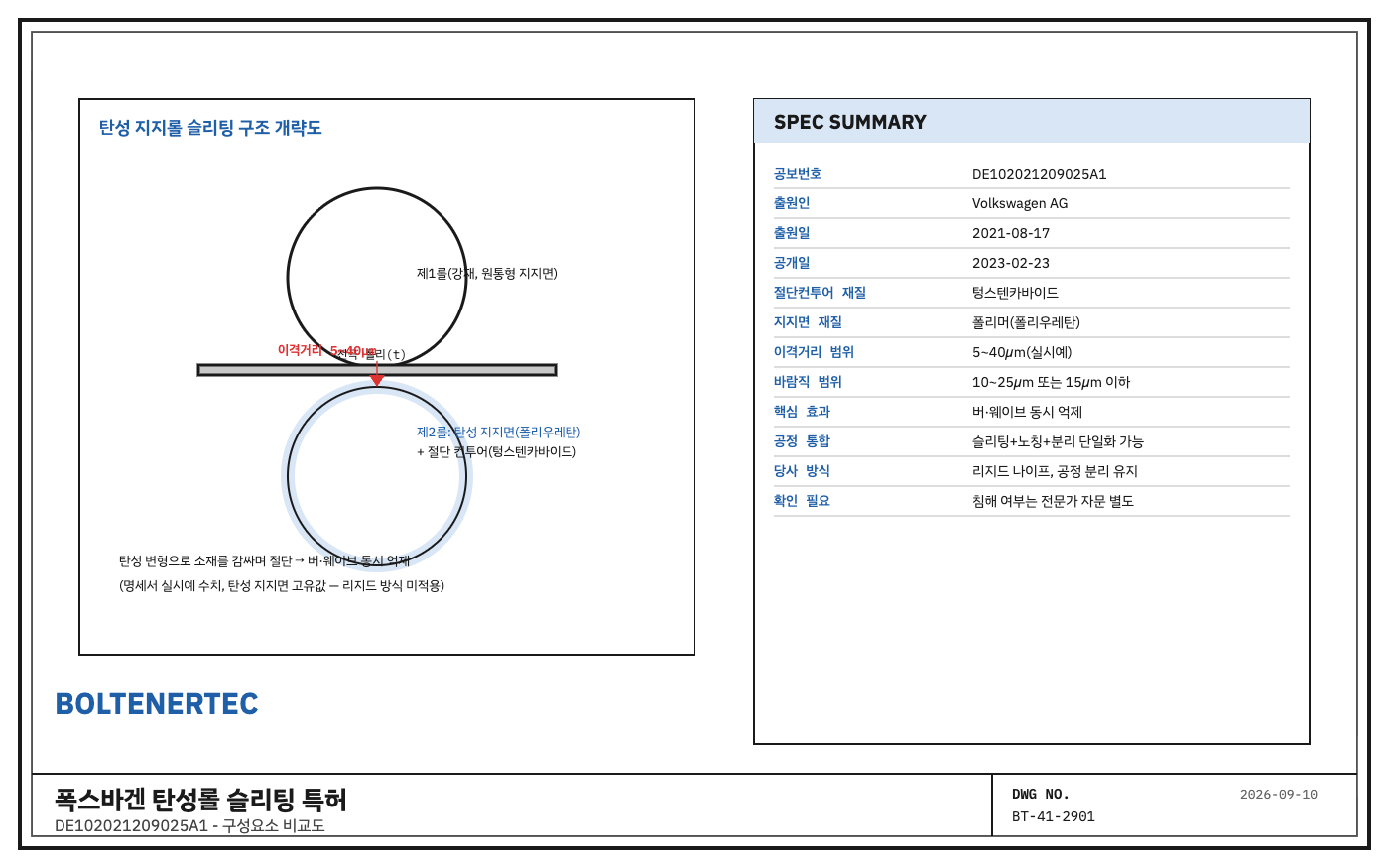
An elastic-support-surface slitting roll structure has been registered in Germany under the name of Volkswagen AG. Publication number DE102021209025A1, filed 2021-08-17, published 2023-02-23; its claims cover simultaneously suppressing burr and slit-edge waviness when cutting electrode foil.
Problem Definition
The patent specification identifies the following limitations of the conventional rigid rotary-knife method. The direct-contact shear method between upper and lower knives creates high friction, limiting slitting speed to 120 m/min, and knives require re-grinding approximately every 200 km of cut length. It also raises the issue that there is no counter tool to suppress waviness at the slit edge caused by thickness-direction (z-axis) material flow. Since re-grinding cycle management and clearance reproducibility are ongoing management items on our own line as well (see “Slitter Knife Clearance: Standardizing Burr Height”), it is worth reviewing the response method this patent presents element by element.
Patent Claim Elements vs. Our Design Mapping (Claim Chart)
| Claim Element (DE102021209025A1 Claim 1) | Figures/Description per Specification | Compared to a Common Rigid-Knife Method (Our Line Basis) |
|---|---|---|
| First roll: cylindrical continuous support surface (first support surface) | Non-elastic, steel | Our method also uses a cylindrical support surface on the lower roll, but without a separate elastic layer |
| Second roll: cutting contour + surrounding elastically deformable second support surface | Cutting contour material tungsten carbide; elastic support surface material a polyurethane-based polymer coating | Our rigid method has no elastic support surface on the second roll either; the knife blade itself doubles as the support surface |
| Minimum spacing between cutting contour and first support surface | ≥5 µm, preferably ≥10 µm and ≤40 µm, particularly preferably ≤25 µm or ≤15 µm | Our clearance value is a line-specific measured item depending on material thickness and knife wear; this patent’s elastic-roll figures cannot be directly substituted into a rigid method (confirmation required) |
| Width-direction (y-axis) tension-inducing texture via the elastic support surface (may be spiral-shaped) | Material is polymer (preferably polyurethane); texture described with a spiral option | Our method has no separate textured support surface for wave suppression; y-axis wave suppression relies on unwind tension control |
| Integration of slitting, notching, and separation processes (a single roll pair processes multiple groups of cut lines) | Preferably a single roll pair generates the entire group of cut lines | Our line has slitting and notching separated into distinct processes and equipment, requiring material re-transfer between processes |
Formula Verification
Non-dimensionalizing the minimum spacing range between the cutting contour and support surface presented in the specification gives the following.
$$0.33 \le \frac{c_{\mu m}}{t_{\mu m}} \le 2.67 \quad (t = 15\mu m \text{ coated-foil reference calculation})$$
This range is a reference calculation obtained by dividing the specification’s example spacing (5–40 µm) by a 15 µm coated-foil thickness; it is not a dimensionless ratio explicitly stated in the patent claims themselves. Directly applying this ratio to our rigid-knife method, which has no elastic support surface, would be inappropriate, and this is left as an item requiring separate on-site measurement.
Shop-notes
- Machinability note: the elastic support surface (polyurethane coating) requires re-coating the entire roll upon wear, potentially resulting in longer maintenance downtime compared to replacing a single tungsten-carbide knife piece. Comparative maintenance-cycle data must be secured first.
- Alternative mechanism review: our company maintains a separated-process approach rather than an integrated slitting-notching roll. The reason for not adopting it is that the notching section’s tension profile differs from the slitting section’s, making it judged difficult for a single roll pair to simultaneously satisfy both processes’ tension requirements.
- Infringement cannot be determined from the published claim language alone; a separate claim interpretation by a patent professional is required for an actual design review.
Design Reflection Checklist
- Whether comparative maintenance-downtime data is secured before adopting an elastic support surface method
- Whether tension-profile compatibility across processes is pre-verified when reviewing an integrated slitting-notching roll
- Whether the 1:1 claim-language-to-design-element comparison table is kept updated
- Whether infringement risk assessment is separately conducted via patent professional consultation
One-line summary: An elastic support roll slitting structure suppresses burr and waviness simultaneously, but its figures are specific to the polyurethane support surface and cannot be directly substituted into a rigid-knife method.