Forge Nano’s gigafactory groundbreaking took place on August 19, 2026 in Morrisville, North Carolina, USA. Forge Nano held a groundbreaking ceremony for the expansion of a lithium-ion battery manufacturing facility, attended by a North Carolina senator, a congressional representative, the mayor of Morrisville, and a Department of Energy (DOE) deputy assistant secretary.
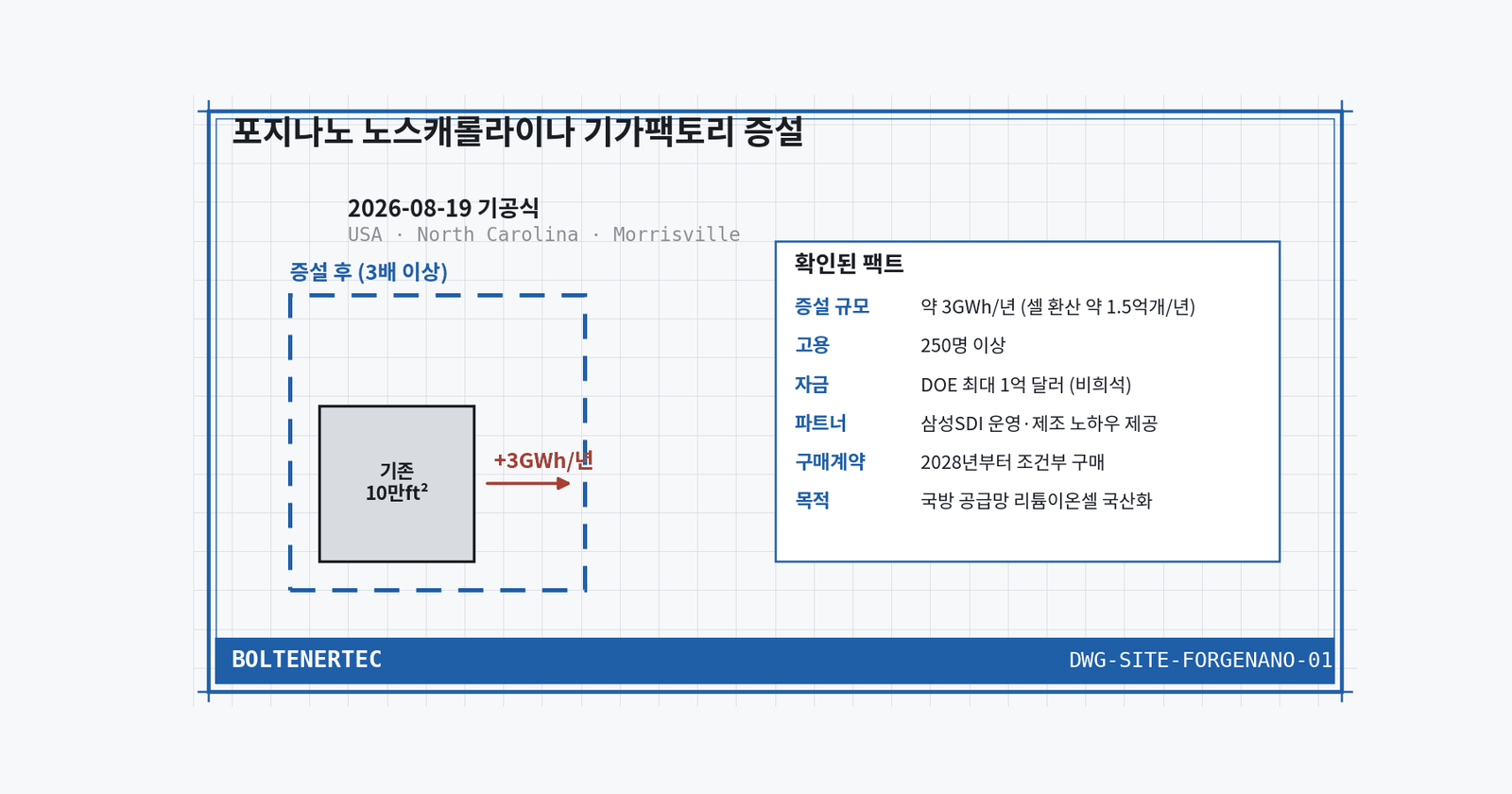
Key News Facts
- Expansion scale: approx. 3GWh/year, equivalent to roughly 150 million battery cells/year
- Expands the existing 100,000-square-foot facility to more than 3x its size
- Job creation: 250+ positions
- Funding: up to USD 100 million in non-dilutive funding from the US Department of Energy (DOE)
- Partnership: Samsung SDI provides operating/manufacturing know-how, with a conditional purchase agreement for cells produced at this plant starting in 2028
- Purpose: reducing overseas supply-chain dependence for batteries used in defense-related applications
Qualitative language (“innovative,” “game-changer,” etc.) from the original press release has been excluded from this summary as promotional rhetoric. All items above retain only the figures and facts stated in the primary announcement materials.
According to Forge Nano’s IR press release (August 19, 2026), Samsung SDI’s involvement extended beyond the operations/purchase agreement to include a USD 20 million equity investment (USD 10 million Series D, USD 10 million PIPE) (source: Forge Nano IR). The expanded facility’s finalized size is approximately 315,000 square feet (about 29,265 m²), roughly 3.15 times the original 100,000-square-foot facility (same source). The production-start target is 2028, timed to align with U.S. National Defense Authorization Act (NDAA) requirements taking effect that year (same source).
Mechanical-Design Impact Analysis
In absolute terms, the 3GWh/year expansion is smaller than large Chinese or Korean gigafactories (single-line 10GWh-class). However, the fact that it expands the existing site to more than 3x its size is significant from a mechanical-design standpoint. Adding new lines on top of an existing building’s frame and foundation load conditions makes floor flatness and foundation-settlement management more demanding than new construction. Roll-to-roll coating/calendering lines experience web wandering once horizontal precision deviates beyond ±0.5mm, so a separate leveling-foundation construction step must precede any expansion on an existing slab. Because Samsung SDI is providing operating/manufacturing know-how, equipment standards (equipment-layout pitch, utility inlet locations) are also likely to be transferred, meaning domestic equipment makers will need to respond to spec-sheet conformity when future equipment orders are placed.
The 2028 production-start target is timed to NDAA requirements taking effect, creating a tight schedule requiring construction, equipment installation, and commissioning to all be completed within roughly two years of the August 2026 groundbreaking. Combined with the approach of expanding the existing site threefold, fast-track process management — running leveling-foundation construction and new-line installation in parallel — appears unavoidable, carrying greater construction-sequencing risk than a typical greenfield gigafactory (estimated; the actual construction schedule is undisclosed).
Shop-notes: Options for constructing a leveling foundation for a roll-to-roll line atop an existing slab include a lower-cost, higher-risk approach that partially cuts the slab and pours a new foundation, versus a higher-cost, lower-risk approach that fully demolishes and rebuilds the slab. The former is easier to align with the 2028 target due to a shorter schedule but retains risk of uneven settlement at the joint between old slab and new foundation, while the latter takes longer but more reliably secures the line’s overall horizontal precision (±0.5mm target) — in terms of construction-risk management, the latter may be preferable (estimated).
Spec Comparison Table
| Item | Forge Nano (NC, USA) | Notes |
|---|---|---|
| Expansion scale | Approx. 3GWh/year | Expands existing 100,000ft² facility more than 3x |
| Employment | 250+ jobs | Per initial announcement |
| Funding | DOE, up to USD 100 million | Non-dilutive funding |
| Partner | Samsung SDI | Provides operating/manufacturing know-how; conditional purchase agreement for 2028 |
| Application | Defense supply-chain lithium-ion cells | Chemistry/capacity specs (undisclosed) |
One-Line Summary
The key point of Forge Nano’s 3GWh expansion is not its scale but the construction condition of expanding the existing site by more than 3x — foundation leveling will govern roll-to-roll line yield.
Design Reflection Checklist
- Confirm the uneven-settlement management plan when leveling-foundation work and equipment installation run in parallel
- Review process-sequence margin (leveling → installation → commissioning) against the 2028 NDAA-driven schedule
- Confirm domestic equipment spec alignment with equipment standards (layout pitch, utility entry points) transferred from Samsung SDI