The Ministry of Trade, Industry and Energy (MOTIE) announced it will pursue additional safety measures based on the results of the ESS fire investigation. It plans to clarify the legal permit classification standards for ESS, unify the previously department-varying entrance-door standards for high-pressure gas storage facilities, and extend the ESS lease period from 10 to 15 years (per MOTIE press release).
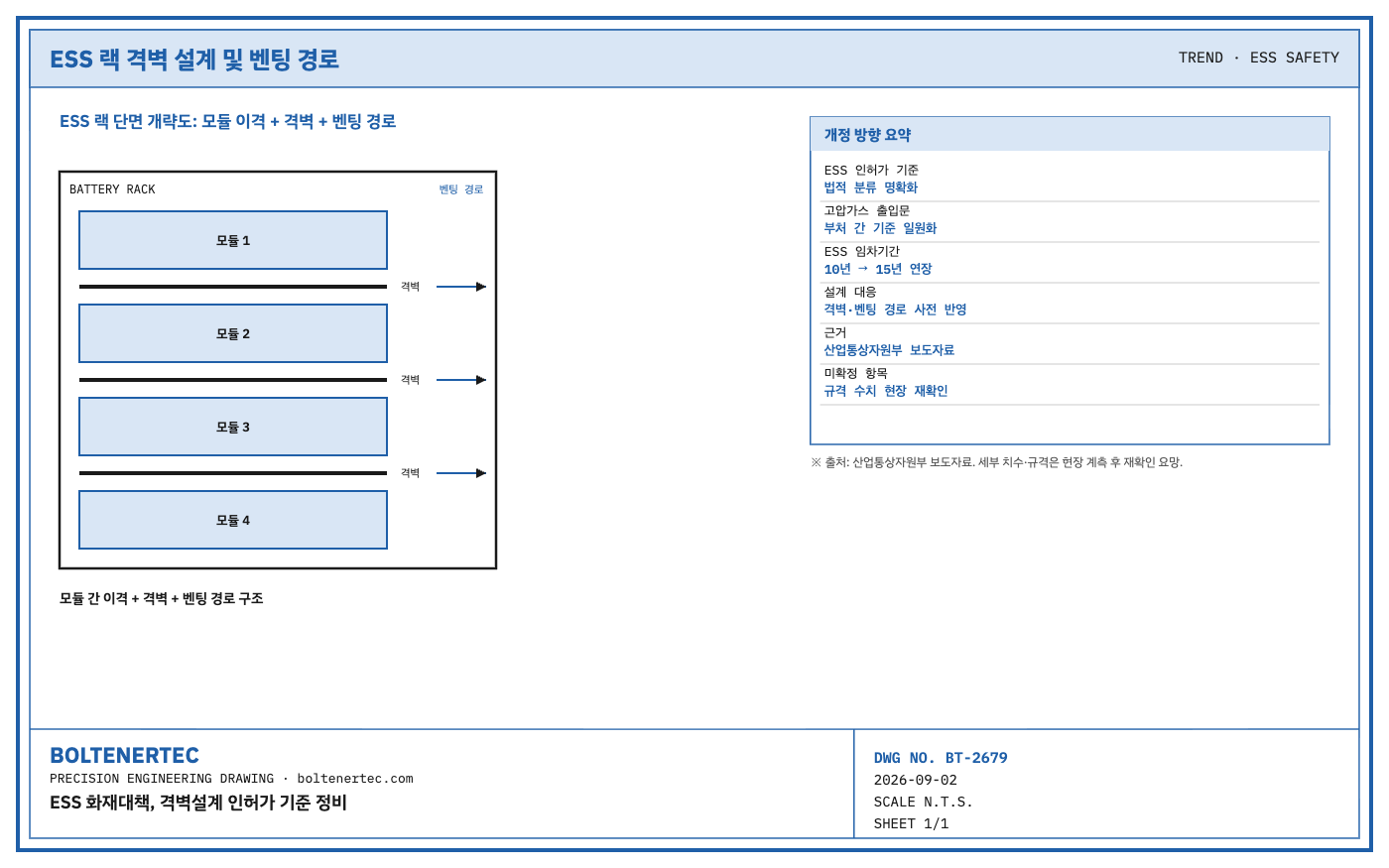
Mechanism-Perspective Impact Analysis
The core of ESS fire safety measures ultimately comes down to a thermal-runaway propagation-prevention structure. The spacing between modules within a battery rack, the material and thickness of the barrier, and the venting gas exhaust path are equipment design variables. As the permit standards and entrance-door standards move toward unification, barrier design matched to fire-compartment standards and pressure-relief paths must be reflected in drawings from the equipment layout design stage to prevent permit delays. The extension of the lease period to 15 years also affects mechanical design. It means the fatigue life and corrosion margin of the rack structure must be re-reviewed on the assumption of long-term operation.
Spec Comparison Table
| Item | Revision Direction (MOTIE Announcement) | Mechanical Design Response Point |
|---|---|---|
| ESS Permit Standard | Legal classification clarified | Equipment layout drawings must align with permit drawings |
| High-Pressure Gas Storage Facility Entrance Door | Unified standards across departments | Door interlock and opening-width specs need review |
| ESS Lease Period | 10 years → 15 years extension | Long-term operation requires re-review of rack structure fatigue life |
One-Line Summary
Unifying ESS safety regulation is a signal to reflect barrier and venting-path design from the earliest drawing stage.