Taiwan’s ProLogium has moved its all-solid-state battery out of the lab and into gigafactory mass production. This is the news of its Gen3.5 Lithium Ceramic Battery (LCB), announced on September 2, 2026.
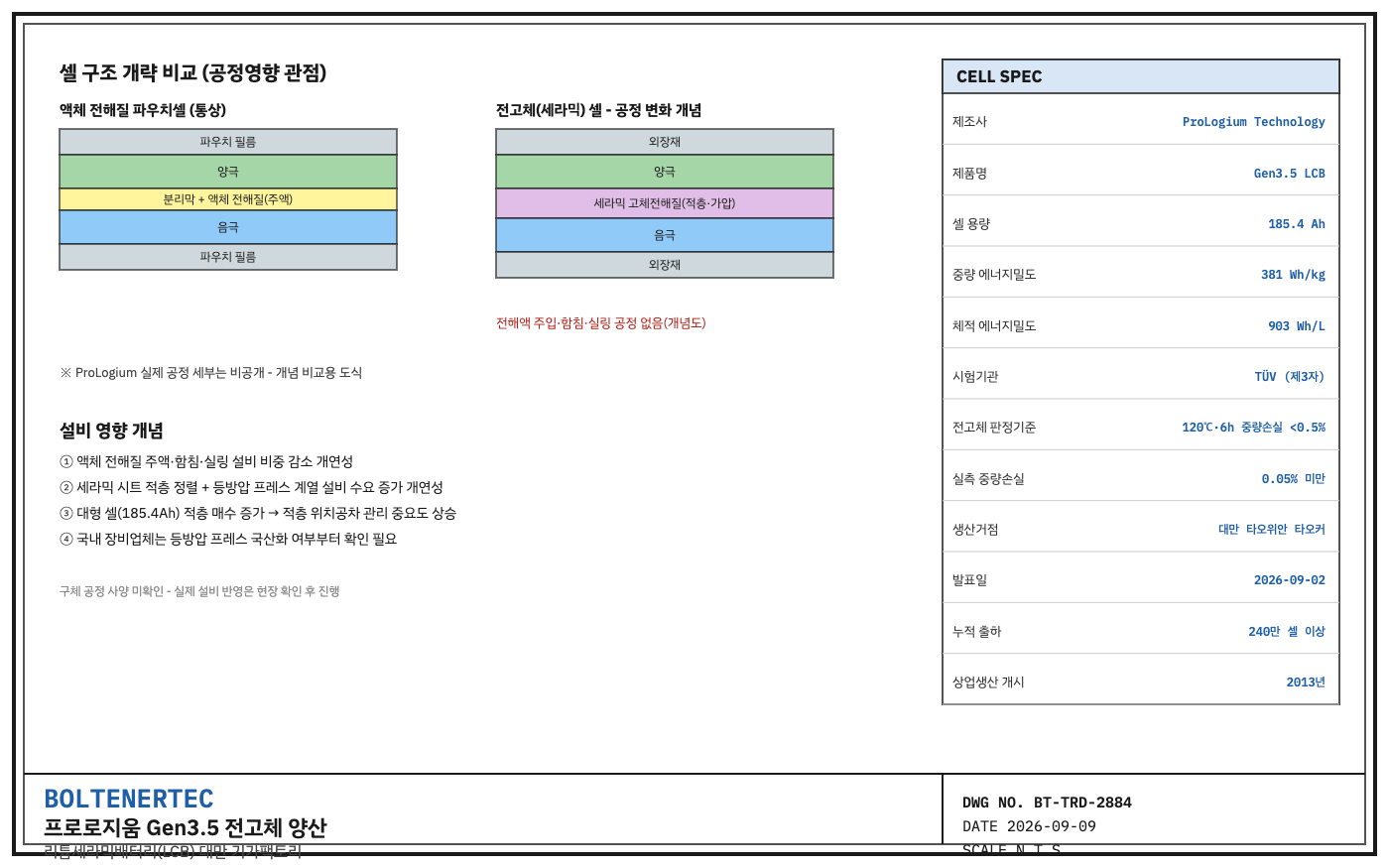
Key News Facts Summary
ProLogium Technology announced in a press release on September 2, 2026 (local time) that its Gen3.5 Lithium Ceramic Battery (LCB) has entered mass production at its Taoke Gigafactory in Taoyuan, Taiwan (source: ProLogium / GlobeNewswire, September 2, 2026).
Third-party TÜV testing on the large-format 185.4Ah cell confirmed a gravimetric energy density of 381 Wh/kg and a volumetric energy density of 903 Wh/L. The company stated that weight loss after 6 hours of exposure under 120°C vacuum conditions was under 0.05%, meeting the all-solid-state classification criterion of 0.5% or less. ProLogium stated it has been in commercial production since 2013 and has cumulatively shipped over 2.4 million cells for consumer, specialty, and automotive applications. ProLogium stated that it progressed from 1st-generation Sheet-by-Sheet production (2013) to 2nd-generation Roll-to-Roll production (2017) and then to gigascale 3rd-generation production starting in 2024, and that it obtained an all-solid-state classification certification from UL Solutions under GB/T 43568-2026 as well as IATF16949 automotive quality certification in 2022 (Source: ProLogium / GlobeNewswire, 2026-09-02).
Impact Analysis from a Mechanical Design Perspective
The internal chemistry and material composition of ceramic solid-electrolyte cells fall outside boltenertec’s scope, so the reaction mechanism is not addressed here. From an equipment perspective, the point worth noting is the change in process configuration.
If the structure eliminates the liquid-electrolyte filling process, the share of electrolyte injection, impregnation, and sealing equipment within an R2R line is likely to decrease, while the share of ceramic-sheet stacking and pressing/sintering equipment (such as isostatic presses) is likely to grow. However, ProLogium’s actual ceramic process specifications are undisclosed, and the stacking alignment tolerance or pressing conditions for the large-format cell (185.4Ah) have not been confirmed. For domestic equipment makers to respond to this trend, the first step is to check whether isostatic presses or ceramic-sheet handling equipment can be localized.
ProLogium stated that it is developing 4th-generation (Gen4) technology based on a fully inorganic electrolyte system, and expects it to require only about a 10% modification of existing production equipment (Source: ProLogium / GlobeNewswire, 2026-09-02). This suggests that a future process transition may take the form of partial equipment modification rather than a full line replacement, though the specific equipment to be modified has not been disclosed.
There is also a link to Korea’s materials industry: EV Advanced Materials is described as the first Korean strategic investor in ProLogium, having invested in July 2021, while POSCO Holdings holds an equity stake and is cooperating on the joint development and supply of solid-state battery cathode materials, silicon anode materials, and solid electrolytes (Source: Money Today, 2026-09-10; The Guru). However, this is a materials-sector collaboration, and no equipment-supply relationship has been confirmed.
Spec Comparison Table
| Item | ProLogium Gen3.5 LCB | Note |
|---|---|---|
| Cell capacity | 185.4Ah (large-format cell) | Per ProLogium announcement |
| Gravimetric energy density | 381 Wh/kg | TÜV third-party test |
| Volumetric energy density | 903 Wh/L | TÜV third-party test |
| All-solid-state classification criterion | Weight loss <0.5% at 120°C, 6 h vacuum | Met at measured <0.05% |
| Production site | Taoke Gigafactory, Taoyuan, Taiwan | Per ProLogium announcement |
| Mass production start | Announced September 2, 2026 | Transition from pilot to gigascale production |
| Production generation transition | 1st gen Sheet-by-Sheet (2013) → 2nd gen R2R (2017) → 3rd gen gigascale (2024) | Per ProLogium announcement |
| Certifications | UL Solutions all-solid-state classification (GB/T 43568-2026), IATF16949 (2022) | Per ProLogium announcement |
| Capacity roadmap | Gen4 mass production 2028 / 4GWh by 2030 / 12GWh by 2032 (incl. Dunkirk, France site) | Per Money Today, 2026-09-10 |
Design Reflection Checklist
- Confirm whether stacking alignment tolerance and pressing conditions for the 185.4Ah cell are disclosed
- Confirm domestic availability of isostatic presses and ceramic sheet handling equipment
- Confirm whether the list of equipment requiring about 10% modification for Gen4 is disclosed
- Review the layout impact of a smaller share of electrolyte filling and wetting equipment
One-line summary: ProLogium’s transition of the Gen3.5 all-solid-state cell to mass production leaves detailed process specifications undisclosed, only suggesting a possible reduction in liquid-electrolyte processes and increased demand for ceramic stacking and pressing equipment.